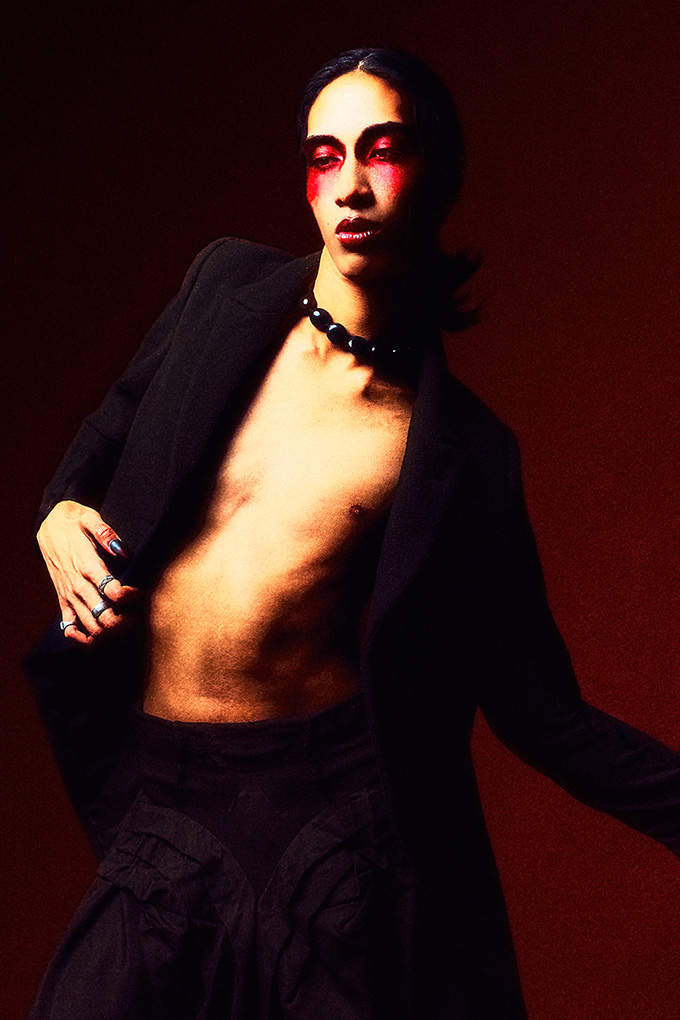
For a time, it was all about the cut crease. Then the clean girl started appearing everywhere. Microtrends and viral products may have taken hold of us in years past, but the beauty world is now going beyond the surface. If the recent runway looks or the exuberant return of Marc Jacobs Beauty are any indication, the days of playing it safe are behind us: we’re taking risks, developing our own niche aesthetic and finding the style that feels most like ourselves. And even though there is plenty to be inspired by, there’s no better blueprint than the expert shapeshifters—the minds and hands behind everyone’s looks, that is the make-up artists, hairstylists and nail artists at the helm of the beauty scene. In Singapore, being bold doesn’t necessarily entail megawatt glitter and avant-garde proportions. It can also look like trying something unexpected, doing it scared and defining new domains. But what does going against the grain truly look like, and what fuels a rebellious spirit? Speaking to Vogue Singapore about their journeys, hurdles and serendipitous encounters, these five creatives are redefining the beauty space one bold move at a time—all while keeping the flame of their artistry alive.

1 / 5
Carolyn Lee, make-up artist
Tell us the story of how you first got into make-up.
I first got into make-up in secondary school. I was knee-deep in my anime phase, and my older sister was a big fan of Japanese fashion magazines—Vivi and Popteen—so I was surrounded by fashion and beauty at an impressionable time of my life. I used to ‘borrow’ her make-up and save up to buy basic products from Watsons and Guardian. I became more invested in make-up during junior college. I was under a lot of stress from juggling school and being a caregiver to my critically ill parent, so I turned to doing creative make-up looks as a way to destress.
You went from make-up enthusiast to make-up artist. What made you decide to commit to it and was it an easy decision?
People are always surprised to find out that I was a chemist prior to becoming a full-time make-up artist. I did work at a couple of labs, both research and commercial, but those jobs made me realise that a long-term career in these fields was not something I wanted. I was still doing make-up on the side as my hobby, and I was playing with the idea of going full-time during bouts of unemployment. However, my Singaporean pragmatism was holding me back from making that jump. This decision was made more difficult as I had impending financial obligations that I had to save for. Yet, what made me change my mind was a toxic work environment. Towards the end of my STEM career, I kept wondering: why should I spend my time and energy wasting away in a field that I had no passion for? I also thought of my mother, who passed away when I was 17. She was unable to pursue her dreams and goals due to illness. I came to the realisation that if I never tried to pursue my dreams, nothing would ever change.
View this post on Instagram
In a clean-girl-dominated landscape, what inspires you to go against the grain?
It helps that my interest in make-up originated from non-conventional sources. From Gyaru magazines to cosplayers to goth YouTubers to beauty Instagram in the mid-2010s, I’ve always been drawn to louder and unapologetic styles of make-up. When hipster Tumblr was trendy, I refused to engage in any sort of content relating to that, and stuck to my subculture spaces that I was comfortable in instead. Was I cringey? Yes! But at least I was able to cultivate what I loved with my friends without judgement. This bubble of mine made it easy to keep true to myself and interests instead of chasing trends. I wouldn’t say that I’m entirely resistant to them though, especially after becoming a make-up artist. I’m better able to appreciate different trends and styles as everyone has a different threshold for the type and amount of make-up they would look good in, and I’ve gotten better at determining them as my client base diversifies. Also, who am I to yuck your yum?
Becoming a make-up artist is still an unconventional path in Singapore. Are there any struggles you’ve faced or are currently facing?
I have a serious case of impostor syndrome all the time. I have always been someone who puts a lot of pressure on everything that I do, and doing make-up as both an enthusiast and a professional is no exception. Being a person from STEM and pivoting to an entirely new job and industry did not help as well. I was constantly plagued by the feeling of inadequacy due to lack of experience, especially when I had just started my professional make-up career a year ago. A lot of things have changed for me in the span of a year though, as I’ve gained more experience being on various sets—commercial, corporate, editorial—and having more clients, so I’m feeling more confident in my abilities now. I don’t think my impostor syndrome will ever go away, but I’m working on constantly improving.
What do you hope to do next?
I’m not someone who sets long-term goals for herself. I pursued this career because I knew that I would enjoy doing it and not because I wanted material gains or recognition. The only thing I can hope for in my immediate future is to be a make-up artist whom anyone can reliably call upon for any kind of service, and to know more like-minded individuals in the industry. My ultimate dream is to create a make-up brand that focuses on inclusivity and creativity, but it’s just a dream for now.
What do you wish to see more of in Singapore’s beauty space?
I would love to see more inclusive and affordable brands and products in the market. Everyone deserves to feel beautiful with or without make-up, and have access to products regardless of economic status and ethnicity. Make-up prices have been steadily increasing over the years, and Singaporean drugstores still do not carry a representative selection of products—especially complexion products—despite being a country that prides itself on being multiracial and multicultural. I would love to see existing brands bring in wider shade ranges.

2 / 5
Christvian Wu, hairstylist
Tell us about how you became interested in hairstyling.
I started as an apprentice at my aunt’s salon at the age of 17. The skill that took me the longest to master was shampooing hair. Every time I shampooed a client’s hair, everything ended up wet. My aunt inspired me when I watched her help many of her clients transform their looks. Seeing how satisfied her clients were afterwards, I then decided to embark on this journey.
You’ve been in the industry since 2010. What was it like when you first joined and what has changed along the way?
When I first joined, I was at the salon serving clients most of the time. During the course of my work, I was fortunate enough to be called on to do editorials for magazines. More people started to recognise my work, and through word of mouth and referrals, I started to grow my customer and media base. Through these experiences, I started building my portfolio in campaigns, advertorials, celebrities and fashion shows. Regarding the industry, we used to learn and recreate looks from European hairstylists, especially when it came to styling celebrities, but now it’s all about the Korean and Chinese wave. They are the ones shaping the industry now.
Your portfolio features experimental shapes and bold styles. How and where do you get your inspiration from?
I love experimenting a lot, so I always try to be innovative and offer new creations. I am often inspired by old movies— my favourites are the classics like Grease, Casablanca and Somewhere in Time—and I also pay close attention to the different seasons of the Fashion Week runway looks. I always draw inspiration from hairstyles created by Eugene Souleiman and Guido Palau.
Of all the looks you’ve done so far, which one is your favourite?
I have created a lot of looks that I like but honestly, there isn’t one that I am 100 percent satisfied with. I want to continue creating and experimenting so that one day I can create something that truly resonates with me.
View this post on Instagram
Was there a time when you took a risk and it did not turn out as you expected? How did you make it work in the end?
Yes, of course. In my line of work, creativity is a key component and it doesn’t pay to play it safe all the time. I remember there was an occasion when I was styling a model’s look and it did not turn out as I expected. Since I was not satisfied with my work, I decided to redo the whole look before presenting it to the client. It turned out to be the right call.
Have you ever doubted if this career path is for you? And if so, what made you continue?
Ever since I embarked on this journey in 2010, I have never looked back. I enjoy what I do and creating new looks is my passion.
At this point in your career, what is something new that you’re trying to master?
I feel that it is especially challenging to make wigs look realistic. At this stage, I am honing my skills to create more creative works on wigs while making them look like the real thing.
What do you wish more people in Singapore would do with their hair?
Singapore is a very humid country, which is why I hope everyone will take better care of their scalp and hair health to ensure that their scalp is clean and not too oily. I also hope that everyone would be more willing to experiment with bolder hairstyles and put more effort into their hair grooming.
What would you say to someone who is starting out in this field now?
I would say, “Never lose your flame”.
In 20 years’ time, do you still see yourself as a hairstylist? And if not, what would you like to be doing instead?
I definitely see myself still in this industry as I am equally, if not even more, passionate about what I do now than when I started. Whether I’ll remain as a practising hairstylist is another question. Perhaps I will switch to something else in the same industry, such as a hair educator. Who knows? Let’s catch up again 20 years later and we will find out.

3 / 5
Melanny, nail artist and owner of @meltedmanicures
What made you pick nails over any other artistic medium?
I’ve used acrylic, oil pastels, charcoal, pencils and more during O-Level Art. Still, for some reason, it didn’t give me as much dimension or satisfaction as I wanted. Since I was 13, I have dabbled with many types of media; however, nails have stuck with me the most because of the exploration of texture they allow. Doing nails allowed me to do things that I would not have been able to express on a piece of paper, like playing around with colours, textures and dimensions.
Describe how you gather inspiration.
I study the environment around us and I find art in everything. Everything is an inspiration to me, even the texture of trees; everything has an artistic value.
Nail art is a delicate process that requires meticulous attention. Do you impose any boundaries on your creations?
I don’t impose any boundaries on my work. Art is experimental to me, so I lean into a lot of things. I just do what I want to do. It could take hours and my back would always ache, but I have a lot of fun and so the outcome always feels satisfactory.
View this post on Instagram
You specialise in surrealist, often macabre nail designs. Was that your niche from the start or did you have to find your way to it?
Growing up, I think we all try to believe it was all rainbows and fairies, despite looking away from traumatic events we tried to mask in childhood—or at least, I did. Doing O-Level Art—and being of the age where I could finally internalise my emotions—allowed me to experiment with mediums that helped me express myself in a way that was digestible. During this time, I realised I like to play around with a lot of juxtaposition, using colours like Wes Anderson’s to cope with difficult subject matters. Surrealism was my best friend, and to this day, it reflects in my art unintentionally but naturally. I wouldn’t say it was my niche being grotesque from day one, but as I grew older, I found I could express myself completely through it—like a kind of metamorphosis.
In your career so far, has there been a time when you had to take a risk? How did it pan out?
Yes, I had to take the biggest risk when I left my previous studio on Haji Lane. It was my third location and the peak of my career, but also the peak of the decline of my mental health. I had no choice but to take the big leap of opening my own studio, which was my biggest dream—I just did not expect it to be so soon. I took a one- to two-month hiatus to studio-hunt, which was a financial struggle for me. It wasn’t easy at first, but with the help of my loved ones I’m now in a studio that I have made into a second home. Not just for myself, but a safe space for anyone who steps foot in there as well.
In your wildest dreams, what do you hope to be doing with your art?
In my wildest dreams, I want people to understand my experience and find peace within themselves, knowing they are not alone in the struggles they face growing up. It is okay to be outlandish and I do hope that one day my art brings people together. When I started doing nails, people found my art to be so gross; now that it’s two to three years in, I am glad to see that my audience has grown fond of my art. I see so many more artists doing the same things as I am, so I hope to keep spreading inspiration.
Being a creative in Singapore brings about lesser job security. What keeps you going?
I’ll be honest, I have struggled with thinking about keeping Melted Manicures running—especially at my age and as a girl struggling with mental health. But that is only 10 percent of the time. I want to do something that I am proud of because I can say that this is mine. I do not want to be chained to a desk; running this entire business on my own may give me a lot of doubt, but it brings me joy.

4 / 5
Sarah Tan, make-up and hair artist
What was the moment that made you decide to become a make-up artist?
There was no singular moment as beauty has always been a big part of my teenage years and even my childhood. It was something I always dreamt of but never thought possible. But there was one moment that made me realise beauty was more than a personal hobby: as I was getting ready for a night out with my friends, I ended up spending the entirety of the pre-drinking session dolling everyone up, at the expense of my own glam. I ended up having to spend the rest of the night barefaced, but it didn’t bother me because seeing the confidence my make-up gave my friends was worth it.
You’ve experimented with bolder looks in your portfolio. How do you get the inspiration to come up with these looks? Walk us through your process.
In general I’ve always been inspired by grungey and dramatic looks, growing up with bands like My Chemical Romance, Panic! At The Disco and Twenty One Pilots. Their visuals tend to lean towards the theatrical and the band members are known to perform with their own signature looks. I also like to look at other make-up artists I am inspired by and try to understand where they draw their inspiration from. There is no one-size-fits-all process when it comes to creating one of my looks, especially depending on the brief and workflow of each project. Sometimes I work off a general mood board that indicates the vibe that we are after and wing it from there; other times I get a face chart or a clean picture of my subject and sketch different iterations of the look so that I can visualise how different stylistic choices would work together.
View this post on Instagram
What was a risk you took with your work that ended up being worth it?
The way I run my social media is a risk I have been taking. I know that posting ‘safer’ looks and ‘marketable’ content is the easiest way to gain engagement and clients, but I choose to stick with the aesthetic that I have created for myself even after receiving feedback that my portfolio may come across as ‘too much’. This choice has proven to be worth it as people are starting to recognise me for my style, and I have been able to build a client base that hires me for me and trusts that I will be able to deliver whatever they throw at me.
Of all the looks you’ve done, on your clients and yourself, which is your favourite?
I am sentimental about many of my looks as I have created many fond memories through the process of creating and documenting them, but one that stands out from the rest would be my recreations of Pat McGrath’s glass skin look for the Maison Margiela haute couture spring/summer 2024 show that broke the internet. This look came about at a time when I was feeling stagnant in my career, doing the same safe clean looks every day for the sake of stability and losing touch with my creative side. The moment I saw the photos from the show and beauty creators speculating on the products and techniques used to create the porcelain skin effect, something awoke in me and I knew that I had to recreate it as soon as possible before an official tutorial came out. I wanted to figure it out on my own. This process brought me back to my earliest but most creative years in the industry, when I would agree to any look presented to me even if it was something I was not familiar with. Forcing myself to figure it out, no matter how technically challenging it may be, reminded me of the artist I wanted to be when I joined the industry.
Maximalism is having a moment again. How do you hope to keep pushing the boundaries in your work?
I’m hoping that more commercial clients start being open-minded in trying out slightly more maximalist looks for their visuals. I have been trying to sneak in edgier or more playful elements into my mood boards and hoping that they take the bait. Aside from that, I also try to organise more personal projects both to push my technical skills and creativity, and for portfolio and social media use as my contribution to the maximalism propaganda.
Do you have a beauty hot take?
There is such a thing as ‘too much’. While I love living by the ‘more is more’ rule, sometimes the tricky part of a maximalist look is knowing when to stop. When you throw a whole bunch of elements together, everything starts fighting for attention and in the end nothing stands out. This applies to all aspects of the look as well, from beauty to hair to styling. Everything needs to complement each other without stealing attention from whichever aspect you have chosen to be the focus of the look.

5 / 5
Sharon Lynn Thesali, nail artist
What made you decide to be a nail artist over any other creative pursuit?
It was a natural progression. I’ve always done my own nails and occasionally for friends or family too. But while in university I needed money and doing nails seemed to be the answer. I do have other passions such as sewing, fashion design or product design—which align with my undergraduate degree—but as of now, nails are my priority.
From your Instagram page, it’s clear that you’ve pivoted from doing press-ons to elaborate works of art. What sparked that shift?
Press-ons have never been my focus. My main form of work was taking nail clients on a daily basis. But I felt it starting to get stagnant. There wasn’t much growth or enough of the creative expression that I craved. There’s only so much that clients in Singapore are open to doing. Eventually, doing these elaborate nail sets set me free from these boundaries. It was rewarding being able to create shapes and designs beyond what is socially acceptable, and being able to create these works of art for people who appreciate the work and understand its value. And the process of creating these nails always brings me so much joy that it’s hard to go back to regular press-ons.
Walk us through the process of gathering inspiration for your work.
It usually starts from a brief or a key idea, then I try to find visual representations or physical forms that are meaningful. For example, in a campaign I did for Chinese New Year, I looked for elements of Chinese New Year that I felt were visually interesting and translatable physically, which ended up being the Chinese knot. From there, I sketched different variations of the Chinese knot, making sure to keep in mind their auspicious symbolism before incorporating other key elements of the campaign, like the horse motif. I then moulded them into three-dimensional sculptures using software such as Rhino 3D or Nomad Sculpt. Finally, I used nail gels and materials to create the final forms.
View this post on Instagram
Creating something like 3D-painted nails must be extremely tedious and time-consuming, with many steps between the inspiration stage and the final product. Was there a time when you doubted yourself in the process of creation and how did it pan out?
There is an element of unpredictability to every project, with the main reason being the deadlines. Most projects usually only provide time for one prototype, or two if I’m lucky. Issues always arise when it comes to pieces being too small or too big, as some areas become more prone to breaking or the 3D models might fail from being too thin. Solving all this not only costs a lot of money, but also takes a tremendous amount of time. As I was outsourcing my 3D printing, some things could not be fixed by simply altering the 3D model and waiting another 24 hours for it to print. When it came down to it, my nail artistry skills came in handy. I could use my tools and materials to alter the look or shape if needed, and fix any broken parts. It’s much easier now that I own a 3D printer and no longer have to outsource. It streamlined my workflow and gave me more control.
You’ve worked on a few projects, personally and commercially. Which has been your favourite?
My first project will always hold a special place in my heart. It was for a campaign with Closet Children and I worked together with my team of friends. We call ourselves Red Table. Working with so many creatives and friends in the same room towards the singular goal of creating a beautiful art piece was special. It was a big team for an unpaid project—photographers, videographers, graphic designers, make-up artists, models, editors—but we were all fuelled by passion and a really big dream.
Give us a beauty- or nail-related hot take.
When it comes to nails in photo shoots, I believe in ‘go big or go home’. I think nails only look good in editorials if they’re either extremely loud, eye-catching, big or if they’re quiet and simple. Anywhere in between looks messy in my opinion. It’s different for nails in real life, of course.
Is there something new that you’re trying to master right now, creatively?
Connecting jewellery pieces with nail art and trying to do it on a larger scale. Think facial adornments, crowns, ear jewellery and the like, but with nails as a connecting thread.
Get your copy of the July/August ‘Audacity’ issue of Vogue Singapore online.