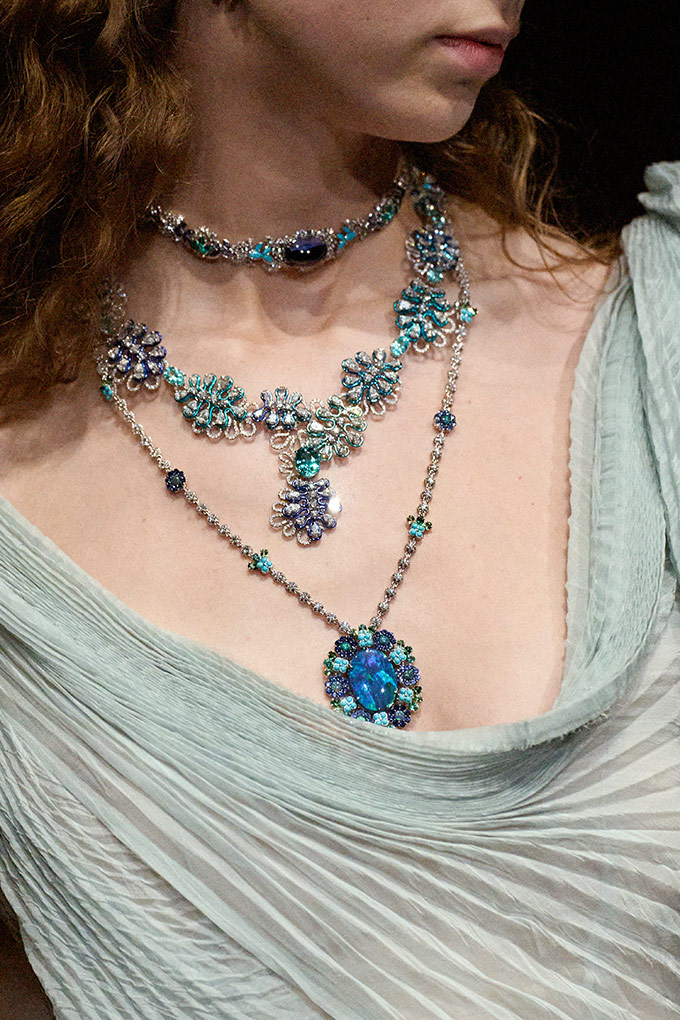
Word of mouth can be a fickle thing. In the ancient world, dazzling opals were a rare and coveted luxury. It is said in medieval accounts that the Imperial Crown of the Holy Roman Empire, an ornate treasure decorated with all manner of pearls, emeralds, sapphires and amethysts created circa 962, had a large opal set in its front centre plate. The gemstone was so spectacular that it was nicknamed Orphanus, or ‘the Orphan’, because there were no others like it; it was described as having a delicate wine-red colour, and the gleam and shine of white snow—an account that sounds not unlike fire opals. The crown was a symbol of the Roman Empire’s power for over eight centuries—royalty, status and desire wrapped up in this gem’s place upon the brows of emperors.
The fortune of this gem, however, has also gone through dramatic change. In the 1829 novel Anne of Geierstein by Sir Walter Scott, the magically-endowed character of Lady Hermione is said to have worn an opal jewel in her hair. When holy water was sprayed on the jewel, its light went out and Lady Hermione, stripped of her powers, turned to ash the next day. It is said, though with some dubiety, that the associations the novel made with magic and evil crashed the popularity of opals and gave the gem the stink of bad luck.

The superstition of opals as a source of evil and misfortune has even found its way into more modern media. In the Harry Potter film and novel series, the character Katie Bell is horrifically cursed after coming into contact with a necklace. The chapter this happens in is named ‘Silver and Opals’—no points for guessing what gemstone said cursed necklace was set with.
Strong reactions to opals come as little surprise, given how visually distinct and impressive its precious varieties can be. Because of tiny silica spheres in their mineral makeup, light is broken up into a sensational array of colours. A precious opal can flash red, green, blue and more as you move it around, and it is one of very few gems in the world that splits the rainbow in such a way and flashes with such a vivid dance of colours.
In the ancient world, before the science of mineralogy was established, opals went by many names that arose out of the gem’s unique optical qualities. It was called ‘upala’ in Sanskrit to simply mean precious stone; ‘opallios’ in Greek to roughly mean changes of colour and ‘ophthalmus’ to relate it to eyes and legends that it dimmed sight, and even ‘pantherus’ in connection with a mythical many-coloured panther beast from ancient lore.
With the benefit now of much less superstitious times, we can appreciate opals for their simple beauty. The intriguing play of colours has come to give this birthstone of October meanings like creativity, hope, and mystery. Precious opals come in three main varieties: black, grey and white. These are defined by their dominant background colour, with black opals the most coveted because of how it enhances and creates the most dazzling flashes of light and colour. A vast majority of the world’s opals come today from Australia after deposits were discovered in the 1800s.

One special variety worth knowing about: Mexican fire opals, which have orange to red background colours. These are among the rarer kinds of precious opals, and one of the more distinct and desirable varieties of this gemstone.
In jewellery design, the radiance and otherworldly appearance of opals speak to an artistic sensibility, and they really shine in the hands of designers who adore and work freely with colour. Victoire de Castellane of Dior Joaillerie, for example, is a designer who paints with gemstones, and whose high jewellery often comes with descriptions and lists of gemstones that run for a paragraph.

De Castellane, in fact, has only named and dedicated one collection in her 28 years as the artistic director of jewellery at house of Dior to a gemstone: Dior et d’Opales of 2017. “The opal is a very poetic stone,” she wrote at the time of the gemstones—her favourite—in collection notes. “It’s like an invitation to enter a fairytale, to experience magic. When I look at an opal, I feel like I’m seeing the Earth from afar, the oceans, the archipelagos, and the reflections of stars on ocean waves.”
Opals have played a recurring role in de Castellane’s designs since, and in the 2026 Diorissima collection the house went a step further by exploring a doublet technique. Though commonly used to enhance and improve lesser gemstones, in the hands of high jewellery houses doublets can create new plays of colour. At Dior, opals were layered over chrysoprase to subtle chromatic nuances.


The doublet technique has also been used recently in the high jewellery of Fred, which concluded this year a trilogy of collections dedicated to the house’s founder. It introduced in 2025 the Opalazur, which layers white opals and turquoise to create more expressive shades of blue that evoke gorgeous summer light dancing on the surface of water.
This year, in Fred’s Golden Light collection, creative director Valérie Samuel designed a line of Promising Dawn jewels inspired, she told me, by “the flash of green light that can occur when the sun rises from the sea.” The house sourced opals from Australia with specifically just blue and green colour plays, cut the gems thinly, and set them with the help of a Parisian watch dial artisan.
Opal jewels are most enchanting, though, when the designs lean into the kind of mysticism and magic that has trailed the gem in its history. Because this gemstone is rather soft (read: not the ideal choice for an everyday jewel) it is often shaped round as cabochons or flat—shapes that maximise the surface viewing area and show off its distinct colour flash. You can even find opals in irregular, organic shapes that are influenced quite simply by how the gem grew. Some opals are even cut with the host rock on it, a style known as boulder opals.

In Tiffany & Co.’s Blue Book high jewellery collections, chief artistic officer Nathalie Verdeille is enjoying interpreting the whimsical flora and fauna of Jean Schlumberger. Drawing on the famous Bird on a Rock, she has designed in this year’s Hidden Garden collection a line of Paradise Bird brooches that opens up the New York house’s aviary to ever more varied and fabulous feathered friends. One bird of paradise design is set with a remarkable fire opal, with shades of orange, green, red, pink, and purple—a palette of colours you could hardly imagine in a single gemstone.

And then there are talismanic designs that lean into the mysteries and rumoured powers of opals. Van Cleef & Arpels paid reverent homage this year to the arts and culture of ancient Egypt in its high jewellery. There are figurative pieces like pharaoh and Cleopatra clips, renderings of symbolic hieroglyph symbols, and a great many pieces that nod to elements of life by the Nile. The most enigmatic and alluring, though, might be the abstract pieces with beauty and a sense of the mystic. This Source du Désert clip, named for a desert spring, twinkles with diamonds and sapphires that give you the feeling of water—salvation in the sand! Yet it is the shifting shine of its black opal that gives you pause and makes you wonder: is it a miracle or a mirage?

1 / 13
Chopard Happy Hearts bracelet in rose gold with pink opal and a diamond, $6,920
Available from Chopard.

2 / 13
State Property Alara Sunburst pendant in yellow gold with an opal and diamonds, $3,300
Available from State Property.

3 / 13
Statement Paris Rockaway Pyramid mini ring in yellow gold with a pink opal and diamonds, $5,132
Available from Statement Paris.

4 / 13
Luisa Alexander Evil Eye bracelet in 14-carat rose gold with pink opal, rhodochrosite and diamonds, $3,286
Available from Luisa Alexander.

5 / 13
Fernando Jorge Signal small earrings in rose gold with pink opal, rose quartz and diamonds, £7,600
Available from Fernando Jorge.

6 / 13
Mindi Mond Infinity earrings in yellow gold with fire opals, Ethiopian opals and diamonds, US$34,000
Available from Mindi Mond.

7 / 13
Seventh Chariot Eye of Revelation pendant in yellow gold with opal, mother-of-pearl and diamonds, US$6,450
Available from Seventh Chariot.

8 / 13
Verdura Copa ring in yellow gold and white opal, US$12,500
Available from Verdura.

9 / 13
Ashaha Siwa earrings in white gold with opals, diamonds and rubies, €14,900
Available from Ashaha.

10 / 13
Anita Ko pendant in yellow gold with a boulder opal and diamonds, $19,221
Available from Anita Ko.

11 / 13
Brooke Gregson Delaunay ring in yellow gold with a boulder opal and diamonds, £6,350
Available from Brooke Gregson.

12 / 13
Irene Neuwirth bezel ring in yellow gold with a blue opal, $12,234
Available from Irene Neuwirth.

13 / 13
Anabela Chan Blue Poppy earrings in aluminium, rhodium vermeil and 14-carat gold with lab-grown opals and sapphires, $3,591
Available from Anabela Chan.