Since opening its doors to the public in 1793, the Louvre Museum has put on show the great works and collective memory of the French. In time, its collections would expand and go from just paintings to over 500,000 artifacts today from around the world. The great and the formidable from ancient civilisations—both real and fabled—inhabit its halls now. It was only a matter of time before these figures found their way to the present, and so it has in a collaboration between the museum and Vacheron Constantin in the form of four exquisite timepieces.

These four watches, limited to just 15 pieces each, represent and take inspiration from four ancient civilisations in the Louvre’s antiquities collections. It marks the latest chapter of the Musée du Louvre and Vacheron Constantin’s ongoing collaboration, which started in 2019 and yielded a first collection of timepieces in 2022. The relationship is built upon a shared reverence for craft and art, and brings two institutions together: one, perhaps the most famous museum in the world, and the other the world’s oldest watch manufacturer with an uninterrupted history.
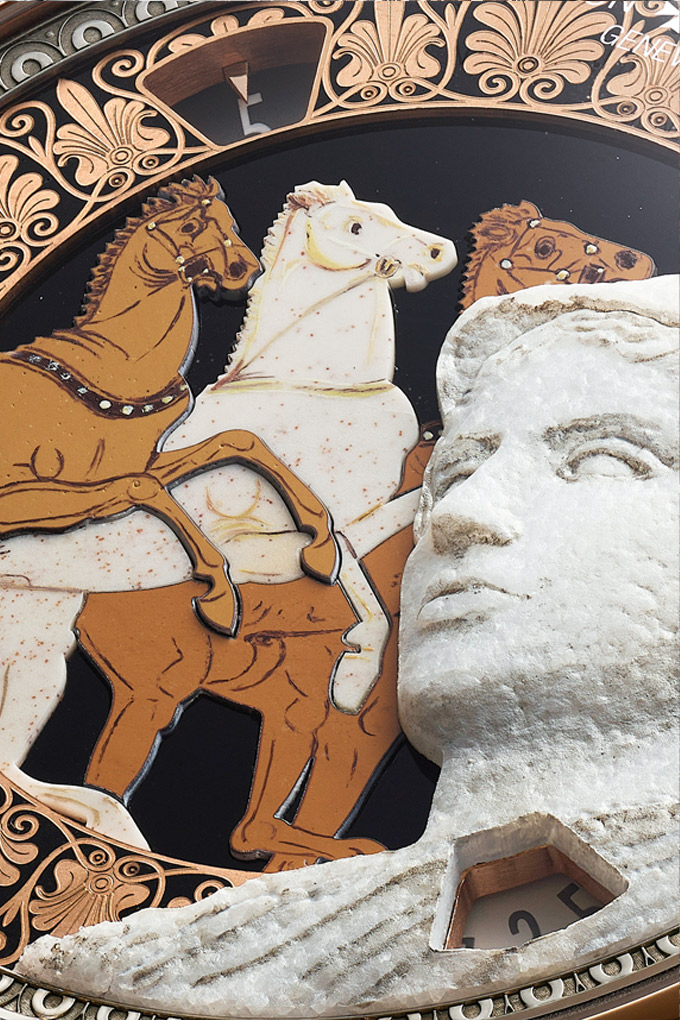
This 2026 collection is titled Métiers d’Art Tribute to Great Civilisations, and interprets four major works from the museum’s antiquities department: the Buste d’Akhénaton, circa 1,500 to 1,000 BC, of Pharaonic Egypt; the Lamassu de Sargon II, circa 934 to 604 BC, of the Neo-Assyrian Empire; the Athéna de Velletri, circa 480 to 323 BC, of Ancient Greece; and the Tibre de I’lseum Campense, circa 27 BC to 476 AD, of the Roman Empire.


Each timepiece miniaturises works which are, at times, mammoth at scale—the Lamassu relief mural, for instance, stands at around five-metres tall—into compositions fitted with micron-level attention to detail. The métiers d’art nature of the collection brings together a host of artistic crafts like stone carving, marquetry, micro-mosaics, engraving and enamelling within the confines of a single dial. Three years of research and development, in fact, preceded the unveiling of the limited edition collection.
“Each dial required between 120 and 200 hours of work,” revealed Sandrine Donguy, Vacheron Constantin’s creation and product marketing director. One of the challenges, she further shared, lay in combining and fitting these different métiers d’art elements and details on watches where the cases measure just 42mm in diameter. “The fitting of these elements had to be carried out with micron-level precision, since any error would have meant losing many hours of work,” she said.


In the interest of authenticity, each timepiece in this Tribute to Great Civilisations collection uses the same materials as the works it references. That means sourcing Italian marble to create the form of a Roman river god; or turning to the Greek Parian marble from the island of Paros to create the sculptural head of Athena. It’s watchmaking savoir-faire and obsessive attention to detail in the service of artistry, translating works and worlds that feel impossibly distant into objects that sit intimately on a wrist.


The Buste d’Akhénaton model, for instance, uses limestone and sandstone sourced from the Sinai in Egypt. Vacheron Constantin employed glyptic work, a highly artisanal form of carving and engraving that creates a relief figure on an otherwise flat surface. Donguy described this glyptic technique as one of “the greatest artistic challenges” of the collection. “While it can indeed be described as micro-sculpture,” she explained, “this technique, which proceeds through abrasion, is entirely different from metal engraving, which involves incising the metal with a burin.”


Another timepiece takes on the Lamassu de Sargon II, the half-human guardian of the Neo-Assyrian Empire, which is reincarnated through a dual technique combining champlevé and flinqué enamel. Here, the winged, human-headed figure is suspended upon slender rods of red agate and blue dumortierite and framed by an engraved-gold outer frieze. The rods echo the alabaster slabs that adorned the base of Sargon II’s palace, painted in corresponding shades of red and blue.
In the Mesopotamian kingdom, Lamassu were placed at sites requiring particular protection, their imposing stature serving a symbolic and mystical purpose. In miniature, that same meaning is transferred to the wrist: the guardian’s bearded human face, lion’s body and eagle’s wings forming a hybrid divine being accompanying its wearer.


These timepieces are feats of technology and technique, placed firmly in the service of art. Each watch is powered by an in-house movement, the calibre 2460 G4/2 made specifically for the manufacture’s collection in collaboration with the Louvre. Instead of telling the time with hands, four discs are positioned within apertures around the periphery of the dial. These tell the hours, minutes, day and date while allowing the artistic composition of each piece to shine and breathe, transforming a watch into a vehicle that revives and reimagines works of art.