Elevator pitch
The Fairmont name is a hospitality institution that needs little introduction. One of the Accor Group’s most well-known brands, it acts a character foil to the venerated Raffles Hotels & Resorts.
Where Raffles prides itself on service, Fairmont is founded on more eye-catching principles. Think social and aspirational, glitz and glamour. Their newest hotel in Hanoi is the city’s only Fairmont and an exercise in maximalism—simply enormous, its interiors form a massive latticework of five-star decadence. The first luxury hotel to open in Vietnam’s capital in nine years, it ushers the buzzy beauty of modernity into the heart of the city’s Old Quarter.

The stay
Making something modern doesn’t mean you have to spurn tradition. In fact, Fairmont Hanoi is a striking example of what a happy marriage between the two can look like—the tagline for the property is, after all, ‘the modern heartbeat of Hanoi’.
Earlier this February, I had the privilege of attending the hotel’s opening, complete with a ribbon-cutting ceremony and buzzy gala affair. Well before the party kicked off, though, I walked through the hotel’s double doors to observe a stark contrast, my senses given a welcome respite after being inundated with the ringing bustle of Hanoi’s Old Quarter.
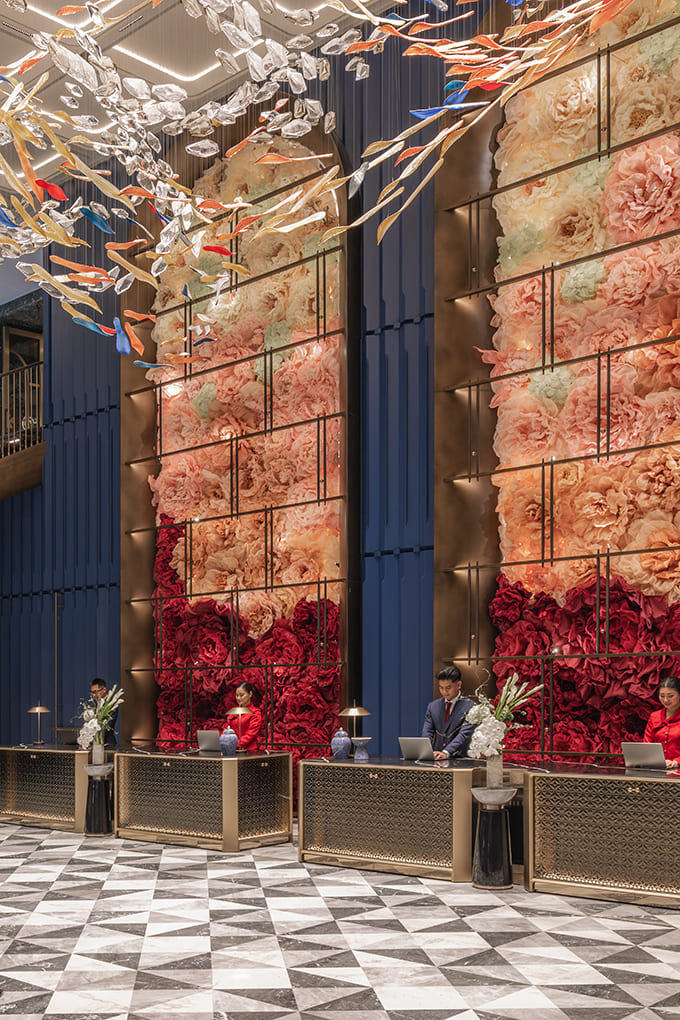
A spirit of ‘extra’ infuses every square centimetre of Fairmont Hanoi’s air. The lobby is home to spotless marble tiling, framed by elegant, burnished metal fixtures and given an exquisite backdrop: the two-storey-tall wall behind the reception counter is covered by a canopy of giant silk roses fashioned by a local artisan. Here, the flowers are a subtle nod to Vietnamese culture, their earthen red tones hinting at the alluvial soil that was crucial to the country’s development.

The hallways are similarly lush, sporting a modern coat marked by bursts of tradition in the form of lacquer artwork referencing seasonal flowers and historical events. Elsewhere, other traditional Vietnamese designs like sculptures of flying dragons and phoenixes were acute reminders I was not just at any luxury hotel—I was in a Fairmont in the heart of Hanoi. It certainly helps that every outward-facing window greets you with a sight of the tube housing and French colonial architecture dotting the surrounding Old Quarter.
The rooms are, perhaps, the clearest embodiment of Fairmont Hanoi’s maximalist sensibilities. Most properties in the Old Quarter are built with smaller, more numerous rooms. The opposite applies to Fairmont Hanoi: the rooms are far larger and fewer per square metre compared to the competition. Inside, sophisticated utility abounds—for better and for worse.


I enjoy ease-of-use as much as the next person. However, operating the plethora of switches dotting the walls felt less intuitive than I’d have hoped. The hotel’s heart is in the right place, though, and I’m happy to report that all the features you would expect from a quality luxury hotel were on display, and then some. Bathroom amenities came courtesy of Le Labo and an impressive spread of locally distilled gin, vodka, rum and whisky occupied the fridge cabinet.
The dining
No modern establishment is complete without an array of food and beverage options that invite the best of decision paralysis. So too at Fairmont Hanoi, where gastronomy manifests across eight in-house restaurants, each one offering spreads across various cuisines, from Vietnamese to Japanese to Italian. The latter, Bacco, is run by Michelin-starred chef Nicholas Isnard and is where I found my place for breakfast each morning.


The Italian restaurant extends a slice of comforting la dolce vita in an otherwise thoroughly modern hotel, its menu dotted with handmade pastas, woodfire oven-baked pizzas and other hearty Italian staples. Meanwhile, a short, fifteen-metre walk across takes you to the other side of the world—to Hiryu, a Japanese restaurant packed with choices sure to satisfy anyone craving for the beloved cuisine. Elegant mains are on offer, of course, but what if you wanted sushi? Teppanyaki? Ultra-rare sakes? Better yet, you can indulge in all three if you, and your stomach, are agreeable.
For a taste of some authentic Vietnamese food, Tran Dynasty is the go-to. Whilst its official opening is slated for later in the year, the taste test I enjoyed was a promising one—and more than enough to tempt a return trip. Popular Vietnamese-Australian chef Luke Nguyen was gracious enough to host us at the hotel’s cocktail bar, YY Bar, and tantalised our taste buds with bite-sized versions of Tran Dynasty’s menu: comforting Vietnamese fare elevated with an expert’s touch and lovingly informed by a rigorous study of the country’s culinary history.
The itinerary
Fairmont Hanoi contains multitudes. Literally. It is the closest thing to a ‘hospitality onion’ I have experienced, a lavish urban retreat that belies its full potential to the average passersby.
Walk past the vast indoor pool, the underground cousin of its rooftop variant, and behold a sanctuary of zen wellness: the Cirua Spa, Fitness & Wellness Club. Quite possibly the crown jewel of Fairmont Hanoi, the Club boasts a fitness studio outfitted with top-of-the-line equipment capable of addressing every combination of compound muscle movement, as well as a jaw-dropping bathhouse replete with hydrotherapy and thermal facilities—with intimate plunge pools, saunas tuned to half a dozen degree settings and regenerative steam rooms aplenty.


If you’re not in the mood for Fairmont’s version of restoration and vitality, there is, of course, a whole capital waiting outside its walls. Hanoi is Vietnam’s oldest city and is appropriately packed to the gills with coffee shops selling the infamous local brew, bars crawling with people from all around the world and warming bowls of pho amid other sundry Vietnamese culinary delights spread throughout the capital’s countless alleyways.
To many travellers, Hanoi is as close to heaven on earth as it comes. Despite the tragic, lived realities of the Vietnamese due to Western domination and colonial rule, the city and its people have continued to flourish against all odds. Fairmont Hanoi might be the newest address to call the capital home, but the property does not detract from the city’s rich, layered history.
For those who wish to learn about the city and its people, a plethora of museums and cultural institutions are peppered throughout—some even within walking distance—each one offering insight into how Vietnamese culture has been shaped through war and its aftermath. What stands out throughout though, is the immensely warm, and gracious nature of its people—something that not only feels integral and grounding to one’s experience of the city, but was reflected in kind throughout my stay at this mesmerising address.