The butler did it. Four simple words that have found their way, for the third time, inimitably tied to the spirit of the esteemed Raffles Hotels & Resorts. Wherever you are and whatever your state of mind, all good things at a Raffles address are coaxed to life, carefully and lovingly, by the butlers. First unveiled in Singapore—then followed up a year later in London—‘The Butler Did It’ campaign shines a light on the humanity behind Raffles’ peerless hospitality. Enter: their latest pilgrimage through two cities in Cambodia, Siem Reap and Phnom Penh.
There, the millenia-old ruins of holy temples proved a far cry from the cosmopolitan churn of Singapore or London. This proved the perfect backdrop for the latest chapter in Raffles’ butler-driven book—the pages in it intimate, immersive and wholly rooted in culture.
Temples galore—and much, much more
From the very start, the unmistakable stamp of Raffles’ quality service was evident. The moment I stepped out of Siem Reap’s airport, a butler was at the ready, an easy smile resting on his face, eager to ferry me to the Raffles Grand Hotel d’Angkor. The same warm affability greeted me at the steps to the hotel, as the staff moved with practised ease to welcome me into the lobby. It’s here that I was struck by the overwhelmingly cosy interior.

Whilst the visually arresting 1800s colonial architecture that is signature to the Raffles name plays out across the facade and foyer, move in a little further, and the hotel undergoes a transformation. The Conservatory, the space behind the lobby, blends heritage with modernity and class with charm, grounding it all in elevated homeliness, by virtue of deep-grained wood flooring, comfortable upholstery and plenty of natural light. The hotel’s various programmes and amenities, some of which take place here accompanied by the dulcet tones of an in-house pianist, proved more than capable of living up to the ambience.
It is abundantly clear that the establishment is a monument to history. If you feel so inclined, its nearly century-old narrative stands at the ready to be told: a tapestry of tragedy and triumph woven expertly by the hotel’s resident historian butler, who is himself a child of the Khmer Rouge era. The Grand Hotel d’Angkor also has its very own gin butler, who boasts a love for cocktail craftsmanship that is matched by her abiding knowledge of Cambodia’s gin distilleries. If you find yourself in the mood to dive further into the subject matter, the swanky Elephant Bar is next door, a reservoir of fine spirits and even finer service.

The establishment’s approach to the classic dinner-and-a-show experience is another Raffles special. If you forgo the generous bounty of Western, Pan-Asian and Cambodian cuisine served at the hotel’s restaurant, 1932, you might look across the swimming pool to the Raffles Marquee.
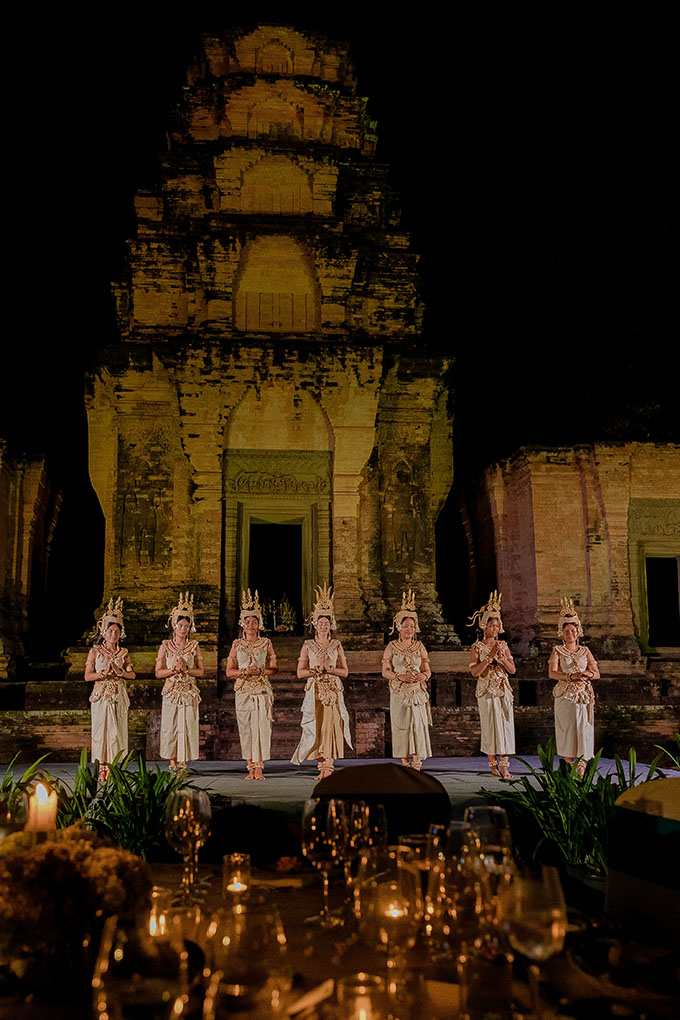
The space is home to a large dining space that features elevated takes on traditional Khmer cuisine. My first introduction to Cambodian fare took place there, boasting an ambok amuse-bouche, a delightfully moreish Cambodian rice snack, and a saraman curry that almost feels like it could be the bolder, richer cousin to the Thai massaman. Meanwhile, a stage lay mere metres away—while we dined, my party was treated to a spellbinding suite of traditional dances like the apsara that immerses you in centuries of history and tradition.

Naturally, a trip to Siem Reap would not be complete without a healthy exploration of the many temples—including the famed Angkor Wat—that dot the region. To prepare, we all had an early night. For me, this was prefaced by a jaunt in the hotel’s original timber cage elevator, followed up by a restful sleep in a lavish room adorned with intimate touches like hand-written letters and hand-picked Cambodian delicacies.

At the crack of dawn, the lot of us zoomed off on vespas, flitting through Siem Reap’s empty streets on the way to the outskirts of Angkor Wat. A once-in-a-lifetime experience awaited our arrival.
Over the course of an hour, we gazed in awe across the temple moat at its western wall, as the first glimmers of daylight slowly bathed the aged stone with dawn’s brilliant hues. Before long, we found ourselves walking on storied ground.

Amidst the jaw-dropping ruins of one of the world’s most magnificent temples—full of cultural artefacts and religious artworks spanning the breadth of both Hinduism and Buddhism, as well as examples of stunning scientific precision that bely its age—there is a humbling sense of time and place, transportive in ways that feel indescribable. As if the ruins held onto the essence of the time it belonged to, forever etched in memory.

Even as we departed Angkor Wat for a delicious picnic breakfast in the countryside, there were more architectural marvels to look forward to, in both Angkor Thom and the Bayon. Smaller, but no less impressive, these other magnificent sights reaffirmed the sentiment that had been steadily brewing in the back of my mind since stepping off the plane: the beauty of Cambodia seems to be shrouded by its surrounding nations, but it is a whole world unto itself, equally deserving of its spot in the limelight.
A capital city on the rise
Before our drive to Phnom Penh, a spiritual awakening was arranged by the Raffles team in the courtyard. Under a radiant pagoda bell, we were blessed by a Buddhist monk, who gifted us with sacred string bracelets to accompany us on our travels. Suitably prepared, we embarked on our five-hour journey across Cambodia’s countryside.

Phnom Penh is a city on the rise, a capital that, on occasion, seems suspended in time. The country’s history will always be tethered in some way, shape or form to the brutality of Pol Pot’s regime. Many families remain torn apart, and to this day, the city’s infrastructure struggles to catch up. And yet, there is hope: found in the burgeoning creative community, the roil of industry and, most of all, in the resilient Khmer people themselves.
Pulling into the driveway of Raffles Hotel Le Royal, located in the heart of the city, we were met by the same endearing joy I had the privilege of enjoying at all hours of the day in Siem Reap. This time around, one of the butlers turned out to be the Hotel Le Royal’s very own resident historian.
His tour of the space was eye-opening, in more ways than one. The Raffles in Phnom Penh leans more classical in terms of visual language and evokes more of its colonial heritage than its Siem Reap counterpart, perhaps a by-product of its use as a wartime refuge for various members of the press. However, it remains grounded in cultural tradition. Elevated, yet accessible—never too far removed from the warmth of the Grand Hotel d’Angkor. A little less wood, a little more white porcelain and marble. Yet all still decidedly Raffles-in-Cambodia.

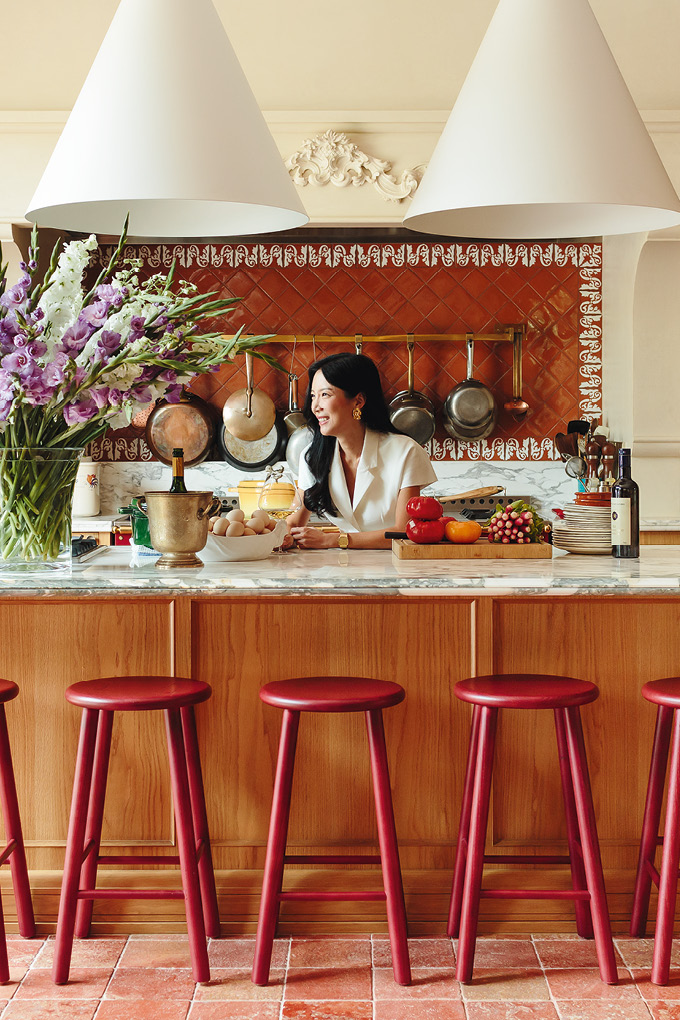
I did not know it at the time, but the standout experience of my entire stay in Cambodia was destined to take place that night. The award-winning Ros Rotanak is the country’s first female celebrity chef and its most outspoken culinary ambassador—and it was to her private residence that my group was invited to sit down for several courses of hearty, home-cooked food.
In many ways, our sojourn to her expansive abode served as an uncanny mirror to the hospitality embodied by Raffles’ butlers. Throughout the night, the best and brightest tenets of Cambodian culture were on full display—gracious behaviour and disarming service, utterly divorced from any semblance of pretense.

Seated on the second floor of one of their extended housing structures, the table feasted and fellowshipped through the night, fully embracing the hospitality of her kitchen staff. Chef Nak is an avid, lifelong learner of shared history, adamant in her quest to research and infuse Cambodia’s rich culinary history with modern techniques. And it shows.
From start to finish, the gastronomic journey was a masterclass in bespoke execution and delivery. No two dining sessions ever share the same menu. Each drink and every course is crafted according to Chef Nak’s uncompromising artistic vision for the day. Cambodia’s famous kampot pepper danced across hearty curries, zesty salads and enriching broths. These hinted at the cuisines of neighbouring countries and yet, every bite felt uniquely, refreshingly unfamiliar.

Our last two days were filled with a plethora of sights and sounds that make up the fabric of Phnom Penh. We visited the grand, sweeping grounds of the Royal Palace of Cambodia; wandered the halls of the Sosoro Museum, where two thousand years of history comes alive through interactive exhibits; shared afternoon tea with several acclaimed local artists paving the way forward for Phnom Penh’s creative community; and indulged in a drink or three at the Hotel Le Royal’s own Elephant Bar.

Each of these curated experiences felt like beautiful, moving vignettes in a tale that would remain forever in my memory. It seemed fitting, then, that for the butlers’ last act of service, I was graciously accompanied by a key staff member at the Hotel Le Royal to visit Phsar Art 2025, a vivid arts market abounding in creative energy and artistic solidarity.
This visit was not in my original itinerary, but after meeting one of the artists over tea, I felt compelled to drop by. I stayed for hours talking to the different artists there, many of whom were from countries as far-flung as France and Mexico, but who fell so in love with Cambodia they now reside there. My time at the market was the perfect bookend to my stay in Phnom Penh. Being welcomed into a community brought together by a shared love of art was just one example among many that seemed to signal a bright hope for the country’s future.

There is a certain kind of magic in Cambodia’s air, charged as it is with ancient tradition and buzzy modernity alike. There are parts of the country that will forever be unavoidably entangled with the lasting consequences of colonialism and the Khmer Rouge, to be sure. But that only serves to re-affirm the sheer grit and determination of the people’s spirit. The Raffles Hotel butlers are certainly a testament to this vision.
No detail goes unnoticed under their warm, watchful eyes. Remember: whichever wonders you might experience at a Raffles Hotel, they did it. They, like the Khmer people, have weathered the storm and made it their own—and by doing so, have made it yours, as well.
Explore more of the experiences offered by Raffles Hotels & Resorts here.