In the world of Chanel, feminine liberation is the thread that connects everything. From Gabrielle Chanel’s earliest innovations like the use of jersey in women’s fashion to the invention of the all-occasion bouclé jackets and skirt suits, and the little black dress, Chanel’s designs freed the body and granted its wearer the ease to move and live their lives in. That’s exactly the impetus behind Sport, the house’s latest collection of high jewellery that taps into the allure of the physical.
“I was inspired by Chanel’s sporty style,” explains Patrice Leguéreau, the director of Chanel’s jewellery creation studio. It’s an integral part of the house’s history—though perhaps not as obvious because it is an intangible concept. It’s about the “elegance of the line and the freedom of movement”, adds Leguéreau of the thrust.


For proof of the importance of sportiness, consider that as early as 1921, Chanel had already created a Sport atelier within her haute couture house. The inner, hidden fashion design codes that she instituted served movement: jacket sleeves with high armholes, pleated and unrestrained skirts, dresses worn by slipping over the head instead of having to step into them, and more. In fact, when Chanel opened her first fashion boutique in the seaside resort town of Deauville in 1913, one of her earliest lines was jersey sportswear.


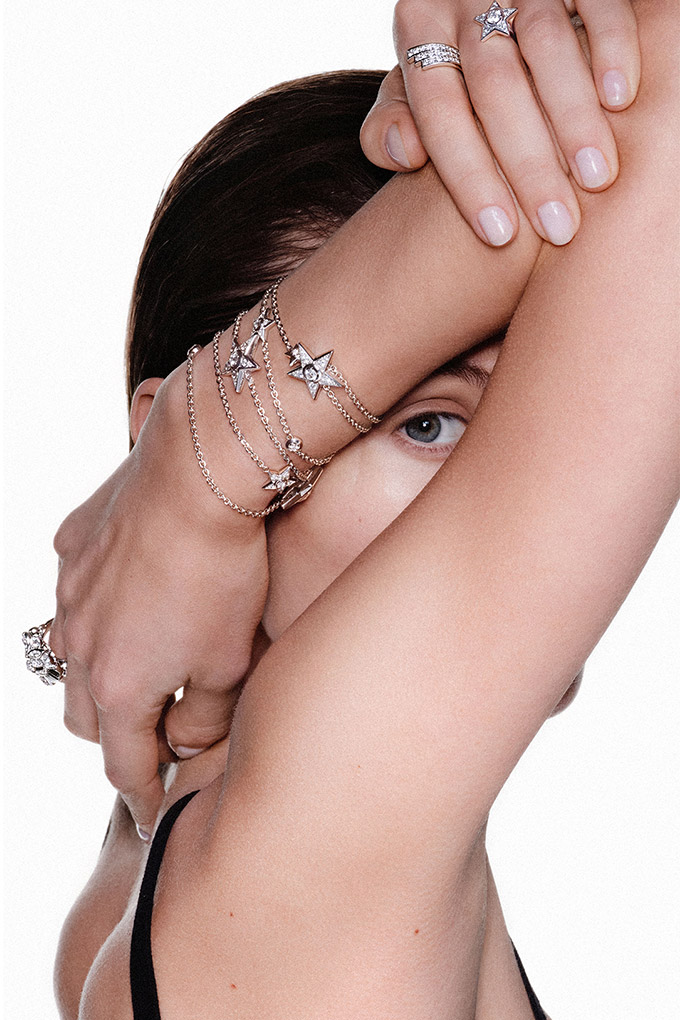
So it is with import that Leguéreau interpreted this core value as an 80-piece collection of high jewellery. The team at Chanel met this creative challenge in three ways. Firstly, by honing in on a sporty aesthetic—tapered lines, chevrons and smooth contours that evoke speed and kinetics, and athletic motifs such as chronometer numbers, coats of arms and stars of victory. There’s also an expressive use of colour, which is achieved through gemstones as well as coloured, anodised aluminium and vivid lacquer details.


Secondly, by tapping on inimitable Place Vendôme jewellery craftsmanship with a post-modern bent. Sport features cutting-edge technical savoir-faire and several firsts for Chanel. Quick-release fittings from sports equipment are turned into genuine, working clasps. A novel tube chain is designed to mimic and move like drawstring cords. The centre setting of nearly every cocktail ring can be swivelled to reveal two different main stones. The famous sans-serif Chanel logotype is deconstructed to form a graphic pattern. Classically precious materials are mixed with high-tech ones, such as coloured anodised aluminium and super lightweight carbon fibre. And for the first time in Chanel jewellery, the rectangular Mademoiselle turnlock clasp from the 2.55 handbag is rendered as a functioning, swivelling clasp on a necklace.
Lastly, what is perhaps the most impressive ensemble of rare gemstones gathered in Chanel high jewellery. The top prize, without question, is a series of jewels featuring a suite of Kashmir sapphires that took the maison more than five years to source and assemble. In total, five Kashmir sapphires with a weight of 42.86 carats, with three cushion cuts of 17.18 carats, 10.15 carats and 6.36 carats; and a pair weighing 4.40 carats and 4.77 carats set into earrings.


Like a woman in movement, Chanel has taken a big, bold step with its high jewellery. Both conceptually and materially, in the form of unique savoir-faire and the alluring quality of the gemstones.
Leguéreau lets Vogue Singapore in on how Haute Joaillerie Sport came to be.
The Chanel approach to style is unfussy, comfortable and straightforward. Jewellery, most would think, is the opposite. What’s your view on this contradiction?
That’s true, it could be considered an oxymoron! Part of the creative challenge was to infuse this sporty style and allure into a high jewellery collection. It was the same feeling when I paid tribute to the iconic Nº5 perfume or translated the emblematic tweed fabric in high jewellery. Always pushing creative boundaries could be my motto. At the end, when worn, the pieces give that feeling of freedom and suppleness because the features are designed, proportioned and integrated with precision to sit perfectly on a woman’s body as she moves.
I read that you have a passion for sports. Had you been itching and waiting to design a collection like this?
Haute Joaillerie Sport has a personal resonance. Sport and freedom of movement mean a lot to me. And that’s so precious at Chanel, where creation lies at the heart of everything. To be able to combine my emotions with this absolute freedom, nourished by the visionary approach of Gabrielle Chanel. I’ve thought of dedicating a collection to the sporty style of Chanel, so integral to the maison, for a long time. The time has come, almost three years after my first sketches, to celebrate sport’s beauty and passion, its challenges and triumphs.
How did you interpret the idea of movement into your designs?
With their transformability and modular design, so dear to Gabrielle Chanel, the pieces—such as the Sporty 5 necklaces or adjustable pieces like the Gold Slider necklaces—form an ensemble that is light to wear and celebrates freedom of movement.


There are six chapters, or themes, in Haute Joaillerie Sport. Can you tell us a bit about them?
The motifs and graphic design revisit Gabrielle Chanel’s symbols in a sporty way. First, in Graphic Line, the chevron motif (already present in Gabrielle Chanel’s Bijoux de Diamants 1932 high jewellery collection) evokes rhythm and speed. Second, in Chanel Print, I wanted the logo revisited as a sports print. Third, in Quilted Icons, the iconic quilted motif in a light, openwork version. Fourth, in Sporty 5, Gabrielle Chanel’s lucky number becomes a working design feature in the form of a snap hook. Fifth, in Gold Slider, innovative high jewellery techniques in the form of an adjustable button slider. And lastly, Sweater, where the sport sweater and its drawstrings are interpreted in high jewellery.
Colour, and indeed coloured gemstones, are key in Haute Joaillerie Sport. How is it different from how Chanel has approached colour before?
I wanted colours that were clear, distinctive and assertive. To create two- and three-tone contrasts, knowing that there are never more than two or three colours in any one piece. This graphic signature was conceived to showcase the beauty of the gemstones, exceptional not only for the variety but also for the finest ensemble of sapphires ever presented by Chanel.
These, I presume, are the Kashmir gems which have pride of place in this collection. Tell us a bit about them.
The set of five Kashmir sapphires illustrates the outstanding quality in this collection. The fruit of years-long research work, it is a tour de force in itself. Not simply a set, but rather a peerless and priceless ensemble distinguished by exceptional quality and superlative character. The cuts of these gemstones are of a precision that is extreme and faultless, and they are graduated to echo the taut, sleek line I wanted. They reflect the absolute excellence of the collection.
Are there pieces from Sport that you’re particularly proud of?
The Graphic Line set, adorned with the amazing set of Kashmir sapphires. The chevron line, with its distinctive succession of Vs, echoes the motif seen on the Comète necklace from the Bijoux de Diamants collection created and presented by Gabrielle Chanel in 1932.

That’s the set Keira Knightley wore in Monaco the night the collection was revealed. What are some of the secret details on those pieces?
They reprise the graphic signature and technical features that make it one of the most outstanding sets within the collection. The clasp of the Chanel 2.55 bag, used for the first time in high jewellery; the transformable design of the solitaire ring; the bands of custom-cut rubies, emeralds, sapphires and diamonds; the Chanel logo spelt out in full on the inner surface of the necklace and the earrings.
Sport introduces a lot of new techniques, materials and details. What were these innovation adventures like?
Believe me, there were a lot of memorable moments due to the technical complexities. Especially when developing elements specifically for the collection, such as the lacquer chevrons, the tube chain, the slider and the carabiner clasp in the shape of the number ‘5’. Or when using new materials that are different from those traditionally used in the world of high jewellery, like carbon, aluminium, ceramic and various coloured lacquers.
An interesting detail in this collection: there are a lot of cocktail rings with a similar design. A centre setting that can be rotated to show a coloured gemstone on one side and a diamond on the other. Why are there so many of these rings?
Cocktail rings have often been at the heart of Mademoiselle Chanel’s styling and she loved to wear them by sets. In this collection, rings are significant. They allow us to showcase the most beautiful gemstones, like 17.18-carat and 6.38-carat Kashmir sapphires, rubies, red spinels, tsavorites and mandarin garnets. Yet they also echo the creative spirit of the collection. The Chanel logo subtly adorning Chanel Print rings, the quilted motif on Quilted Icons, a snap hook redesigned in the shape of the number ‘5’ for Sporty 5 rings. Although they represent a small volume, rings—set with the most exceptional stones— are a marvellous field of expression to evoke the theme of the collection.


The October anniversary ‘Community’ issue of Vogue Singapore is available online and in-stores.