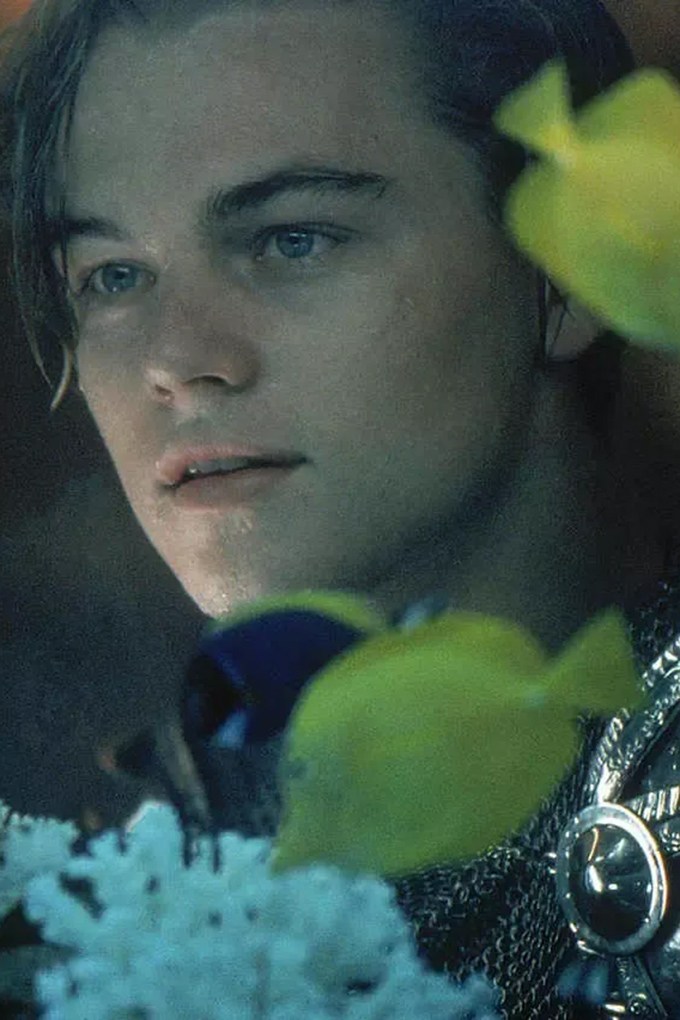
I fear I am in love with a man. Sorry, jump scare. Or that’s what it feels like to say such a thing these days. All it took was a young Leonardo DiCaprio in a knight costume, a fish tank, a longing stare and Des’ree’s ‘I’m Kissing You’ playing in the background for me to become a love-fool. Baz Luhrmann’s 1996 film Romeo + Juliet was my ‘falling in love with love’ awakening. The precise moment when my ‘if he wouldn’t take a bullet for me, I don’t want it’ attitude was born. This incredibly aesthetic and sensorial cinematic standard for love was burned into my undeveloped prefrontal cortex. Maybe it was the millennial in me, but the prospect of catching the eye of a knight in shining armour was something I was excited about and even pined for.
Exactly thirty years after Luhrmann’s modern Shakespearean masterpiece, it’s possible Romeo’s antics would be deemed an ick and ‘doing the most’. But at the same time, does wanting flowers make you high maintenance? It seems like the plethora of dating apps and hence abundance of choice has led to more ambiguity in relationships with romance being the collateral damage. So, are outward displays of affection now seen as desperation? Does sincerity now equate to weakness? Has romance, like an old pair of skinny jeans, quietly gone out of fashion?
View this post on Instagram
“It took me a really long time to discover what I actually wanted, or experience what it was like to be courted by someone and be in a romantic relationship, just because of the nature of dating app culture,” states Daisy Anne Mitchell, 27, founder and creative director of Angmore Media and content creator, who is in a non-monogamous relationship. “It’s very quick, casual, and so often we hear the term ‘the bar is on the floor’ because basic romantic gestures like holding the door open for you, or checking in to make sure you got home safe, or bringing you flowers are seen as these grandiose things.”
For Rahat Kapur, 35, editorial director of Beyond the Boardroom, who is currently navigating single-dom, she finds that while “there may be endless options,” alignment remains rare. She adds, “What complicates this landscape is how polarised our ideas of romance have become. On one end, independence has hardened into emotional nonchalance, and detachment is mistaken for strength, and caring less is framed as power. On the other hand, there’s a renewed urgency around partnership, sharpened by economic pressure,” which can lead to settling. To her, the general sentiment is that most women today aren’t only looking for a so-called provider in the traditional sense, “they’re seeking partnership that complements the lives they have already built, not one that replaces their autonomy.”
View this post on Instagram
If we spotlight the role technology has played in all of this, while hookup and match-making platforms have provided endless alternatives, social media has only amplified women’s seemingly collective dissonance with low-effort men. There is so much discourse online about women lamenting their husband’s ‘weaponised incompetence’ (deliberately acting incapable to absolve oneself from responsibilities), and if you do a quick search on TikTok for ‘grown man stomps’ you’ll happen upon a clip of a fully-fledged adult having a tantrum about how his wife did his laundry. Interestingly, this type of husband shaming doesn’t seem to trigger empathy amongst other women.
The comments include statements like “if you’re not leaving him, leave us out of it,” and that “people are starting to turn on the wives”. Throw in a viral 50-part series called ‘Who TF Did I Marry?’ by Reesa Teesa that captivated audiences across the globe about the antics involved in dating, marrying and divorcing a “pathological liar”. Suddenly, the momentum behind the de-centering men movement all makes sense. Sex And The City’s Charlotte York and her eternal love optimism and pedestal-ing of men would put this crowd into a coma. Or at least nauseate them. “For hundreds of years we’ve been conditioned to feel small, especially opposite men, that’s why the pendulum has swung so far the other way now. We evolve and change over time, but I truly truly believe in the quote ‘you accept the love you think you deserve,” says Mitchell.
View this post on Instagram
While socials have opened the floodgates for commentary on red flags or ghosting, situationships (and don’t even get me started on ‘black cat energy’ or ‘becoming a high value woman’) and generally how problematic certain types of liaisons or even marriage can be, it has also birthed the rise of performative romance, whereby acts of affection are bartered for traction and likes.
Maybe romance only works if it’s behind closed doors? “Funnily, even though I share my dating life and experiences very publicly, my romantic ones are very private. I have been seeing someone for the past year or so. When we were first dating, I spoke about it often online, but once it got serious, I held it a bit closer to my chest.” Even for someone like Mitchell, who has openly shared her courting sagas on TikTok, some things are reserved for just her and her beau.
“I wouldn’t want to show you my heart, and then have you show it to the world.” When I asked my husband if he would be embarrassed about me sharing some of the romantic things he has done for me in this article, like writing me hand-written notes, he thoughtfully answered that while some things were okay (yes, the notes), he felt other moments should be just kept between us. Zero shame on his behalf—just a desire to maintain an element of privacy and sacredness. Boundaries aside, for him, romance is not just about the momentous occasions, or big declarations of love.
While there is a time and a place for that, he places importance on ‘micro romance expressions’, and how a simple kiss in the morning, or Friday night date can amalgamate into a powerful sense of belonging and safety in the relationship. A recent Vogue Singapore survey of our Club Vogue members would agree, deeming romance overall as quiet, daily, and intentional—not performative, with 35 percent of respondents saying presence, showing up and effort are the most important elements.
Perhaps then, romance itself shouldn’t be seen as a loss of ‘aura’ or lame, but not being earnest with it, being performative, or worse yet, staying in a relationship that compromises your values, should be the uncool part. “This is why modern romance often holds women in a productive tension between hope and discernment. The pressure to settle or choose something rather than nothing assumes that partnership is inherently superior to solitude,” argues Kapur. “Yet many women now understand that it’s better to be alone, versus being in a relationship that requires them to carry the emotional weight, dilute their standards, or abandon their expectations.” Mitchell is on the same page. “We are at this incredible juncture where for the first time, we don’t need a man to survive. We have the choice and the power to show up in romance however we want.”

Is romance possible in the era of algorithmic relationships? Our survey results highlighted that despite complexity and fatigue, faith in romance remains. In fact, 54 percent of respondents are feeling hopeful. Personally, as you already know, I love love, and I’m not afraid to love out loud. The fever dream of Emerald Fennell’s Wuthering Heights paired with Charli XCX’s ‘Everything Is Romantic’ is making me feel optimistic. Maybe it is this generation’s Romeo + Juliet—a timely reminder that transcendent love is something that anchors us to authenticity, albeit potentially messy and heartbreaking at times. Romance signals possibility. And in an increasingly transactional, surface-level world where convenience is king, the feeling or even efforts of romance can’t be faked. A spark, a longing, vulnerability and a loving does something to you on a cellular level. To me, it’s cool to care. Bring back yearning, I say.