In July, Boucheron always surprises. Since the brand debuted its Carte Blanche collections in the summer of 2020, the Parisian house and its creative director Claire Choisne have carved a unique place on the haute joaillerie circuit. Ask any jewellery editor which collection they are most excited to see and the answer is almost certainly Boucheron’s. When I meet with Choisne in the brand’s historical home on 26 Place Vendôme in July, there’s a surprise of another kind. I walk in for our interview and find myself seated on a pouf next to a bathtub. We are in the bathroom of the private apartment of this maison. Alright, great acoustics, maybe, and Choisne playfully points out that the tub has a spectacular uninterrupted view of the famous Vendôme column—perhaps the most luxurious loo vista possible.
We are hidden away in this unlikely room to discuss Choisne’s latest triumph of unlikely high jewellery: a daring, maverick 10-piece collection named Human Being. “At the time,” the creative director says, taking me back two or three years to the collection’s conception, “I was hearing noise about AI. I’m really fond of innovation, but that one was a little bit [of a] mixed feeling, you know?” She grimaces a little bit, then continues: “I spent a lot of time learning about that and the result was that I want to pay tribute to humans.”

Indeed the collection centres itself on the elemental things about outstanding, one-of-a-kind jewels: the necessary emotion, ingenuity and determination to bring such creations of extreme beauty to life. Collections of high jewellery are designed by people, gems must be cut, polished and set by human hands, and these wonderful objects are destined, after all, to enter people’s lives and represent preciousness of all kinds. Not that AI, that first spark of a thought for Choisne, is to be disregarded entirely. “I’m clear in my mind. I think I know what humans can bring, what AI can bring, and there’s room for everybody. But I wanted to focus on what humans can do.”
The result is wickedly smart. Choisne and Boucheron approached the theme with the irony of the human condition. Us humans are all, fundamentally, the same; and yet every person other than our selves is essentially unknowable. To express this same-different duality, the brand designed just five sets of jewels—all of them the same cluster style, yet each with a different inspiration and execution. “I wanted the silhouette to be the archetype of a high jewellery necklace,” Choisne explains. First, she and her team thought of visiting museums like the Louvre to consult old paintings. Then, she considered the Barbie doll and her necklace (“Everybody knows Barbie, and Barbie’s got a necklace, so that could be an archetype!”) but that was perhaps too obvious.

In the end, Choisne turned to that great-and-hated tool of our times. “AI won’t be able to do a high jewellery collection, but AI will be better at me than finding the archetype. A human brain is able to give an idea, but AI will give you le moyenne (the average).” It suggested a cluster necklace silhouette, which took her by surprise at first. “I realised that during all of my career, in 25 years, I had pushed myself to forget the idea of a cluster necklace because I love to do things [differently from] everyone else,” she admits.
With this cluster silhouette, Boucheron fashioned five remarkable jewels. Rain, in clear, hollowed rock crystal, with over 4,800 diamonds suspended in plant-based resin to mimic the look of raindrops on skin.

Light, made entirely from 1,500 carats of morganite, painstakingly sourced and custom cut to ensure uniformity of colour and clarity. “The morganite was so difficult. We had to cut so many roughs to get the same colour. It’s easier to ask a dealer to sell you a nice emerald,” Choisne laughs, recounting the process. As if sourcing gems so large and perfectly matched weren’t difficult enough, Boucheron also drilled directly into the morganites to place white gold and set diamonds in it.

Checkers, made from 163 gobs of onyx, hollowed for lightness, and zapped with a femtosecond laser—the ultra-precise high-tech laser used in LASIK surgery—to create a houndstooth pattern. “I really wanted the onyx to feel like fabric,” says Choisne of the effect, perhaps a nod to founder Frédéric Boucheron’s upbringing in a family of drapers.
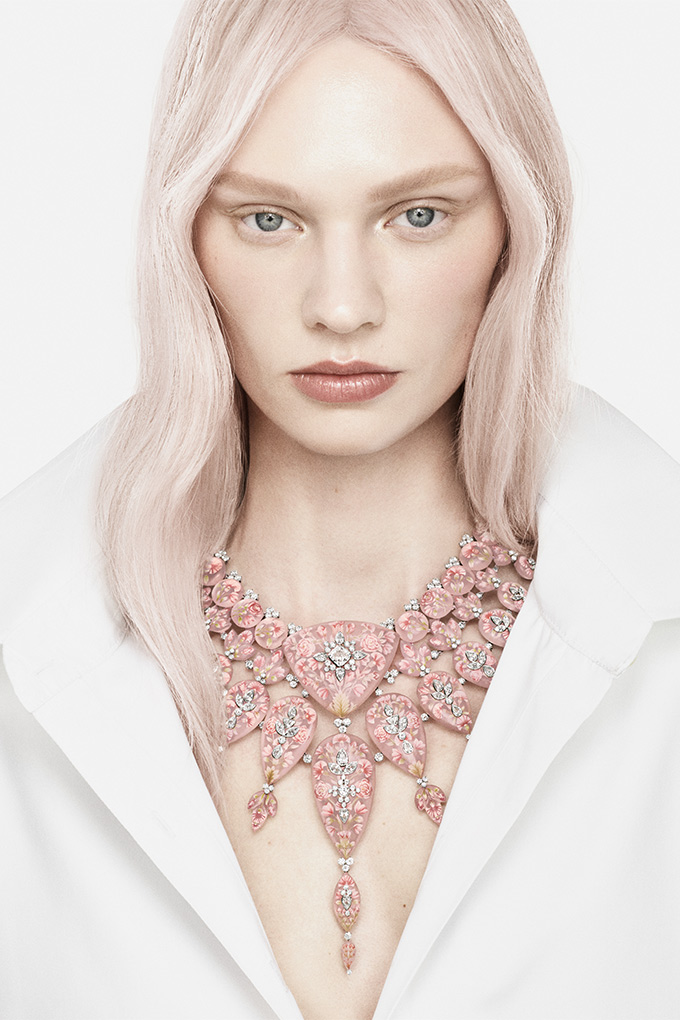
Two designs, though, stand out for their especially human touch. Boucheron enlisted the help of two external craftspersons to create the Flower and Tattoo pieces. In Flower, the micro-miniature artist Alexandra Carle was brought on to paint by hand a richly patterned floral wallpaper on frosted rose quartz. Each component was painted under magnification, and the necklace and its accompanying ring took around 3,290 hours of work to complete. When I ask Choisne about how the paint was varnished to protect it, she smiles coyly and insists on keeping some secrets.

This sense of play and mischief was at its strongest in the Tattoo design. So surprising and fascinating was its inspiration that Choisne had a board of visual references on hand to show and tell. During her research, she discovered photographs of society women in the Victorian era who were covered with tattoos. Even more improbably, they were lensed with their arms, legs, backs and décolletages out, wearing their jewels and showing off their body modification. “Worn with diamonds and everything, that’s crazy!” Choisne exclaims. To create the illusion of tatouages in jewels, Boucheron tapped the bewilderingly young but talented glyptician Joseph Bongrand, only in his 20s and a master of this rare, ancient art of carving in stone. The maison worked with smoky quartz, carved on the reverse to create bas-relief butterflies, birds, snakes, flowers and leaves.


“When I choose someone, it will be someone really passionate and in the details, someone looking for perfection,” says Choisne of how she decided on these creative and artisan partners. One more prime quality she looks for: “Nice to work with—I love nice people because it’s long, it’s difficult, so it’s important to be surrounded by people who are happy.” In fact, she shares with me that the search for talent is often a two-way street. She is approached by people asking to work with Boucheron, and a number of jewellers in the brand’s two ateliers “came from other maisons”, she says, “specifically to work on the Carte Blanche. Because it’s challenging, it will be different, and it won’t be boring. It can be difficult, but they like it.”

Such is the reputation of Boucheron’s Carte Blanche that, even as the market for haute joaillerie booms and demand, one imagines, grows, Choisne feels moved only to create as much as is necessary to realise and fulfil each collection’s creative intent. “It’s easier for a designer to design. A lot of designs—it’s easy. To reduce and focus on the best is more difficult,” she says. Last year, Boucheron put out an ikebana-themed collection named Impermanence that consisted of six sets of jewels that were offered for sale only as complete sets. This year’s Human Being is composed of just five necklaces and five rings.
“In fact, now I’m more confident that in high jewellery, the quantity is not the point. The level, the meaning and the level of crafting is important. There is not a big compatibility between quantity and perfection, so I don’t push for more pieces,” Choisne says. “Actually, my dream would be to do one collection with one piece. I think that could be difficult and great to achieve.” Unthinkable, perhaps. Though with the acclaim that this house’s carte blanche has earned, who’s to say it couldn’t be possible?
The October 2026 ‘Artisanal’ issue of Vogue Singapore is available online and on newsstands.