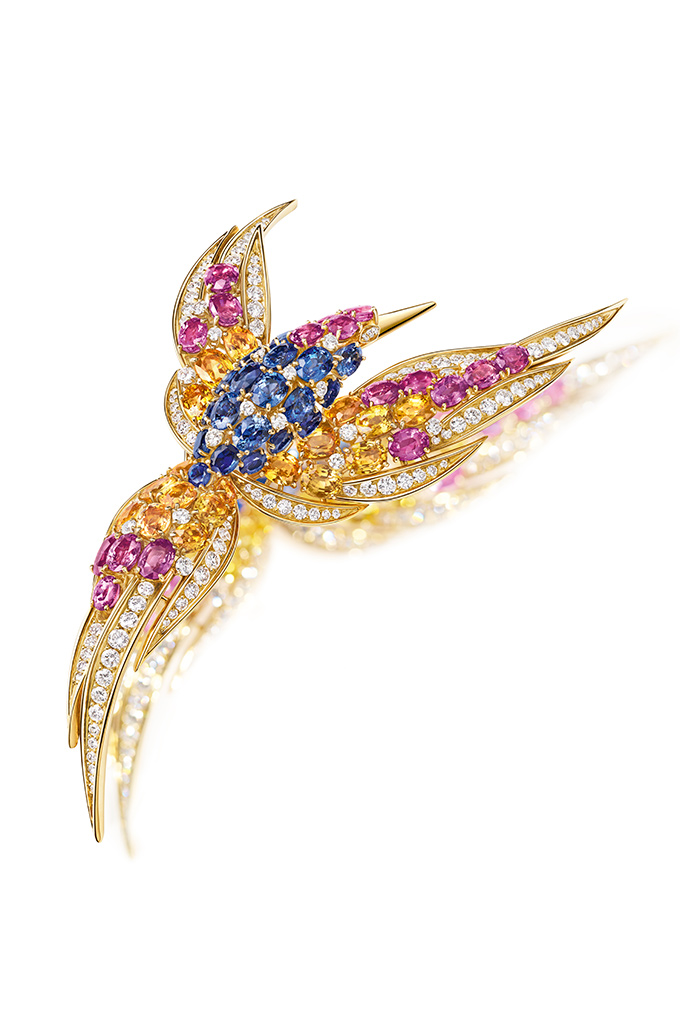
The story of Fred Samuel is inextricably linked to light. He was born in Argentina and grew up bathed in radiant sunlight. As a young man, he moved to Paris, the City of Light, to apprentice with the Worms brothers, expert gemstone dealers who were among the first to embrace the advent of cultured pearls. Samuel wrote in his memoirs: “I was not learning a trade, but learning to love the trade, and even more, to love these stones that both contained and captured light!”


In 1936, Samuel established his own business at the tender age of 28—a move of great audacity. Instead of setting up on the haute bourgeois street of rue de la Paix or the frightfully elegant Place Vendôme, he chose 6 rue Royale a couple of streets away, taking over the boutique and workshops of the famed jeweller Georges Fouquet. When he opened the first Fred Samuel boutique, he had business cards made that described his point of view: Fred Samuel, ‘Le Moderne – Joaillier – Créateur’, or ‘The Modern Jeweller Designer’.
When the Second World War reached France, Samuel was moved to join the fight. He was captured, made a prisoner of war, and escaped in 1940 to return to rue Royale. When he resumed business, he was forced to drop his last name. Fred acquiesced, and even after peace resumed and life returned to normalcy, he kept the four letter prénom that is still the brand’s name today. Later in life, he recalled the choice to go simply by Fred as “perhaps a gesture of defiance”. A matter of semantics, but a big contributor to the maison’s informal and convivial personality.

It was after the war, though, that Monsieur Fred truly found his style. “By some force,” he wrote in his memoirs, “I was drawn to beauty.” He found a new kind of light in the South of France, and inspired by it he invented a style of fine jewels with casual glamour. He opened a boutique in Monaco, attracting famous clients like Marlene Dietrich and Princess Grace. A combination of the French Riviera vacationer’s ease and the Côte d’Azur’s spectacular light has since shaped the house’s bon vivant outlook and earned it the moniker, The Sunshine Jeweller.


In 1966, Fred’s son Henri Samuel came up with the brand’s most famous design. The Force 10 bracelet, named after a category of gale winds, and inspired by yachting cables and carabiners. The Samuel family were and are still avid sailors, and the Force 10 bridged sportiness and sophistication—a rare combination that presaged the world’s turn to casual chic. It’s a simple design pairing buckle and cable, but it summons up images of the Fred mythos: sparkling sunlight on impossibly blue Riviera waters, and a sense of sport and suntanned good health.
“Sometimes, when the Parisian sky weighs a little too heavily over our heads, I find myself gazing at the display case that holds these bracelets,” wrote Fred in his memoirs. His mind would drift to marinas and boats, and he hoped “that all the people wearing these bracelets experience the same sensation”.
A sensation of buoyant joy, indeed, that the bird brooch (pictured above) from 1991 expresses beautifully. Crafted in yellow gold and set with diamonds, and yellow, pink and blue sapphires, the jewel encapsulates something of the elegant free spirit that suffuses the house.

As the maison Fred celebrates its 90th anniversary this year, ‘light’ can be thought of in two ways. As the illuminating force that gives shape to our world, and light as the absence of weight—a légèreté of the spirit that informs the house’s relaxed but elegant style. Decades after he passed his business on to his son, Fred wrote that he would nonetheless remember the whisper-pale pink lustre of the pearls he was so famous for in Paris—a signature shade known in its time as Fred pink. Henri Samuel, father and predecessor of present-day artistic director Valérie Samuel, put it simply and sweetly: “Our philosophy: to craft jewellery seriously, without taking ourselves too seriously.”
The July/August 2026 ‘Audacity’ edition of Vogue Singapore is available to pre-order online.