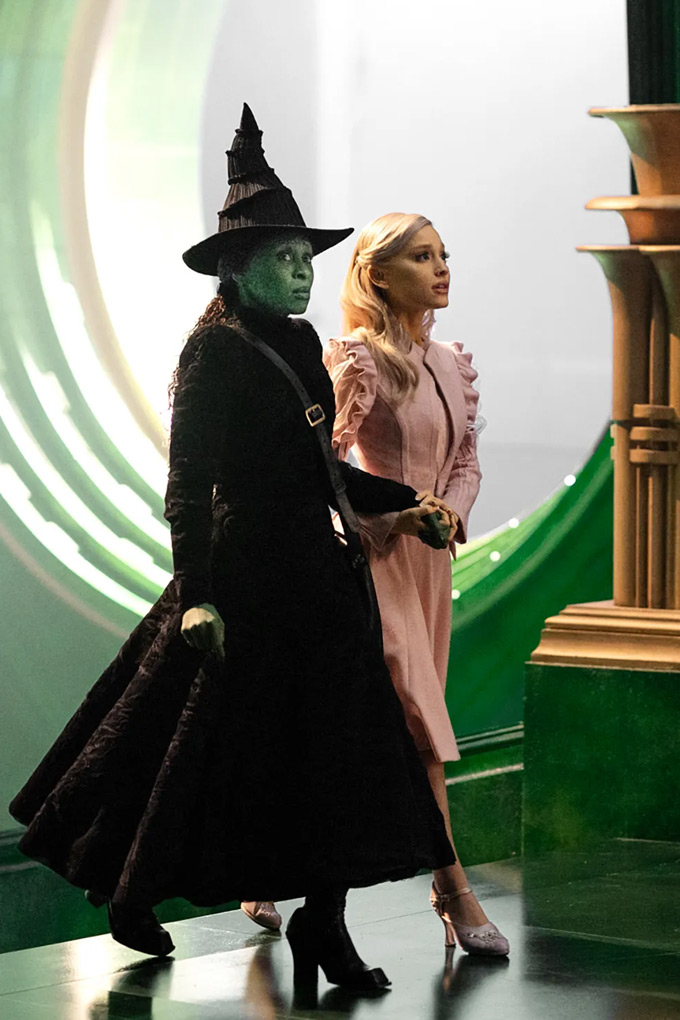
The story of Wicked has become, over time, one simply crammed with astonishing figures—and I don’t only mean the likes of Idina Menzel, Kristin Chenoweth, Shoshana Bean and Annaleigh Ashford. Twenty-one years: that’s how long the show has been running at New York’s Gershwin Theatre. $1.66 billion: that’s how much it’s grossed on Broadway, at time of writing. Twenty-five: that’s how many actors have played Elphaba in that production full-time. (There have been 22 Glindas.) Add to that the 238 costume changes, 226 pairs of shoes, and 84 wigs per performance, and one’s eyes begin to water a bit. It’s a lot—but then again, isn’t “a lot” sort of Wicked ’s whole thing? It’s a big show about the powers of good and evil, with a talking goat, flying monkeys and a spiky love triangle thrown in for good measure.
The team charged with turning Wicked into a two-part movie-musical extravaganza starring Cynthia Erivo and Ariana Grande has certainly embraced its muchness. For costume designer Paul Tazewell (a Tony winner for Hamilton and an Oscar nominee for Steven Spielberg’s West Side Story), the project had three main references: Gregory Maguire’s Wicked: The Life and Times of the Wicked Witch of the West, the 1995 novel exploring the world of L Frank Baum’s The Wonderful Wizard of Oz that inspired Wicked’s plot; The Wizard of Oz, Victor Fleming’s classic 1939 film adaptation of Baum’s book; and the Broadway show itself, with its great Stephen Schwartz score, book by Winnie Holzman (who also wrote the new film’s screenplay) and devoted fan base. “It was important to engage that audience,” Tazewell says, “and not completely redefine what Wicked feels like.”

Like Susan Hilferty, who designed the stage production’s Tony-winning costumes, Tazewell made the earth and the air his lodestars while building the wardrobes of Wicked ’s two central characters: the green-skinned outcast Elphaba, portrayed onscreen by Erivo, and the girlish, blond-tressed Glinda, played by Grande. (Other important players include Michelle Yeoh’s wise and wily Madame Morrible, headmistress of Shiz University, where Elphaba and Glinda meet; Jonathan Bailey’s dashing Fiyero, their shared love interest; and Jeff Goldblum’s charlatanic Wizard of Oz.)
“I had already known Paul for a long time because he had designed the costumes for Harriet”—the 2019 Harriet Tubman drama in which she starred—“and [we] had this deep understanding of what it is to allow a character to express themselves through the clothes they wear,” Erivo says. When she had an idea for Elphaba’s glasses, her pyjamas or her footwear—“I said to [Paul], ‘I would love for the heel of my boot to get higher as we move on in her story’—”he honoured it. She and Tazewell agreed that “No piece of costume is frivolous,” Erivo says. “Everything has a use, and everything is meaningful.”
“You could look at any shoe, any button—you could touch any of them, and they tell our story,” adds director Jon M Chu, himself a longtime Wicked fan who first encountered the show during its pre-Broadway tryout in San Francisco.

This story was originally published on Vogue.com.