It is a testament in and of itself to be known, of course, by just your first name—but also by the captivating aura one carries. Such is the magnetism Tilda Swinton exudes, four decades into her acting career. Today, the 65-year-old Oscar-winning, Scottish actor commands both international acclaim and art-house reverence—an achievement reserved for very few. Dialling in from London, she appears a vision in black, her signature ice-blonde hair cut into a delicate pixie. Her eyes, sharp yet tender, radiate warmth; behind her, sunlight streams through a tall, statuesque window. There is something almost painterly about her presence, at once watchful and gentle.
“It’s been a very satisfying and transformative year,” she begins, thoughtfully. “I’ve managed to—and I’m very blessed to be able to say this—transition into a way of working that I’ve been looking forward to for years. This year, I finally managed to do it. I haven’t actually shot a film this year, and I wanted to take that time off to develop my museum show, work on my book, and write. I’ve actually been able to do all of these things. I’ve been trying for years to ring-fence the time, and it’s a little like turning a big ship around—it takes years of warning.”
Swinton graduated from the University of Cambridge in 1983, carrying with her a torch for performing through student productions and, later, with the Traverse Theatre in Edinburgh and the Royal Shakespeare Company. Her theatrical beginnings opened the door to something far greater, a spark that ignited with her first film, Caravaggio, which traced the life and inner world of the Italian Baroque artist Michelangelo Merisi da Caravaggio. It was here that she forged a long and organic collaboration with the late visionary artist and filmmaker Derek Jarman and one of her closest friends, celebrated for his singular art films and, in particular, his explorations with Super 8mm shorts, a medium that would become his signature.
“The three things that really fulfil me, that will never let me down, are fellowship, nature and art. These are the three beating hearts that I feel keep me going.”
“I met Derek Jarman and the friends we worked with when I first moved to London and started working. Those people, some of whom I still work with now and who are my dear friends, we all drank from the same artistic well, which was a long tradition of a kind of artistic sensibility that went way back through the ’70s, through the ’50s, through the ’30s and all the way to William Blake. You know, there was this—not exactly a tradition, but a wiring—which we recognised. It was about fellowship and camaraderie. So I think between the two, that’s the earth that I’m planted in.”
Swinton would go on to collaborate with Jarman for nine years, appearing in every project from 1986 onwards, from The Last of England to Blue. Together, they forged a rare and electric synergy, weaving non-linear narratives that explored the profound, the difficult and the wildly imaginative. Their work ventured boldly into queerness, politics, sex, identity and desire. Everything they created was an attempt to capture the extraordinary, with characters larger than life, existing on the edge of reality and imagination.
“The most challenging moment was when Derek Jarman died, because I had worked with him for nine years in this very particular way,” Swinton reflects with a soft tenderness. “I mean, it was completely pre-industrial. It was not what you might call acting. It was not professional. We were just messing around most of the time with a Super 8 camera. Every so often, we’d make a 35-millimetre film, which meant pulling together a crew, a budget, a script, costumes—and actually playing parts. It was formal in its own way, whereas most of the time, what we did was wonderfully informal and experimental.”
She adds: “But when I worked with him, I really couldn’t imagine working with anyone else. So when he died of AIDS in 1994, that was a huge challenge, because apart from losing my best friend, I also lost my way of working, and I didn’t know whether I was going to be performing. I thought, well, how can I do what I do with Derek, with other people? Aren’t you supposed to be a proper actor? Aren’t you supposed to operate in some kind of professional way? And the miracle, really, is that other people did come towards me at that point, and I slowly built up other families. I’m very, very proud to be able to say I have a number of families now that I work with quite regularly in an ongoing way, even after he left, which is amazing.”
It was Sally Potter’s Orlando that placed Swinton firmly on the international map. Loosely based on Virginia Woolf’s 1928 novel Orlando: A Biography, the 1992 fantasy-romance film traces English history through the journey of an aristocrat who lives for 400 years—as a man, then as a woman. It was the role that showcased the full breadth of her depth and range, particularly in exploring gender identity and dissolving boundaries on screen. The performance cemented Swinton’s reputation as a creative chameleon, bringing with it a certain cachet of artistry and experimentation that drew the attention of a global audience.
With a touch of softness, she recalls the memory of sleeping with Virginia Woolf’s Orlando beneath her bed at 15. Swinton recognises the trailblazing nature of the work she created with Potter, noting that radical costume dramas were scarcely the norm at the time. This instinct for treading the line between convention and experimentation continues to define her work today—most recently in Tilda Swinton: Ongoing, both a book published by Rizzoli in late September and an exhibition at the Eye Filmmuseum in the Netherlands, running from 28 September to 8 February 2026. Each offers a lens into her deeply collaborative and synergistic spirit.
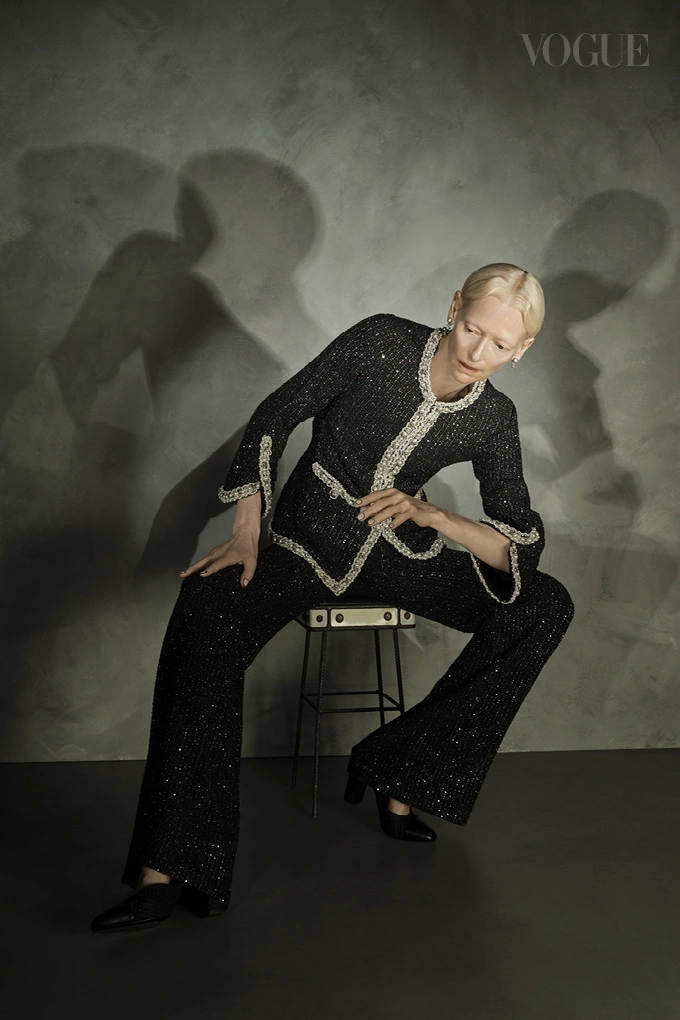
“I think what I might be able to offer is an example of someone who has worked for 40 years in a collective way—in a way that I think we’re encouraged to believe is not possible. You might think it’s possible to work like that for the first few years of your life, but then, once you find your feet, you cut away from the herd, go solo and become a brand. I’ve never done that. I’ve always been in a team, and these teams have grown out of a series of very, very nourishing—genuinely nourishing, I would say—sustaining relationships. Working relationships with people I’ve gone on to collaborate with, some of them for decades. And that’s why I call the show Ongoing,” she reflects.
“I set the museum a challenge. I said, I’ll do it if I can commission new work from these collaborators. And they said, ‘Yes!’ So I asked Apichatpong Weerasethakul, Joanna Hogg, Luca Guadagnino, Olivier Saillard and Tim Walker to make new work. Jim Jarmusch and Pedro Almodóvar were both shooting films at the time and couldn’t produce new work, but we made an intervention with Jim Jarmusch’s The Dead Don’t Die on two screens. And at the very end of the show, we built a little cinema and screened Pedro Almodóvar’s The Human Voice—a 30-minute film we made during the lockdown,” she shares with a glint in her eye. This spirit of collaboration extends naturally to Swinton’s longstanding relationship with fashion—as a muse and creative force. Her association with Chanel began in 2013, when she became the face of the maison’s Metiers d’art Paris–Edimbourg collection, appointed by the late Karl Lagerfeld. The fit, clearly, has been an enduring one.
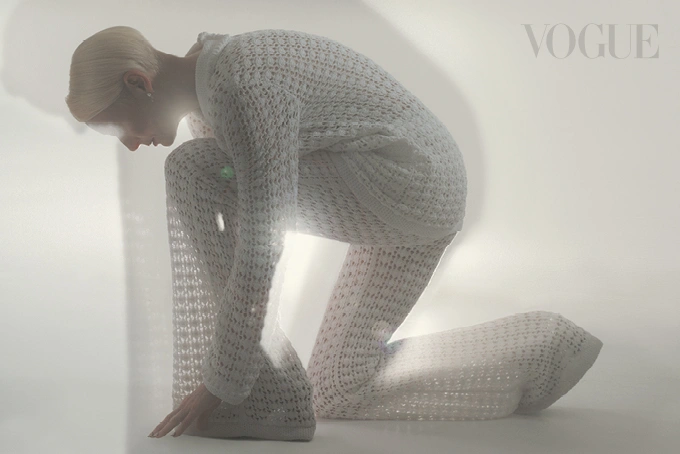
Now serving as a Chanel ambassador, her role embodies a commitment to championing the arts at large—through her involvement with the Chanel Culture Fund and the BFI & Chanel Filmmaker Awards. It is, perhaps, one of the most exciting moments for the maison: a period of cultural renewal and reinvention under its new creative director, Matthieu Blazy.
“What Matthieu is bringing with him and what he’s inspiring within the house and in the world—as the world sees what the house is supporting him in doing—is extraordinary. With this show, this collection that he presented, most of those pieces could have been made by Gabrielle Chanel herself. It’s gone right back to the code, and yet he’s spun it with such a fresh eye and such a fresh touch. It feels so light, so hopeful. Matthieu has, for many years, been the power behind so many great designers. And this is his moment now. He really knows how to cut; he really knows how to make. He’s a maker. And Chanel was a maker. I cannot wait to see what he does with couture.”
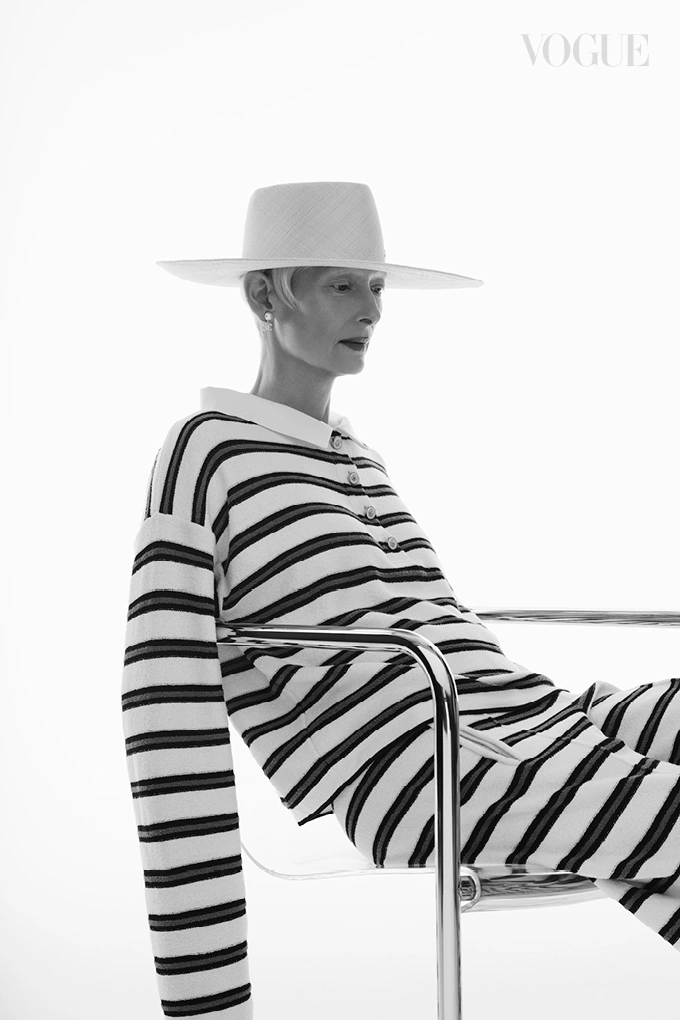
This November, Swinton will be visiting Singapore for the first time for Chanel’s re-showing of its Cruise collection, originally unveiled at Lake Como in April—and she speaks of a blazing excitement. It has been a year of richness for her—in art, in film, in culture, in essence. Yet, at her core, there remains a quiet appreciation and a focus on nourishing herself. Our conversation settles on the theme of legacy, something Swinton has effortlessly carved without having to overthink. We linger, too, on the idea of ongoing—a word that seems to live on in Swinton herself.
“It’s really about process. It’s not about finished work; it’s about what it is to be a young person finding your way. Joanna Hogg and I were going to make a film, but we decided instead to reconstruct my first apartment in London. It’s all about the experience of being a young artist trying to find an artistic practice. And I think if anybody’s expecting lots of bells and whistles and glamour, they might be disappointed. But what I hope they’ll find is something very modest. And my real hope is that people leave—particularly young people—and say, ‘It’s very simple. It’s very straightforward to make work. Maybe I’m going to do it’.”
And as for what truly nourishes her? “Nourish is a word I love and that I use a lot. It’s a concept that I hold very dear as a sort of essential impulse. The three things that really fulfil me, that will never let me down, are fellowship, nature and art. These are the three beating hearts that I feel keep me going.”
Editor-in-chief Desmond Lim
Photography Sølve Sundsbø
Styling Jerry Stafford
Hair Malcolm Edwards
Make-up Val Garland
Manicure Jenni Draper
Production Farago Projects
Executive producer David Bay
Set design Tom Conant
Hair assistant Karen Bradshaw
Make-up assistant Paula Maxwell
Stylist’s assistants Suzanna Snow and Felicity Flick
Photographer’s assistants Michael O Williams, Matt Davies and Finbar Taylor Jones
Digitech Lucie Rowan
Tailor Nafisa Tosh
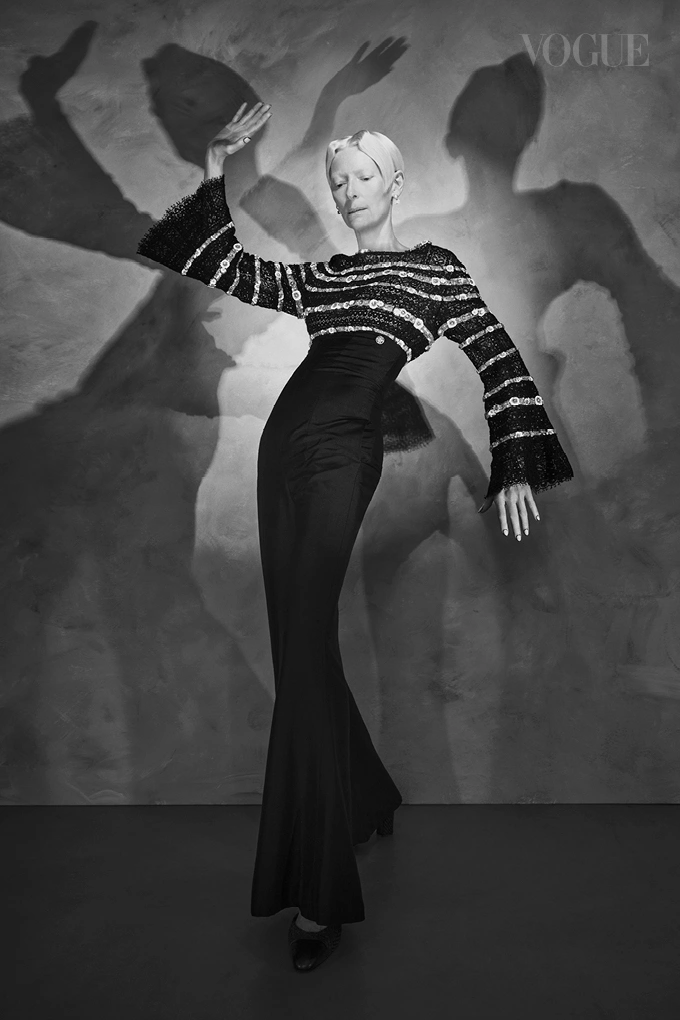
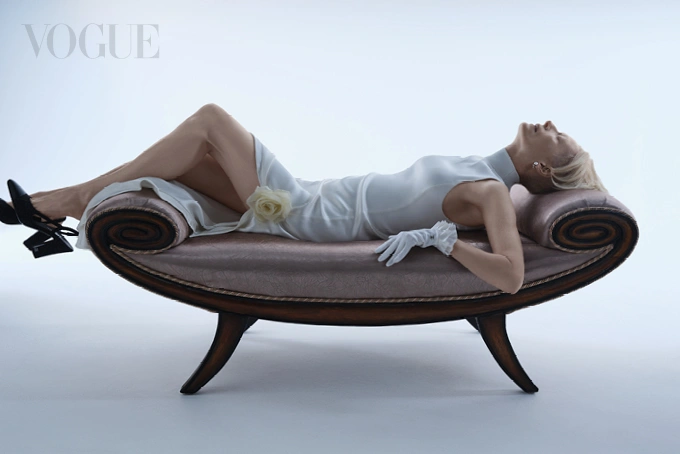
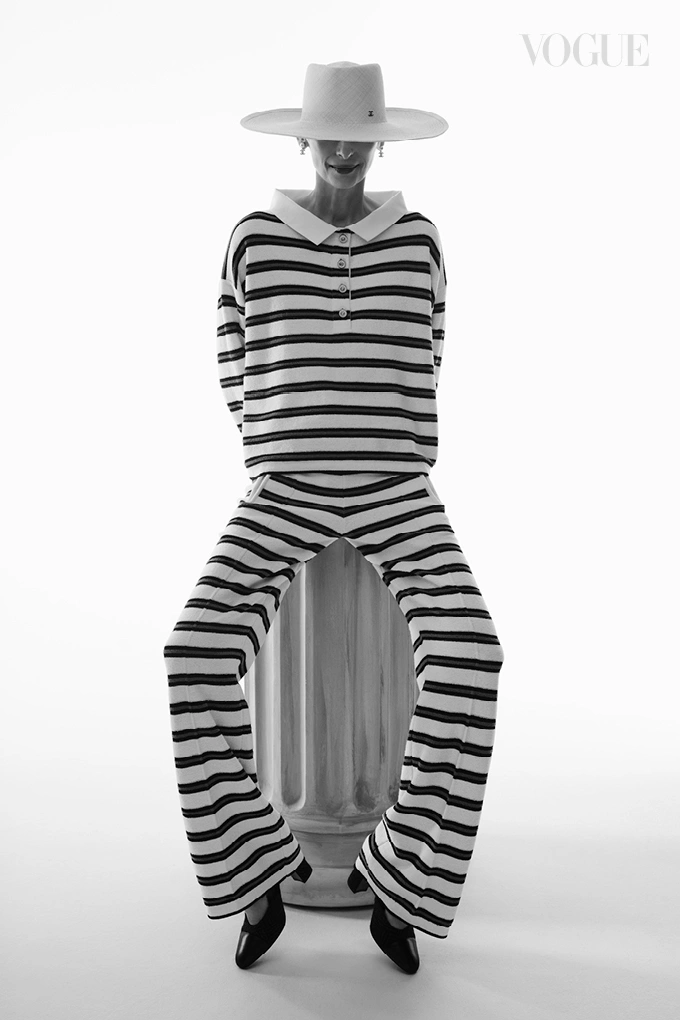
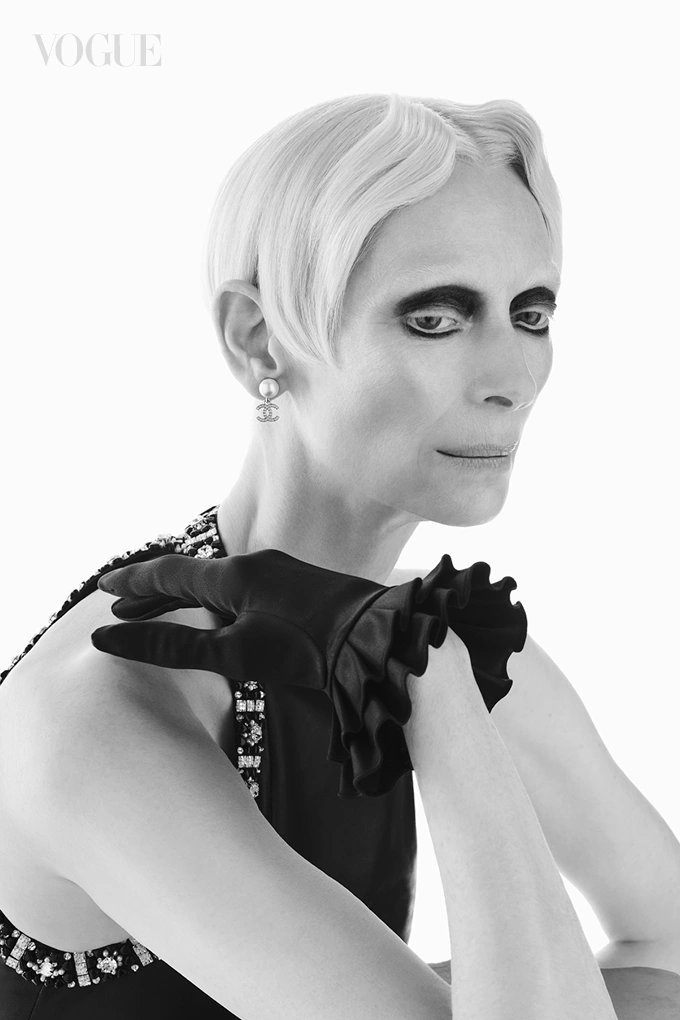
Swinton wears Chanel clothes, shoes and accessories throughout.
The November issue of Vogue Singapore—themed ‘Nourish’—is available to pre-order online and on newsstands from 14 November.