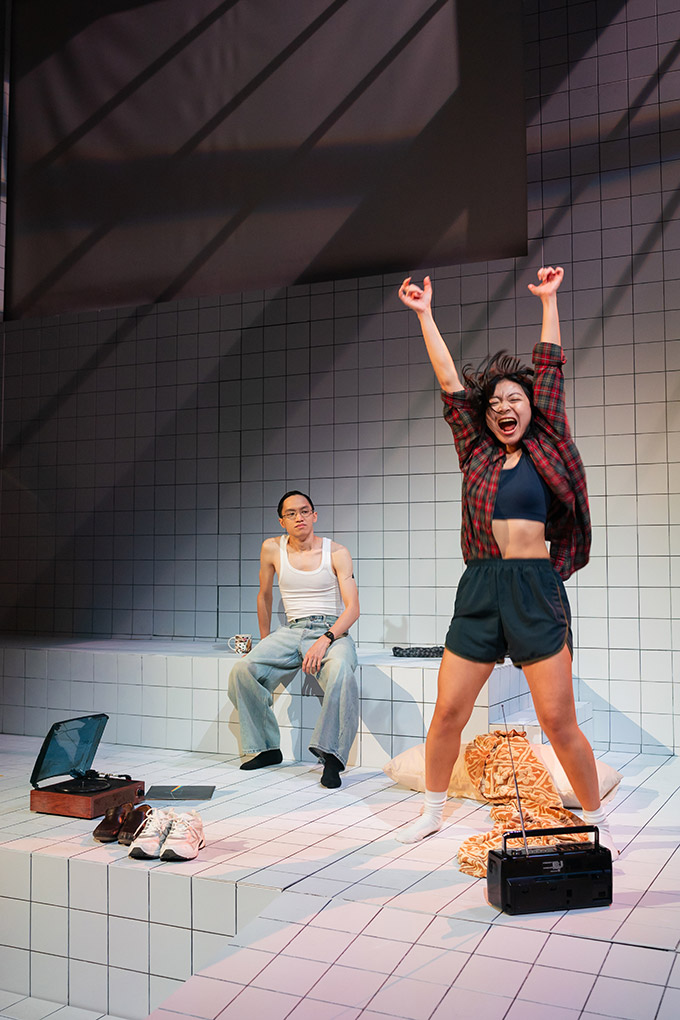
The year is 1993 and 16-year-old Candice wonders why everything looks so grey. The city pales in comparison to the world of sex, drugs and rebellion she sees from glimpses of MTV and alternative magazines. Her religious, conservative mother burns all her tapes and magazines in a fit of moral panic and Candice snaps. She embarks on a night-long bender to discover the wild, unruly side of Singapore she longs to be a part of.
It’s a riot of a play, one that walks a fine line of comical theatrics and striking introspection. The script outlines candid teenage hysteria with a hyperlocal colloquialism that’s a nostalgic reminder of younger days, while the sobering ending lands with the unsettling realisation of the unfortunate consequences to one’s actions.
Playwright Joel Tan models the main character Candice—played by lead actress Coco Wang Ling—after his kindergarten school bully, who lived in Serangoon Gardens. He sets the premise of the play in the 90s, when Singapore was on the precipice of leaning heavily liberal or conservative after a political shift. Pop culture was gaining prevalence, and local music acts and creative freedom ensued. “But soon after, there was a series of bans on things like performance art, chewing gum, and a cultural lockdown of sorts was implemented. We were intrigued by this amorphous period of the 90s and that’s why it was set in 1993,” quips Sim Yan Ying “YY”, the play’s director.
As the curtains rise, Candice’s yearning for perceived freedom and discovery of a bigger world out there is expressed with a fiery gusto. Below, YY and Wang both share their creative process, meaningful audience interactions and how their own stories are weaved into the threads of The Serangoon Gardens Techno Party of 1993.
Congratulations on the opening of the play! How does it feel now that the show has opened?
Coco: It’s really satisfying to finally have an audience to share the play with. We were worried people wouldn’t understand the gist or find it funny. Seeing them resonate and see much of themselves in the piece and the characters is refreshing. A part of the audience enjoyed it because it’s hilarious, punchy and highly engaging. But there’s also a quiet rage that people resonate with, it’s almost uncomfortable. It sits with them in a really deep place and they see themselves in the main character Candice, understanding why she does the things she does from a different perspective.
What was the creative process like in bringing this play to life?
YY: After the casting process and initial roundtable discussions, the cast and crew gathered again for a three-day ensemble workshop. The actors experimented with the script, trying out different kinds of performance languages they felt fit the scene. It was very free-for-all–we gave the cast free reign and trusted them to make creative decisions on their feet. Much of it eventually made their way to the final stage and contributed to the overall shape of the play. This was helpful for me as a director because I could process these takeaways and re-synthesise before weaving everything into the final rehearsals.
Coco: Before this play, I had never been part of a process where the sound design was so integrated into the rehearsal. The multimedia elements typically come in a week before the show starts and as an actor, it can be quite jarring because these elements re-inform the show and performance at the last minute. I’m very grateful that we spent more time with NONFORM, the multimedia sound designers, during rehearsals. It was pivotal in the whole creative process leading up to opening night. I think it coloured the scene and gave it more weight.

Themes of freedom, self-discovery and conformity underscore the play. How do they resonate with you?
Coco: I left Singapore to study theatre in Melbourne, and I felt so liberated there. Everybody created so freely, whereas back home, media restrictions were constantly at the back of my mind. I remember having to come back to Singapore and feeling trapped. But as an actor, I realised that I can’t quite set my career here if I don’t give it a chance. So I made a commitment to myself and learned that there is heart in making art in Singapore. You learn to take the limitations as perimeters of freedom and get even more creative. It wasn’t necessarily very difficult for me, Coco, to tap into Candice’s angst and frustration of wanting to want more out of this country, but as Coco, I’m also learning that this country and its people have so much to offer.
YY: It’s interesting because upon reading the script, I thought to myself, “oh my God, I’m Candice!” I related so much to the character and many others have also articulated the same sentiments. It’s not every day you see such an unhinged character like Candice on stage. Joel and I have jokingly termed it as a siao zha bor play. It’s really for the those out there who feel stifled and trapped by this environment, but also for those who know a people like that and are trying to see them a little more clearly and understand why they do the things they do. It’s a visceral experience in terms of experiencing her energy. I think most of us feel repressed and feel that sense of conservatism pervading this society here. Some people feel it more acutely than others, and those are the Candices in this country.
Serangoon Gardens Techno Party 1993 is set in 1993 but still relevant for today. How does that reflect Singaporean society of the past, present and future?
YY: With social media, you now have more access points beyond governmental control to find these areas where you can feel free and true to yourself. I feel like the past-present-future, or the past and present at least, of our society is that Singapore conservatism is still present—just in different ways and forms. In the future, I hope we will be allowed to fight for the causes we believe in and focus towards issues like that.

Coco, the play also dissects Candice, her role in society and the relationships with those around her. Are the dynamics between the characters any indicator of the culture of that time?
Yes, definitely. We see Candice’s mother being really religious and conservative. She represents a future that Candice does not want for herself. It’s something that’s imposed on her that she’s desperately trying not to become. She also has her idol–a radio DJ she listens to every night that represents hope of a bigger world out there. As she embarks on her wild bender, you also see the 16 year old in her come through–the naivety and wishful thinking that life is bigger and greater than it actually is. She also meets a Caucasian teenager who represents her ideas of Western culture that she’s been fetishising.
YY, the play sheds light on social rankings and the class system as well. How does that play a part in the way the characters see the world and their perspectives?
I think that’s primarily reflected in the characters Candice and Jun Hao’s relationship. He is a 21-year-old policeman who lives in a one-room Toa Payoh flat and signed on young enough because he needed an iron rice bowl, whereas she is this 16-year-old living in a landed property in Serangoon Gardens and has the money to buy anything she wants. This power dynamic between these two characters is really interesting because she’s a teenager and he’s a legal adult, and PSLE was his highest education level while she was on track to be a university graduate. She also comes from a wealthier background while he did not. In the show, we see her get away with a lot. She has the opportunity to escape her wrongdoings and start over with a new life, while Jun Hao is essentially trapped in Singapore and has to face the consequences of his actions. So it’s that intersectionality of gender, class and education level that explores this.

Coco, this is your second performance run at Wild Rice after HOTEL! How does it feel being the lead this time?
It’s been incredible. I’m very grateful to have been able to do both these incredible productions. Working with an ensemble and doing HOTEL! actually gave me a lot of confidence to take charge of Candice in this work. I was able to come in with a fearlessness that I know my nerves would typically get the better of. Compared to HOTEL!, The Serangoon Gardens Techno Party of 1993 was much more physically and emotionally taxing. It’s been a really fun journey preparing to take on the lead. There’s a certain kind of endurance being in character throughout the whole play and journeying with her because as the scenes go on, she gradually gets more deranged and I feel the impact.
What is the most memorable scene in the play for you?
Coco: There’s a scene at the end where Candice climbs high up a ladder and she’s got this beautiful monologue that Joel has written. It’s sort of the climax of the story where she breaks and she thinks she has made it. That image of her looking down, literally above ground and being in a state of euphoria feels very powerful.
YY: For me, it’s the scene where she escapes to Perth. The walls of her new apartment come down behind her and she’s alone in a new country, taking in the unfamiliar space and it feels like everything that happened was a fever dream. The events in the play took place in 24 hours, and with no social media at the time, everything existed purely in memory. With no physical traces to remember it by, there’s a hazy doubt it ever happened. But as the walls come down on her, she goes to a radio that is playing her theme song that’s heard throughout the play, and turns it off. A scrim proceeds to roll down, and the words The Serangoon Techno Party of 1993 is projected on it. I felt it was a very quiet but beautiful moment in the show.
Is there anything about the play that the audience might not notice but should look out for?
Coco: The costumes! It tends to be the most overlooked part of stage design. Our costume designer Johanna has done a wonderful job. In the past, convent schoolgirls would wear their pinafore belts really low, while some would hem their skirts to be a little shorter or tuck their shirts in a certain way. All these tiny details were considered in our costumes to really reflect the time period the play was set in. It’s these things that you don’t necessarily think is intentional but those who share these lived experiences would recognise and resonate with it.
YY: I think it’s the adult version of Candice actually. We are so taken by young Candice’s journey and trajectory, and she’s so funny and interesting to follow. But I think it’s her older, mature voice and the burden of her guilt that leads to her seeking closure that’s often missed. Some of the audience have managed to access that and when they do, it adds a layer to the play that’s really poignant and important to the work as a whole.

What do you hope for the audience to take away with after watching the show?
YY: If there’s one thing I hope people will experience is that the Candices of Singapore and the world will feel seen. That they don’t feel so alone in their crazy demeanours, and people who are not Candices to understand the Candices a little better, whether it be their energy or the endearing nature for the pureness of heart they have.
The Serangoon Gardens Techno Party of 1993 runs from 17 October to 1 November 2025.