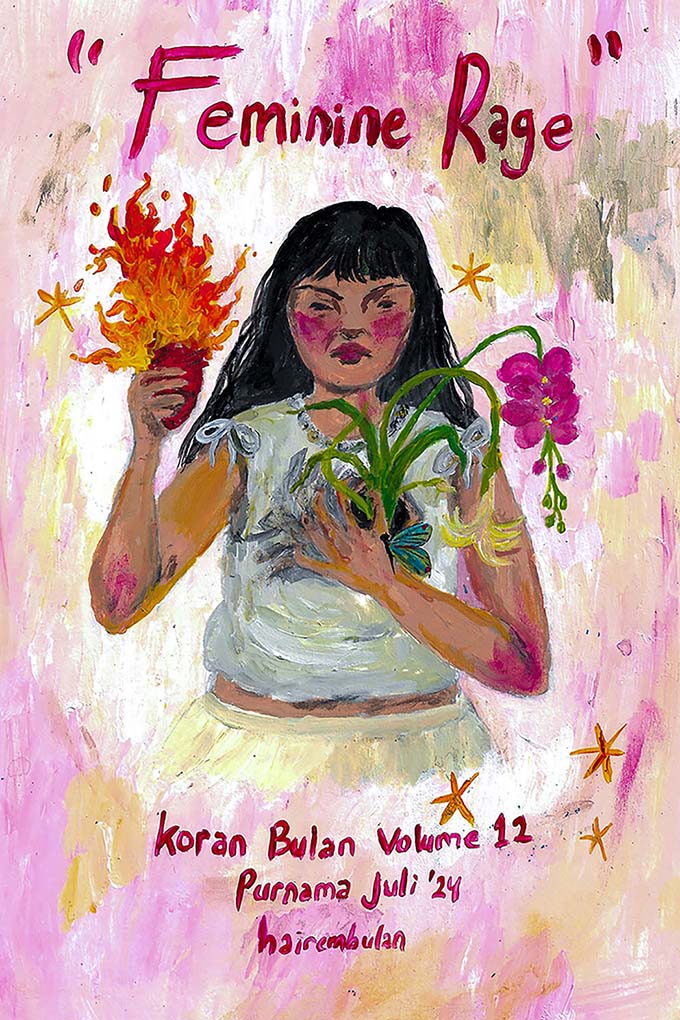
Artefacts of her life. That is how Indonesian artist and zinemaker Hai Rembulan describes the more than 70 zines she has crafted since creating her very first one. A self-taught artist, Rembulan’s introduction to the vibrant and underground world of zine-making opened up a universe of creative freedom and personal exploration. Since then, her zines have become intimate chronicles, capturing the complex layers of her existence with a sincerity that feel increasingly rare—even within the indie zine community today.
Expressed in vivid technicolour and marked by a raw, unfiltered honesty—her work spans a rich tapestry of themes. From her ongoing journey of self-discovery and her unapologetic queerness, to her deep connection with the natural world, every page beats with real life and emotion. Interwoven among these reflections are lighter moments—like gentle, innocent musings on the antics of her beloved cats—a reminder that her zines are not only a personal archive, but a colourful portrait of how she sees the world.
In a world where such personal stories can often be overlooked, Rembulan’s work stands as a bold celebration of authenticity and belonging. For Vogue Singapore’s October issue, she reflects on the enduring support system of the indie zine space, a space of solidarity, resistance and kinship.

1 / 5
Is there a specific community your zine speaks to most?
As all my zines are personal and political, I feel a strong connection to stories about women, queer people, marginalised communities, the working and lower-middle classes, and the Sundanese.

2 / 5
What inspires you most in the art of zine-making?
The real world is a fundamental source of inspiration for me. My past and present, nature around me, a childhood memory of a starfruit tree, the cats that taught me intersectional love. Dreams are another big source of inspiration for me. They can be the ones experienced in my sleeping hours or simply my hopes for the future. They can even be the dreams of the fantasy worlds I create: of fairies, tree spirits and horses that can speak. They’re all important inspirations that balance out my art-making process. Sometimes I might need a medium to channel more worldly fears into a zine. Other times, I’m sick and tired of the world and my dreamland helps me believe and hope again.

3 / 5
What is something you won’t compromise on in a zine?
The most important elements are honesty and courage. Zines are getting more varied now, but it’s important to remember that zines have always been a safe, alternative space for people to share their stories and be themselves. Whenever I finish a zine, I always sit with it and ask myself if I have been honest with myself and safe with the content I’m creating. That final thought process is equally as important to me as the creation or distribution process.

4 / 5
What are you most drawn to when looking at other zines?
I am interested in personal zines, especially the ones that are made by women, queer people and marginalised communities. Up till today, I still have to remind myself that I am not the only one who is brave enough to speak up and be vulnerable in a zine. So when I read other zines that share similar narratives, I feel a sense of solidarity that strengthens my belief in the narrative choices I make for my zines.

5 / 5
As a zinemaker, what does kinship mean to you?
In 2015, I made a weekly zine to cover the medical treatment costs for a kitten that I had found in a dumpster and an old cat that had a miscarriage. Because of those weekly zines, I can say that I’ve been able to rescue cats, become a full-fledged artist and have made friends in every part of Indonesia. I live because of zines. Not all zines have the same sort of narrative, but kinship is the initial breath of zines. So, by making, creating and buying zines, we can create the same bond—to live freely.