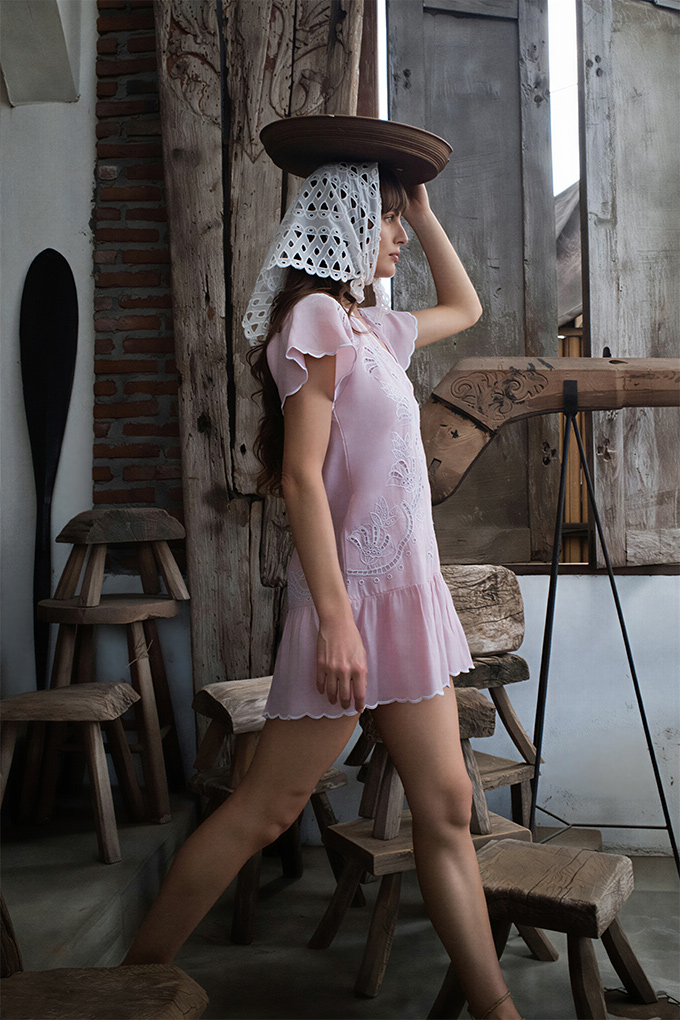
Behind the visual refinement that is signature of Bangladeshi brand Maison Amali, is quite simply, many man hours. Some gowns, crafted with over 22,000 beads took over 300 hours to create, with thoughtful curation at the core of the label’s ethos. With a commitment to mindfulness and durable, yet delicate craftsmanship, each garment has been made to elevate a woman’s innate radiance, one thread at a time.
Founded and designed by Shagufta Ali, each intricate detail is made entirely by hand. Raised in a South Asian hub of fabric, industry and garmentry–Bangladesh is the second-largest global exporter of clothing, Ali studied law to “understand systems of power and do something meaningful for women.” She also gained an education at Istituto Marangoni, London (ranked in the Top 10 fashion schools by Vogue Business for international career trajectories). In the law discipline she learnt structure and “how to think with precision”, whereas fashion taught her how to emote. Maison Amali is where those two worlds collide and co-exist.

Collections of razor sharp tailoring, embellishments and flair with restraint come to life not from a sketch but a question. Ali asks herself: “How will a woman feel when she wears this?” A recognition that every woman is unique, with their own essence of style is part of the young couture house’s allure. It is this focus on individual pieces and a sustainable, made-to-order model that truly makes Maison Amali distinctive in a deluge of mass market retailers. Pre-consumer waste, landfill fodder and deadstock are eliminated as the garments are fabricated in close collaboration with skilled artisans for each client on request.
Despite only being established less than two years ago, the brand continues to gain recognition within Bangladeshi and wider South Asian communities. Celebrities such as Rakul Preet Singh, Bhumi Pednekar, Bidya Sinha Mim, Diana Penty and more have chosen to support Maison Amali. According to the label, while “Bangladesh clothed the world, it lacked fashion houses that celebrated women as powerful figures, dressed not only in tradition, but in confidence, structure, and bold self-expression.” Maison Amali has seized that opportunity with gusto. We chatted with Ali to discover more about this fresh, new perspective.

You describe how honouring heritage is so important to you. How did growing up in Bangladesh impact your design aesthetic?
Expressing oneself through art is deeply rooted in Bangladeshi culture. Creativity was never separate from life, it was woven into it. My grandmother played a significant role in shaping my understanding of art and heritage. She began designing and making her own clothes as a teenager, and was quite the fashionista for her time. She created outfits for me when I was a child, and as I grew older, I watched her carefully select wooden blocks and hand-print her own saris. Block printing is one of the oldest traditional textile techniques in Bangladesh, and witnessing her practice it was my first real introduction to craftsmanship. She would take me to cultural and book fairs, she introduced me to Rabindra Sangeet, and taught me about hand embroidery. Through her, I connected with my heritage in a deeply personal way. She made me realise that culture is not confined to textbooks, it is something you live, wear, and express.
Later, my education in fashion school helped me understand the global value of authenticity and legacy craftsmanship. The true essence of my background is reflected in my work through hand techniques, beading and embellishment. These elements do not overshadow the contemporary nature of my designs; rather, they elevate and strengthen their presence. It can be seen in the threadwork, the intricate detailing, the age-old techniques, and the carefully placed motifs, each chosen with intention and respect for tradition.

The apparel manufacturing sector or ‘rag trade’ is a huge contributor to Bangladesh’s GDP. What is your stance on fast fashion as someone who is an advocate of conscious fashion?
My stance on fast fashion is that it is part of a global evolution, but one that must be managed responsibly. While fast fashion is a significant contributor to Bangladesh’s GDP, the responsibility for its impact does not lie with one country alone. It is a global system driven by international demand. Most garments produced in Bangladeshi factories are not made for the local market; they are manufactured for export. Ironically, many of the clothes labeled “Made in Bangladesh” are rarely available within the country itself. Instead, they are shipped abroad and later purchased at higher prices in foreign markets. This highlights how deeply interconnected and globally structured the fast fashion industry truly is.
If there is a meaningful global shift in the demand for fast fashion, Bangladesh’s economy will inevitably adapt. Change in consumer perspective will encourage the growth of more conscious brands and emerging designers who can redirect revenue toward sustainable and ethically driven practices. Fast fashion, as it stands, should not be blindly supported. Beyond its strain on natural resources and contribution to climate change, it diminishes the intrinsic value of fashion, reducing creativity and craftsmanship to mass consumption. My academic focus has been in luxury fashion, as fast fashion never resonated with me. However, I believe extremes are rarely the solution. There must be balance, an industry that is both economically viable and environmentally responsible, creative yet conscious.
“Fashion plays a significant role in a woman’s confidence and sense of self. It influences how she is perceived by the world and how she perceives herself.”
Why did you want to pivot from law to fashion?
Fashion has been integral to my identity for as long as I can remember. Like my grandmother, I began designing my own clothes while I was still in school because I couldn’t find anything in Dhaka that truly reflected who I was. Designing became my way of expressing myself, of shaping my own narrative through what I wore.
However, fashion was not considered a conventional career path in my family; it was seen more as a hobby. At the same time, I was deeply drawn to women’s empowerment and creating larger spaces for women to thrive. Law felt like the natural path toward that purpose. Law school was transformative. It shaped my discipline, strengthened my voice, and made me the woman I am today. Through that education, I discovered that advocacy is not confined to a single profession. It can be woven into whatever path feels most authentic. I realised that what came naturally to me, fashion, could also be a powerful platform for empowerment.
Fashion plays a significant role in a woman’s confidence and sense of self. It influences how she is perceived by the world and how she perceives herself. Understanding this made my pivot clearer. Transitioning from law to fashion was a difficult decision, but it has been the most rewarding one, because it allowed me to merge purpose with passion.
The main question you ask yourself before you start a collection is “how will this make a woman feel”, but what do you want them to feel?
I want her to feel self-assured. I want her to embody her most confident self. I want her to feel as though she does not need to conform to anything or anyone, like she can command a room with poise and purpose. My designs should uplift her. They should not change her personality, but rather enhance it. Fashion, to me, is not about transformation into someone else, it is about refinement and elevation of who you already are. Each piece should serve as an extension of your strength, not be a disguise.

Your designs play with the duality of “softness supported by strength” and offer a “new language of femininity from Bangladesh.” Can you tell us more?
In Bangladesh, femininity has long been central to how beauty is perceived. For years, this aesthetic has shaped a singular and widely accepted perspective of women’s fashion, often reflected through soft, flowing silhouettes and predominantly traditional attires. My approach is not about introducing masculinity into womenswear. It is about introducing structure, a certain strength that anchors you at your core. It is about creating a new language in fashion that feels powerful without compromising femininity.
Each design seeks to balance these elements intentionally. Structured shoulders, defined hips, monochromatic palettes, and tailored silhouettes communicate strength and presence. At the same time, intricate embroidery, cinched waists, deep necklines, and feminine cut-outs express softness and sensuality. The dialogue between these two energies is where the identity of the brand lives. For me, it is not about chasing trends or creating something merely “unique.” It is about reinterpreting and amplifying classics, refining timeless silhouettes with depth, intention, and a modern sense of power.
Meticulous craftsmanship is very visible in your work. Is patience essential for both designer and client in producing a sustainable garment?
Yes, it is extremely important. Our goal is to create garments that clients can cherish, reuse, and keep for years, pieces that are not confined to a single occasion. To achieve this, clear and often continuous communication between myself, my team, and the client is essential. From customisation options and exact measurements, to modesty preferences and personal details, every aspect is thoughtfully discussed and considered.
Because each garment is made-to-measure and handcrafted, the process can take weeks, sometimes even months for more delicate and intricate pieces. It requires patience on both sides: patience from us to create with dedication, precision, and heart; and patience from the client as they anticipate wearing something made especially for them. In the end, that shared commitment is always worth it, seeing the final creative outcome and, most importantly, the satisfaction and joy of the client.

Can you tell us more about your material philosophy? E.g. What fabrics or embellishments do you prefer to use?
We prefer to work with a considered mix of silks, heavy crepe, and net, depending on what each design requires. The combination allows us to create varied textures while reinforcing our core concept of strength balanced with femininity. Fabrics such as net and silk naturally evoke softness and fluidity, embodying femininity. In contrast, heavy crepe offers a matte, structured, and more formal finish that introduces depth and strength to the silhouette. In terms of materials and embellishments, we integrate both traditional and contemporary elements. Traditional techniques such as zardozi, dabka, resham embroidery, tambour and kasab thread. Alongside these, we incorporate modern details like crystals, pearls, and beadwork to create a refined yet relevant aesthetic.
Talk us through your opinion on the favouring of “output vs authorship” or “speed over precision” when it comes to fashion in Bangladesh typically…
Bangladesh’s garment factories operate within a system that prioritises speed over precision, largely because they supply international brands that demand high-volume production within tight deadlines. However, this export-driven model does not define or dictate fashion within Bangladesh itself. The local fashion landscape is shaped by homegrown brands and designers. Many of them give precedence to output over authorship, often producing similar styles without a distinct signature or clear creative vision. In my opinion, there is a general reluctance to take risks or explore unconventional ideas.
Traditional attire remains the dominant focus, yet even within that space, there is limited experimentation or storytelling. While tradition is preserved, it is not always reinterpreted with depth or innovation. When it comes to the balance between speed and precision, most local brands still lean toward speed. Only a handful emphasise craftsmanship and detailing, and even then, that commitment to meticulousness is often seasonal rather than foundational.
Your couture team is grass roots. Why did you want to avoid importing skills and focus on the local instead?
I wanted to harness the craftsmanship of hand embroidery and embellishment that have been passed down through generations in Bangladesh. These techniques carry a depth of heritage and skill that is unmatched, and I wanted to ensure they remained a central part of my work. When it comes to tailoring, our local artisans are exceptionally skilled. What was missing, however, was exposure to a different style and design language, one that had not been widely introduced in Bangladesh before. By sharing this approach, I aimed to expand their creative horizons, while respecting their expertise.
Building a local team was important to me not only for creating garments, but also for nurturing a broader ecosystem. I wanted this practice to feel accessible, to encourage more people to learn, share, and grow with it. The goal was to ensure these techniques thrive and evolve, rather than remain exclusive or gatekept.
“I wanted to harness the craftsmanship of hand embroidery and embellishment that have been passed down through generations in Bangladesh. These techniques carry a depth of heritage and skill that is unmatched, and I wanted to ensure they remained a central part of my work.”
How has your made-to-order model been instrumental in your business and your principle of investment in artistry and legacy?
For Maison Amali, the made-to-order model is far more than a production mechanism, it is a strategic expression of the brand’s values. By eliminating overproduction, it protects gross margins and preserves pricing power, ensuring the integrity of the brand is never compromised by excess inventory or discounting. Limiting volume reinforces exclusivity, while the element of wait time becomes part of the desirability, transforming acquisition into an experience rather than a transaction.
More importantly, made-to-order is fundamental to Maison Amali’s investment in artistry and legacy. True artistry requires time, technical precision, and individual attention, qualities that cannot coexist with volume driven production. The made-to-order process allows each garment to be constructed with intention, precise fitting, and enduring craftsmanship, preserving traditional skills that would otherwise be diluted by scale. The result is clothing designed to last; pieces that become valued possessions, even heirlooms. At the same time, the personal interaction and anticipation inherent in the process foster deep emotional connections with clients, strengthening loyalty and brand perception.

Why is the intimacy of the human touch as opposed to machine-made in your collections so integral to Maison Amali?
I wanted to create something exclusive, pieces that evoke a feeling the moment you wear them. Garments that tell a story and embody the essence of true luxury. To achieve this, the human touch is essential; machine-made pieces cannot convey the same depth of emotion or connection. The hand-embellishment techniques used in my designs are part of my heritage, and preserving these traditions has been central to the identity of my brand. Through them, every piece carries both history and soul, making each creation unique and meaningful.
What would you say is the Maison Amali creative signature?
Sophisticated bold silhouettes. Structured co-ords with intricate embellishments and feminine cuts. Intricate embellished jackets with sharp shoulders.
Who would be the ultimate Maison Amali woman?
Amal Clooney embodies the essence of my brand: strength, confidence, and elegance, all while staying effortlessly feminine. My designs enhance a woman’s personality rather than change it, and Amal’s timeless style and poise perfectly reflect that philosophy.

You love to speak to women globally, with that in mind, what are your intentions for the label in the coming years?
We intend to build a stronger direct relationship with women globally through curated experiences, private appointments, and digital innovation that preserves the intimacy of bespoke service. Beyond clothing, our goal is to foster a global community of like-minded women who share these values and see Maison Amali as an extension of their identity. The intention over the coming years is to deepen, not dilute, our global presence. We aim to strengthen our position as a made-to-order luxury house by expanding our reach thoughtfully into key international markets like UAE and London where there is alignment with our values of artistry, discretion, and timeless elegance.


6 / 6
Avara long tail pants
Available at Maison Amali.
Maison Amali items are available to shop globally online.