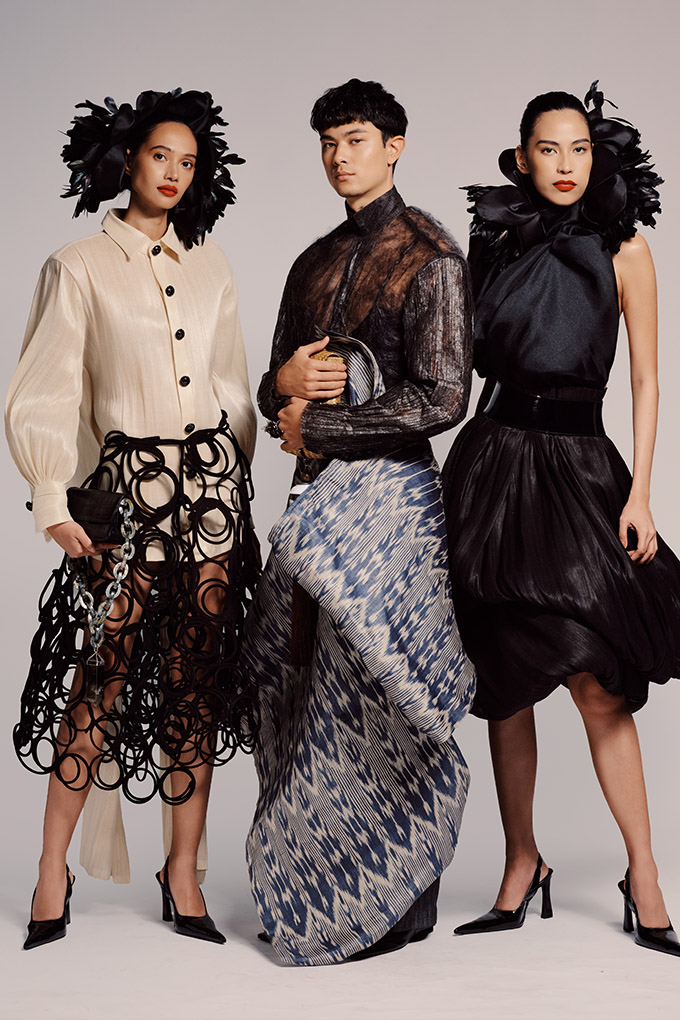
To discuss Rajo Laurel is to discuss Filipino fashion. For over two and a half decades the lauded designer, alumni of New York Fashion Institute of Technology and Central Saint Martins, has been championing the artisanal artistry that his national ancestry is renowned for, but with a contemporary eye. As head of Rajo Laurel Enterprises and Laurel et Ross Enterprises, and Creative Director and CEO of House of Laurel, RAJO, RAJOMAN and RAJITO, Laurel bridges couture, comfort, cerebral maximalism and craftsmanship. His kaleidoscopic range of looks appeal to both local celebrities like Nadine Lustre, Bretman Rock, Lea Salonga and the generally fashion savvy alike.

As a main arbiter of communicating Filipino culture via couture and clothes, the award-winning visionary and Project Runway Philippines and Drag Race Philippines judge is now taking a 30-piece collection to Bangkok, Thailand for a special showcase. The presentation is supported by the Department of Trade and Industry (DTI), through the Philippine Creative Industries Development Council (PCIDC) in a historic partnership with Thailand’s Creative Economy Agency (CEA). “Malikhaing Pinoy: Lahi”, which coincides with Bangkok Design Week, will be a specific type of alchemy–an exploration of a distinct Philippine narrative and a considered reflection on how lineage can invariably inform the future. We caught up with the multi-hyphenate before he set off to launch his cross-border collaboration to discuss what it means to truly be representative of Filipino fashion.
How would you describe the unique visual dialect of Rajo Laurel?
I’d like to think of myself as a story-teller. And it’s through the language of fashion and through the discourse of my clothes that I tell my stories. My distinct language is to create my narratives through the lens of all my experiences and specifically of being a Filipino. I really love to present Filipinos in the best light and I utilise fashion to do that. When it comes to my visual dialect, to answer simply, it is through a Filipino perspective and expressing that is what I want to bring to the world. I always strive to create context around the things I create.

Would you say to wear a Rajo Laurel piece is to have a sensorial experience?
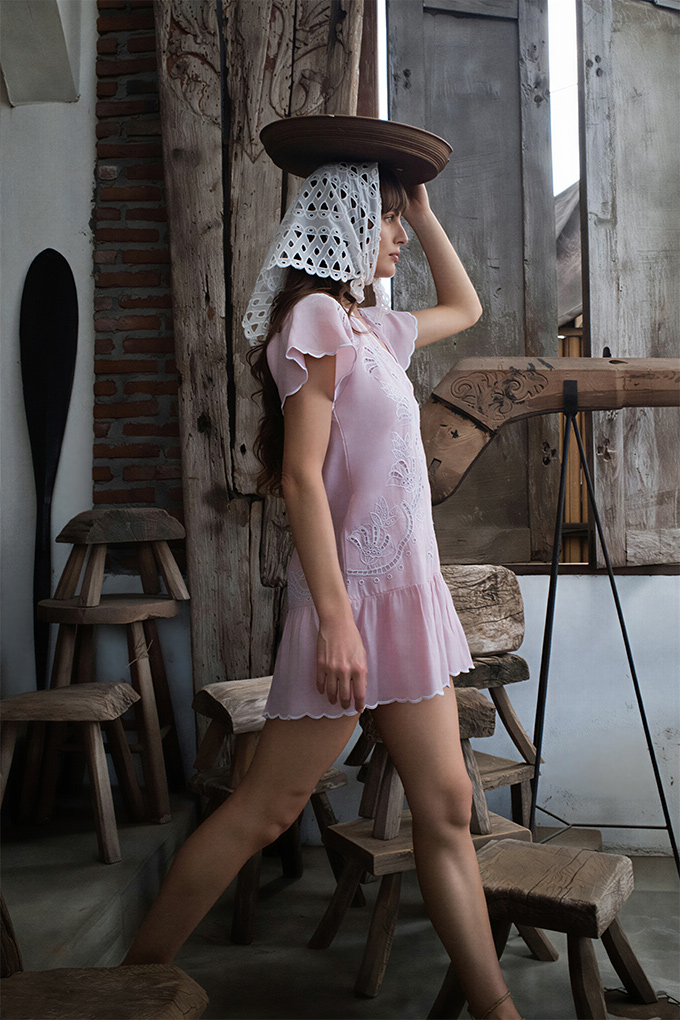
Yes I would say so, primarily because a lot of the work I do is really celebrating craft and embracing the handmade. Most of the things we produce in my studio are made all by hand and I think that’s one of the distinguishing features of what a Rajo Laurel piece is. You can actually feel the undulation of the fabric with each wave, almost like sculpture. I really enjoy sculpting material through drapery. In short, I fabricate the forms that create the wearer’s experiences.
In your opinion, what are the undeniable hallmarks of Filipino fashion?
Without sounding presumptuous, it’s the fact that we are so creative. We hardly have a fabric industry to speak of and we actually manufacture with the most humble of materials. As a developing nation, the business of fashion here is almost bare minimum. We do not have the proper access to the highest forms of textiles, fabrics, tools and so on, but despite that, we harness our creativity and that really shines through. We are very good with our hands and the hallmark of our output is how ingenious we are. With very little we can present something beautiful. And I am very proud of that.

What is the meaning behind some of the material choices you make like jusi or raffia, for instance?
It’s essentially down to what is available here. We have a very strong kinship to craft and the handmade. I love the texture of raffia and I wanted to translate that into modern narratives of what it means to be Filipino. Raffia is utilised in many forms in our culture, be it protection from the rain for the Northern tribes, or even sleeping mats (what we can call ‘banig’). I wanted to try and use this particular material as fashion and I wanted to see how its texture would actually act as a piece of garment. That was the initial idea, then we began to experiment. I navigated around our islands to see what was interesting to me and my eyes and then tried to transform what I found into almost a mirror of us, to define who the Filipino is today.
What do you think of the concept of ‘Bayanihan’ or the community spirit instilled in Filipinos as it applies to the fashion world?
You know the Bayanihan concept is intrinsic to us as a culture and we always have that mindset. We are not solitary people, we move as communities. Then we attract more packs and we grow, we expand. Bayanihan started with how one transports houses from one village to the next–the entire village is actually connected in this shared purpose. Everybody assists one individual to realise their goal and I love that. I used the Bayanihan way to push for this particular collection.
Let’s spotlight your upcoming showcase in Bangkok. Would you say “Malikhaing Pinoy: Lahi” is a love letter to the Philippines?
Absolutely, this is my love letter to the Philippines, an attempt to characterise and visually create images of who the Filipino is today. I’m very interested in pushing that agenda forward, in asking: “What is Filipino?” I want to use everything at my disposal to help explain this.

To compliment your works you’ve accessorised the looks with the creations of Arnel Papa, Celestina Maristela Ocampo, Cholo Ayuyao, Monchét Diokno Olives, and MX Studios by Maxine Santos Tuaño like abaniko fans and coq feather headpieces. What was this collaboration process like?
I’m very lucky because my collaborators in many ways are my friends. I choose them primarily because we have such a strong camaraderie and we are all in the artistic field. The creative dialogue that came out from this collaboration is a conversation. We ruminated over some things “what if we do this, do that?” all with respect and love for the creative community and that’s how we came up with this collection. We essentially just spoke about it, started making things and somehow we crafted this wonderful conversation. Really to summarise, the collection is a collaborative conversation.
You were also inspired by acclaimed Baguio weaver Nada Capunan.
Yes, I love Nada Capunan and very sadly she passed away, however I was very fortunate to be able to visit her when she was alive and I learned so much from her and utilised that particular experience in creating some pieces for the collection.
What would you love for people to take away from this 2026 couture collection?
My main message for this particular couture collection is that when people are watching, they would say, “Ah, this is the Filipino now.” I want them to experience what it means to be Filipino through my eyes and through a creative lens, but also through a global lens. Hopefully, I’m able to achieve that visual expression.
Why is it important for you to be an advocate for cultivating the Filipino creative economy internationally?
Because that’s my community and these are my friends and this is who we are. This is my world. It’s imperative to me to showcase what we can do as a creative society on a global stage. I want to say, “Look, all you need to see is a bit of our light, a light that shows how imaginative and innovative we are as a people, as designers.” It’s very personal for me to propel this proposition forward.

If we focus back on your local presence, you’ve dressed some iconic trailblazers like Lea Salonga–who do you fantasise dressing?
Oh that’s an easy question! Oprah Winfrey. I love her and I want to put it out to the universe that one day I will get the opportunity to be able to dress her. Fingers crossed. Maybe if she reads your article it will happen.
From celebrating your roots, to your outlook on style sensibility–what are your hopes for Filipino fashion moving forward?
My hope and prayer for the Filipino fashion community is that we garner more attention and that we are able to in many ways show the world what we can do and how special we truly are. I want everyone to know how wonderful we are with our hands and how what we do is so unique, beautiful and transformative. The collection really is the story of people and of my country. It is my story and I think perhaps it is time that the story is heard.