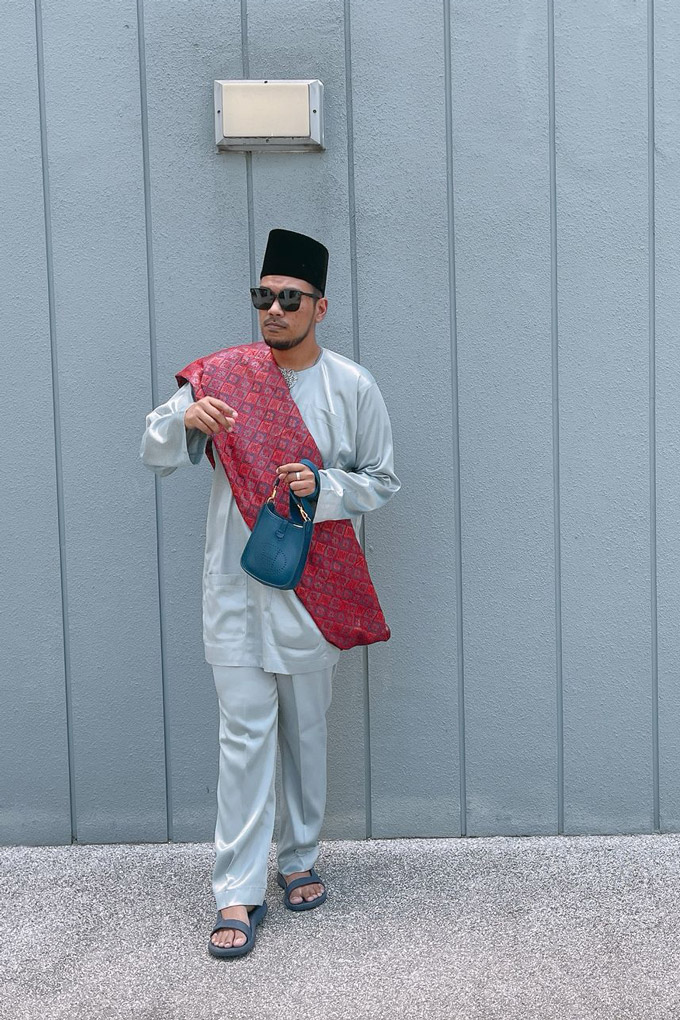
An enduring piece of heritage. A marker of respect. A final flourish—to an otherwise incomplete outfit. Such is the kain samping, a traditional cloth which is typically worn over a man’s baju kurung or baju melayu in Malay culture; a skirt-like adornment over the trousers. The outfit formula might be a familiar sight—and one that we’ll certainly see plenty of soon enough—as it is often worn during the Eid or Hari Raya festivities. After all, it is widely recognised as an integral part to the Raya uniform for any Malay man who is wearing the baju kurung; a ceremonial marker of sorts which completes the festive outfit.
There are a variety of cloth types that can be used as a kain samping, but considering the elevated nuance of the festivities, the kain samping is often a kain songket, a luxurious cloth woven with gold or silver threads. Some men prefer to opt for a songket that contrasts against their baju melayu for that pop of colour, whilst others love a good monochromatic finish. Tying the samping on the hip or waist is in itself, an art of its own. Some might prefer neat, tucked-in styles—often worn with a ‘cekak musang’ style baju collar, otherwise known as a standing collar. Whilst a more relaxed means of wearing the samping would be underneath the baju melayu—usually a ‘telok blangah’ style or collarless style of baju—where just a sliver of the songket pattern or kain samping would still be visible.
The takeaway? There is no one outfit formula to wearing the kain samping. Especially for most local Malay men; when the heat ramps up, and the layers start to come off, some begin to wing it; the kain is made a shawl, a bag, an accessory. Ahead of the Hari Raya festivities this year, we speak to some stylish individuals about how they wear the samping, and the cultural significance it holds in today’s context.

1 / 4
Afiq Juana, co-founder of Kebaya Societe
What does the samping represent to you?
To me, the samping is the final flourish to the men’s baju melayu. Whether it’s tonal, color-blocked, or intricately woven with gold or silver threads, the kain samping offers space to explore seasonality and trends. It has the power to completely refresh an outfit and shift its mood.
Are you personally an advocate for wearing the samping? Do you prefer the traditional way of tying it over your baju kurung, or do you lean more experimental?
Absolutely. While I enjoy experimenting with the way I wear the samping, there’s something undeniably sharp and refined about the traditional method.
Do you think your manner of wearing the samping is a reflection of your personal style?
Without a doubt. My approach to the samping is always intentional. It reflects my personal style and often is dependent on the stories I’d like to tell.
What do you think is the cultural significance and relevance of the samping?
I believe the kain is deeply embedded in our stylistic consciousness. While I see its form evolving with time, I have no doubt that its cultural presence and significance will endure. I hope it will stay.

2 / 4
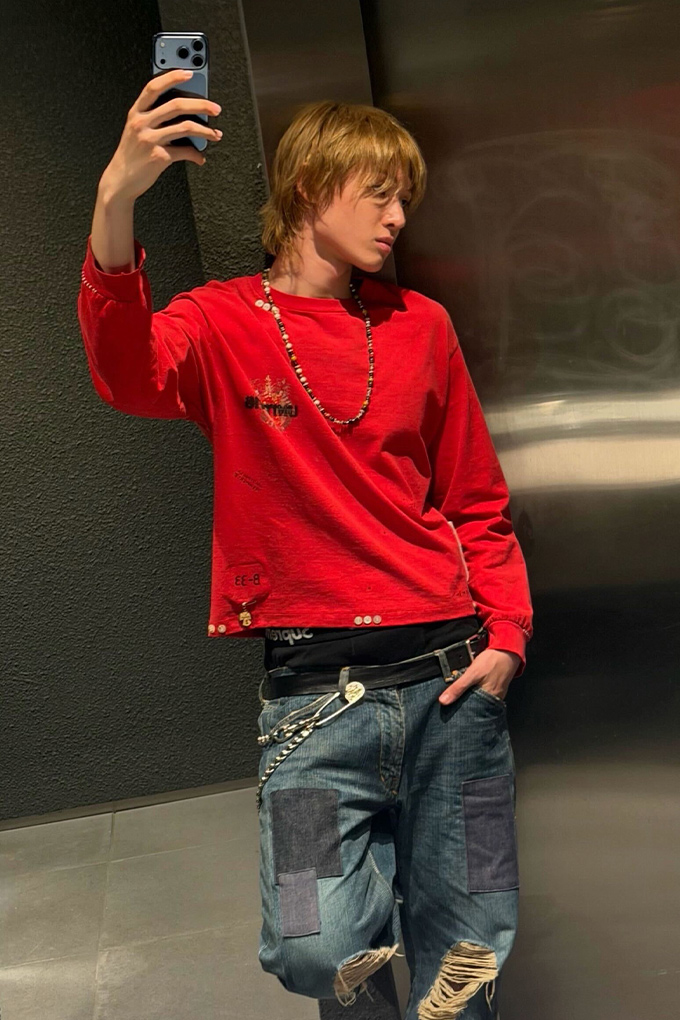
Sufiyanto Amat Sopingi, co-founder of Kebaya Societe
What does the samping represent to you?
The kain samping is a reflection of my Malay heritage. It’s something I usually incorporate into my everyday attire. I tend to wear a lot of dark colours so I’d match my attire with a monochromatic or plain kain, channeling the aesthetic of Yohji Yamamoto or Rick Owens.
Do you prefer the traditional way of tying it over your baju kurung, or do you lean more experimental?
I experiment with how I wear or tie the kain samping from time to time. My stylistic preference, choice of colours and type of textiles is dependent on the occasion. I prefer wearing a kain batik or kain pelikat for more casual situations—both of which are familiar to Malay men—especially the pelikat, which is a piece of long, checkered cloth usually wrapped around the waist or hip. Meanwhile, the songket tabur (scattered pattern) and songket penuh (fuller pattern) are more appropriate for evening or formal events.
For daywear or casual meetings, I wear my baju over the kain samping, but if it feels like a dressier affair, I’ll usually tuck my baju into the kain samping. My choice of colours tend to be on the darker side and I usually wear it quite low—below the knees. It’s also really versatile; when I’m in need of a bag I can tie it up, or I can wear it as a scarf when I’m feeling cold.
What do you think is the cultural significance and relevance of the samping?
The kain samping has gone through many changes, primarily in terms of how it’s worn. We see the emergence of the ‘instant’ kain samping, making its manner of wear more practical. Even though the mode of wear has changed, the form and its meaning remains the same—it is a classic staple in the Malay man’s wardrobe. Over time, we might still see other changes being made but I believe its relevance and the form of the kain will forever remain.

3 / 4
Rohaizatul Azhar, fashion lecturer and freelance writer
What does the samping represent to you?
To me, the samping represents tradition and cultural pride. It’s the finishing touch—the one thing that instantly elevates the look from “casual Friday prayers” to “Raya-ready”. I genuinely feel like the look isn’t complete without it. It’s also about being connected to something bigger—your roots, your family, your people. That said, I think it also feels very of the moment. If Gen Z boys can wear skirts over pants and call it fashion, what’s stopping us from rocking the samping beyond formal occasions?
Are you personally an advocate for wearing the samping? Do you prefer the traditional way of tying it over your baju kurung, or do you lean more experimental?
Oh, I’m 100% team samping. I do both—sometimes I go classic with the kain folded at the centre or off to the side, depending on the vibe. But most of the time, I freestyle. I pinch the front, create an asymmetrical fold with soft pleats and just wear it the way that feels right that day. And if it gets too hot—because let’s be real, it always does—I just throw it over my shoulder like a shawl. Practicality meets flair.
Do you think your manner of wearing the samping is a reflection of your personal style?
Yes, without a doubt. My style is all about mixing respect for tradition with a bit of play and personality. So the way I wear my samping—folded one day, draped another, sometimes styled like a streetwear accessory—is a direct reflection of that. Most of the time, I wear my baju melayu over the samping instead of tucking it in but that’s also because I prefer the ‘telok blangah’ style, which is more relaxed but still formal in its own way. If I’m ever (read: hardly) in a ‘cekak musang’ mood, then I’ll go full classic—samping neatly folded, shirt tucked in, the full works. But I’m not strict about it. I treat the samping as an adaptable piece.
What do you think is the cultural significance and relevance of the samping?
The samping should always have a place, especially during Raya and formal occasions. It’s part of the tradition, and it will always be. But to keep it alive and relevant, we need to reimagine where and how it’s worn. I think if we stop gatekeeping it as strictly ‘formal wear’ and start letting it live, it’ll always stay fresh, and never feel like a costume. So, style it with intention, and wear it in ways that feel personal to you.

4 / 4
Syah Afsyari, retail advisor at Chanel
What does the samping represent to you?
It represents Malay culture—from long before our time. Back then, it was already being used, not just as an accessory, but also as a beautiful art piece with its beautifully-woven fabrications.
Are you personally an advocate for wearing the samping? Do you prefer the traditional way of tying it over your baju kurung, or do you lean more experimental?
Yes, I think it does beautify the baju kurung substantially and it adds touches of grandeur to it. Generally, I prefer the classic way of wearing it, but I do experiment with it once in a while, just to change up a certain look that I wish to portray.
Do you think your manner of wearing the samping is a reflection of your personal style?
For sure. There’s always a story behind every style or way someone chooses to wear the samping, and the choice of how to wear it in itself, is a reflection on one’s style or allure.