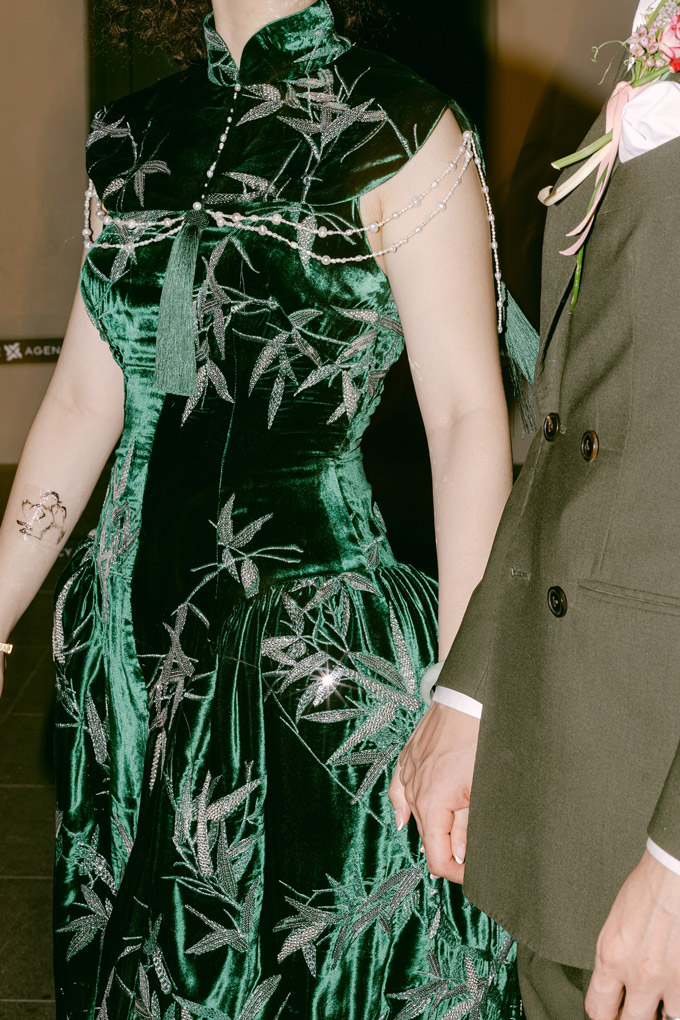
The qipao. The mandarin gown. The cheongsam. All words of endearment, a reference to a beloved garment that brims with old world charm. Once, a form of everyday dress cut in a looser fit, before the 1920s saw it transform into the snug, body-hugging silhouette we are familiar with today. Those high slits were worked in later as girls experimented with various finishings—be it in its collars or pipings, or even sleeve shapes. But it was many years later when Hong Kong-based films like The World of Suzie Wong (1960) and the ever-iconic In The Mood For Love (2000) casted the garment anew.
“Many women cite In the Mood for Love as the film that revitalises their love for the cheongsam, by showcasing it in this utterly glamorous way on the inimitable Maggie Cheung. That was certainly the case for me too,” muses Julianne Tan of Sub Rosa, a bespoke studio which often tailor makes modern, minimal cheongsams for the modern day bride. But the love has since gone deeper for women like Tan.
Ahead of the Lunar New Year celebrations, we speak to four different women; some longtime makers of the traditional dress, some proud owners of storied, hand-me-down garments. Each one with their own story to tell, and all connected by a seemingly intangible thread to their roots—one they’ve threaded on their own with a nurtured love for the cheongsam. For some, it’s a symbol of heritage and a reminder of their roots; for others, it’s an open, blank canvas for creativity to unfurl—a means of reclaiming tradition in a contemporary fashion scene.
In conversation with four women who are proud makers or owners of the cheongsam, Vogue Singapore takes a deeper dive into each of their personal connections with the garment and how they view their role in honouring the cheongsam today.

1 / 4
Julianne Tan, founder-maker behind Sub Rosa, a bespoke studio specialising in tailor-made cheongsams
What does the cheongsam represent to you?
To me, it is not just for Chinese women, but the cheongsam can be worn and appreciated by anyone who feels an affinity with Chinese culture in some way. Though some might feel excluded from the cheongsam or believe that they “cannot pull it off”, I’ve never found that to be the case, and truly believe that with the right fabric and cut, the cheongsam is for everyone.
Putting on a cheongsam can also give us a sense of connection—to a memory, or to the women in our lives or throughout history who have gone before us and worn them too. I often leaf through a copy of a book produced for the National Museum of Singapore’s cheongsam exhibition in 2012, and looking at the photos of women from almost 100 years ago in their different, dazzling cheongsams always reminds me that we are part of a long line of women who have worn this garment, and connected to a history and heritage that is much larger than us.
The cheongsam also serves as a wonderful blank canvas that is truly a bespoke designer’s dream. Even when holding certain key elements constant—such as the curved Mandarin collar, or details such as piping and delicate buttons—the cheongsam gives us endless opportunities to play with shape, fabric and detailing.
As a maker or owner of this heritage garment, how would you describe your role in telling the story of the cheongsam?
I see my role as something closer to a caretaker and champion of the cheongsam—to celebrate and shine a light on it, by paying tender attention to its cut, fabric and how it fits on the body, to create the best versions of it for the women who wear them today, in a way that is relevant for our time.
For me, this means choosing to always focus on the inherent elegance and simplicity of the cheongsam, without fuss or frills, and using the cheongsam to highlight the natural beauty and strength of the woman who wears it. These are guiding principles my clients and I always hold close, even when we set out to create unique variations that put a twist on the cheongsam.
Through my work, I’ve seen women of all ages, proportions, professions and personalities slip into a cheongsam, and the effect that the cheongsam has on them can be really transformative, in a way that is hard to pin down and describe fully. It makes them walk a little taller, or hold their head a little higher. There is a strength and elegance that the cheongsam brings out in everyone that I’ll never tire of witnessing.
Do you think perceptions on wearing the cheongsam have changed over the past few years?
Over the last decade or so, I think we’ve witnessed a significant shift in the popularity and perception of the cheongsam in Singapore. When I first started creating bespoke bridal cheongsams, well-intentioned mothers of the brides would sometimes ask: “But where is the red and gold embroidery, where are the dragons and phoenixes?”. I’ve not heard that for years. There’s a much wider acceptance and even an active pursuit of cheongsams that feel more understated—a way to honour heritage in a way that feels fresh and modern for us now. Now, we see bridal cheongsams made in everything from beaded lace and satin, to wool suiting fabrics and patterned jacquards.
Could you share any interesting personal anecdotes of your customers with a vision for their desired cheongsam?
Some clients have viewed the cheongsam as a powerful way to pay tribute to their loved ones, and some of my favourite cheongsam projects have been those that include a sentimental, personal connection to a family member. One example was a client who brought in an heirloom pink brocade cheongsam from her fiancé’s family, and wanted to explore making a coordinating capelet, so the ensemble would be more aligned with her personal style, whilst also paying tribute to her mother-in-law, whom she never got to meet.
Another example is a client who brought one of her grandmother’s many handmade kebaya blouses to me—with the blessing of her family—to repurpose her granny’s own embroidery into her wedding cheongsam. These were such sweet choices that allowed them to honour and remember beloved family members during these significant life moments, and gave the pieces so much meaning.

2 / 4
Hu Ruixian, founder-maker behind Studio HHFZ and bespoke dressmaker of the cheongsam
What does the cheongsam represent to you?
I see it as wearing my culture, and a representation of my Chinese roots. Ultimately, it’s who I am and an identity I am proud of.
As a maker of this heritage garment, how would you describe your role in telling the story of the cheongsam?
As fashion constantly evolves, the same can be said for the cheongsam. These days, it is not necessarily worn in the same way as how the ladies in the olden days wore it. Different individuals have their own interpretations of this treasured piece of heritage, and my role is to translate each of these individual perceptions into reality.
How has your relationship with the cheongsam changed from your younger days?
Funny thing is that I didn’t get to wear cheongsams as often as I had hoped when I was younger. So I’m thankful that my job has allowed me to connect with this beautiful art form and even been bestowed the honour of making them.

3 / 4
Cherie Paw, heritage cheongsam owner who rents out cheongsams online at @cheongsamdollie
What does the cheongsam represent to you?
To me, the cheongsam represents the passing down of tradition, grace, elegance, and the timeless beauty of women through generations. Much like the Chinese idiom 飲水思源 (yǐn shuǐ sī yuán), which means, “When drinking water, think of its source”—when I wear a cheongsam, I think of the generations before me who created and cherished this garment, allowing me to wear it today.
As an owner of this heritage garment and someone who rents it out to others, how would you describe your role in telling the story of the cheongsam?
I know how rare or expensive it may be to find or buy a cheongsam, so I hope to make them more accessible, giving others the opportunity to wear and experience their timeless beauty by renting them. I also want to show how the cheongsam remains relevant today by inspiring others to embrace tradition in a modern way. My hope is that everyone who wears it feels not only empowered and beautiful whilst wearing it, but also deeply connected to the craftsmanship behind its creation, as well as the rich history that has shaped its evolution over the years.
How has your relationship with the cheongsam changed from your younger days?
When I was younger, I found wearing a cheongsam somewhat awkward and embarrassing because it stood out so much in a society that often pressures us to conform. It wasn’t trendy or conventionally cool and its figure-hugging design made it feel even more daunting. However, I’ve grown to embrace it. I now love its bold silhouette and timeless elegance. The cheongsam is different and special, and I deeply admire the artistry and craftsmanship behind it. It has become a symbol of confidence and individuality for me.
Could you share any personal anecdotes of your customers expressing renewed interest in the cheongsam?
One of my loyal, recurring customers shared how much they love the variety of fabrics and designs, noting that the cheongsam offers endless variations—from styles suitable for everyday wear to more glamorous and flattering options for certain events. Another customer mentioned how they always receive compliments from the older generation when wearing a cheongsam, which makes them feel confident and proud of their heritage.

4 / 4
Lucy Yeo, bespoke cheongsam tailor and founder of Mama and Misse
What does the cheongsam represent to you?
The cheongsam is a traditional dress that represents Chinese culture and identity. I always tell my daughter this: “Why is it that we see the Malay ladies wear the baju kurung and kebaya; the Indians wear their saris; but it is harder to find a Chinese woman who would wear the cheongsam?”.
Why is the cheongsam important to you?
I loved the cheongsam, even growing up as a child. It’s something I consider precious to me, and filled with stories of its own. It’s why I took great care of even my oldest pieces—like this piece I made in the ’80s—and passed them down to my daughter to carry on its legacy.
As a maker and owner of the garment, how do you see your role in telling the story of the cheongsam?
Every cheongsam we create at Mama and Misse is classic and elegant. We are a small, but dedicated team of grey-haired garment makers with decades of experience in sewing relentlessly, just to offer the finest workmanship on luxurious fabrics, so that we can create cheongsams that can be worn for all occasions and eventually passed down to the next generation. I believe that it is because of this vision, that we have customers of all ages, from young ladies to their mothers and grandmothers. Many of our loyal and returning customers come back just to get their pieces altered so they can wear them again and again.