In Longlegs, Lee Harker’s family home held the secrets to all. The film goes full circle, and the Harker basement is eventually revealed to be the devil in disguise; a harrowing, red-lit basement, under the watchful eyes of the satanic dolls Longlegs had been crafting over the years. The forgotten site of horrors; and the root of all of Lee’s childhood traumas. Anyone who has entered the bone-chilling experience of Longlegs can attest to this; a large part of the film’s compelling narrative was conveyed through its deathly chilling soundtrack, breathtaking cinematography and even more fearsome set design.
Indeed, the mark of a good horror film lies beyond its mere narrative. The real genius of these screen creations instead lies in the full sensorial experience, one that can only be achieved through an arrangement of its contributing auditory and visual elements. And for many, it is what they see on the big screen that might stay with them—long after the film comes to a close. A gripping shot so carefully formulated, it surfaces the most visceral of our fears.
For some, this might be imagined by a distinctive set piece, like that of Frankenstein’s eerie yet unforgettable lab table. For others, it is the piecing together of the most elaborate of gothic interiors; imbued with a sense of the dark, sinister and macabre. Whilst the Harker cabin house in Longlegs might have invoked that inevitable sense of dread in its audiences in more recent filmic memory, more classic horror films such as Crimson Peak, Nosferatu and Pan’s Labyrinth have long been pivotal in building the most nightmarish theatres of our minds with its theatrical architecture, dark furniture and use of dramatic yet Victorian-era prints. Below, a retrospective of the most fantastical gothic set designs that have left their legacy in the history of horror films and cinema.

1 / 8
Nosferatu (1922)
Of vampiric dread and silent horror. As one of the most notable silent expressionist films, it’s hard to rival the mise-en-scène in Nosferatu, which relies heavily on its gloomy sets and play with shadows and light to achieve its true terror.

2 / 8
Suspiria (1977)
One can’t deny the allure of the cult film Suspiria by Dario Argento. In a stunning world of postmodern technicolour, its interiors are emblazoned in electrifying crimson hues, geometric prints and hypnotising frames that warp one’s perception of space and time.

3 / 8
The Shining (1980)
Stanley Kubrick’s The Shining delved deep into the corridors of the Overlook Hotel and amped up on its gloomy, dreadful design through the use of pale, dramatic wallpaper set against high ceilings to create extremely dark and lonely expanses.

4 / 8
Beetlejuice (1988)
Yet another revered auteur finds its way onto this list. Tim Burton’s masterstroke in ’88—Beetlejuice—has always been referenced for the visually stunning architecture of the Maitland residence. Beyond its unique structure, much of the Deetz family’s campy inflections were communicated through the rest of the house—like its high, antique chairs and moody tabletop elements at the family dinner table.

5 / 8
Pan's Labyrinth (2006)
The spine-chilling allure of Pan’s Labyrinth has captured the hearts of many a dark fantasy enthusiasts. In one of its most eerie sequences, the monstrous Pale Man sits at the head of a colossal dining table of rich abundance. Under a fire-lit dome splayed with Roman-esque visuals and flanked by structural arches, it paints a picture of an inviting yet deeply foreboding scene.

6 / 8
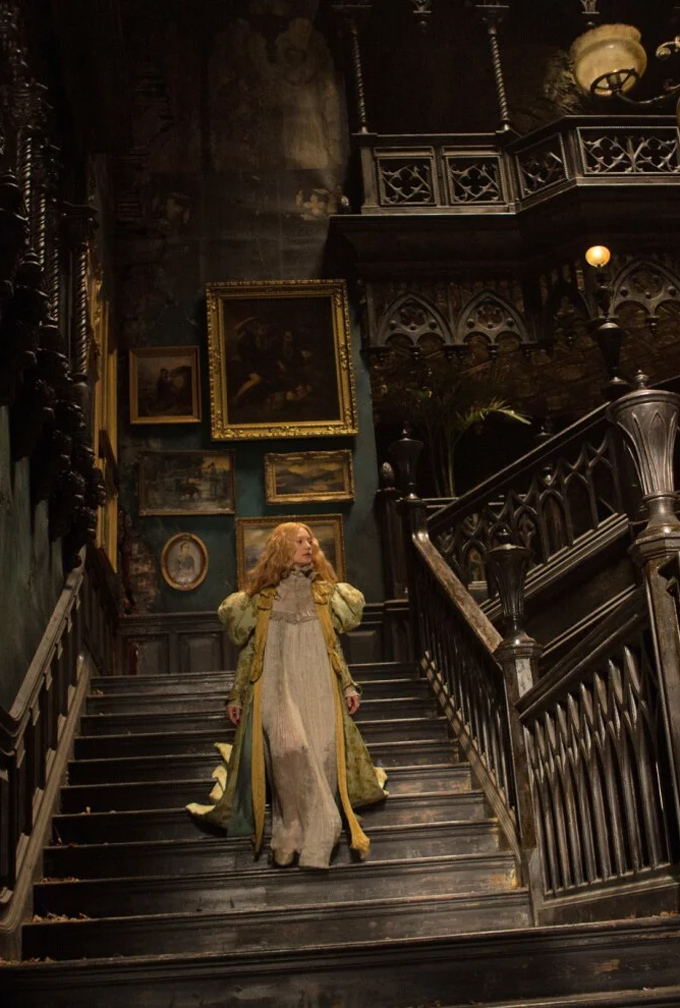
Crimson Peak (2016)
The gothic family estate of Thomas Sharpe (Tom Hiddleston) and Lucille (Jessica Chastain), Allerdale Hall will be one to remember for anyone enamoured of the dark fantasy genre. Its towering, ornate foyer coupled with its rich, beautiful furniture was essential to create the atmosphere of the film.

7 / 8
Annabelle (2018)
Into the dollhouse we go. Nothing quite like the child-like taunt of the bedroom in Annabelle. Of pinked walls and a room that screams girlhood, it only adds to the horrifying draw of the haunted doll that sits at the root of our childhood traumas.

8 / 8
Longlegs (2024)
All through Longlegs, the satanic horror influences of the film are shown in splices—especially through its sub-narratives of other families who have been killed. Shot in door frames and in bloody flashes, it all culminates in the Harker family basement. Where the dim of a candle lights up posters of Victorian brides, cryptic codes and eerie paraphernalia.