Were shoemaking as appreciated as painting, Salvatore Ferragamo would count as one of its greatest Old Masters, and his Invisible Sandal as one of his masterpieces. He created it in 1947 by combining his F-shaped wedge, cut away to leave the heel apparently suspended over thin air, with an upper woven from transparent nylon monofilament, a material invented only 12 years earlier: Tech has always driven fashion.
Nigh on 80 years later, the Invisible Sandal provided the starting point for this substantially opaque Ferragamo collection by Maximilian Davis. Its 1947 date and Surrealist appearance led him toward Lee Miller and Man Ray; to the solarisation technique they developed together; to Miller’s photography during the 1930s while living in Egypt with her husband, Aziz Eloui Bey; and, later, her wartime photography for Vogue.
“The ’40s silhouette is where women were bringing back the waist,” Davis said while overseeing the lineup preshow this morning. “I really wanted to bring that into the collection, making sure that the waist was the feature of a lot of the looks.” Along with the bellows pockets of 1940s wartime uniforms, this emphasis on the waist was a key motif of the collection. Most often it was defined by quite prosaically buckled menswear belts, sometimes even two of them, threaded through the garments they were used to constrict and suspend. They were not limited to waistlines. With gentle surrealism, Davis also applied them to bustlines, in dresses where the belts were set into strapped wool bodices from which silk-satin skirts were suspended, sometimes left open at the back.
Davis took only what he wished to from the 1940s context. The long, draped skirting of jackets and fullness of trousers were nicely echoed in menswear, but in womenswear he discounted the blowsily built-up shoulder of the period for a more rounded shape that seemed far sleeker. Some of that suiting was delivered in double-layered transparent silk-wool, which allows you to see the canvassing, pockets, and other guts of the garment. This fabrication was also used in skirts and several dresses that expanded on the notion of scarf dressing, an old Ferragamo trope, to drape material—and sometimes leather—unorthodoxly around the body.
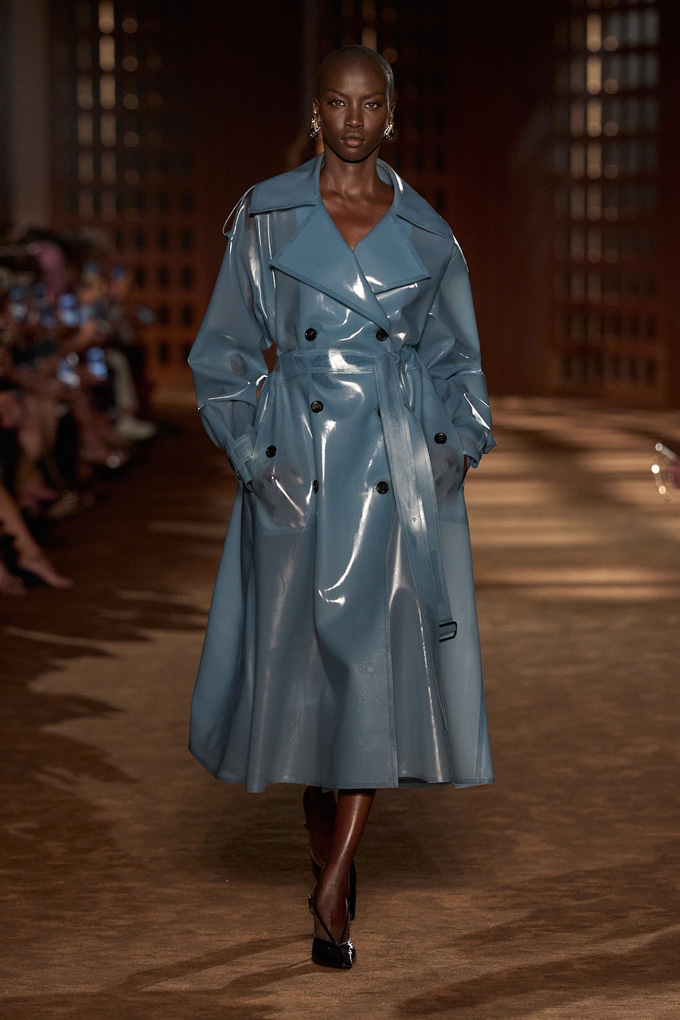
That fabric’s clouded sheerness extended into trenches and dresses made in richly coloured rubber. These carried the obvious hint of kink, but also—especially with light behind them—created an interesting visual echo of Man Ray’s solarisation: The body was most clearly defined where it pressed and puckered against the rubber, only to lose visual definition as soon as its contours fell away from the garment surrounding it.
Davis said that imagining Miller in Egypt steered him toward “tones and colours of something that’s very neutral” and toward dry-feeling fabrics: cotton-linen mixes, viscose, and silk. The pattern that emerged toward the end was an abstraction of sand in movement, rather than dune horizons. The Gancini-fastened leather pieces sometimes came cracked and weathered, as if parched and sun-struck. The paillette pieces at the close were also inspired by exposure, but this time by Miller’s and Man Ray’s photographic experiments at the boundaries of light and film. “For me, it’s also exploring the joy of something,” Davis said. “The joy of photography or the joy of loving.”
This was a complex and compelling lineup that was also commercially pragmatic. That Invisible Sandal starting point was also the first step in a process of accessory development that saw its F-shaped construction abstracted into new iterations of pumps, wedges, sandals, and slingbacks, sometimes with contrasting elements designed to make its material substance visually insubstantial. Ferragamo’s genius was in the creation of footwear, so framing his house’s modern output around that defining metier makes perfect sense. This is what makes Ferragamo distinct. The house-staple Vara pump was also reworked and elevated, its cutesy bow streamlined into a more austere origami-like form, while the newish Cara bag was refabricated and given plenty of runway exposure.

1 / 13
Look 1

2 / 13

3 / 13

4 / 13

5 / 13

6 / 13

7 / 13

8 / 13

9 / 13

10 / 13

11 / 13

12 / 13