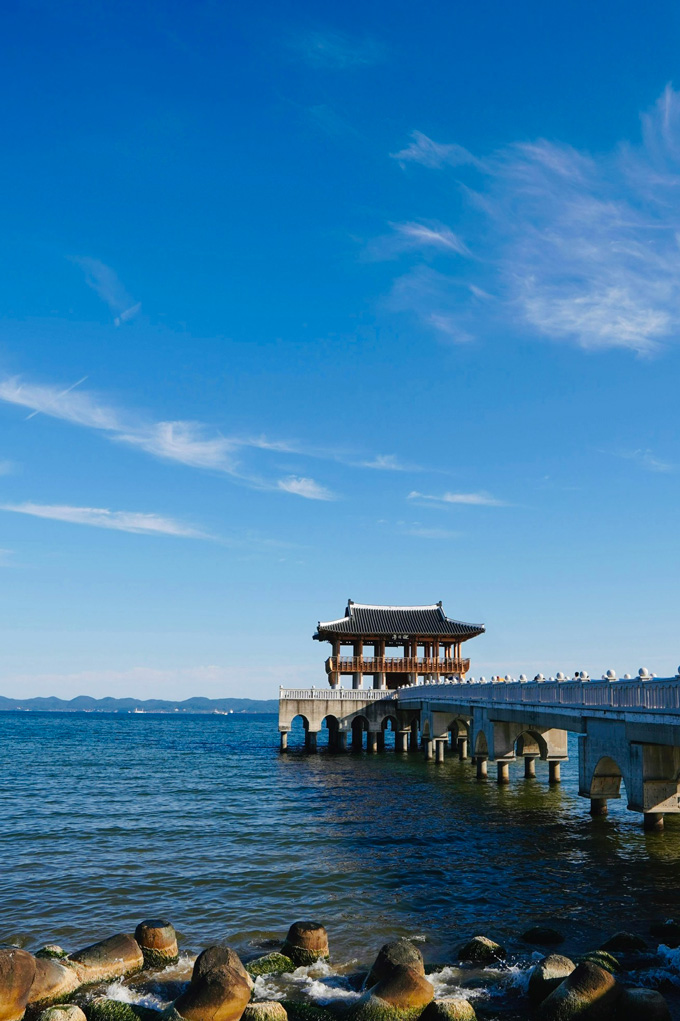
Cloudless skies. Endless stretches of waters that twinkle the right shade of aquamarine. Plus one crucial factor: the off-the-beaten-track charm that is gleaned when one arrives in Pohang, South Korea.
For some, the coastal town might sound familiar. Once an untouched jewel that flanks the East Sea (the Sea of Japan), it has caught the curious eyes of K-drama lovers in recent years, specifically fans of beloved small town romance series Hometown Cha-Cha-Cha and When the Camellia Blooms. This is especially so for the former, which unexpectedly created a sense of inexplicable appeal for viewers to visit its filming site in Pohang and explore the fictional seaside fishing village which the show was centred around. Little did we know however, that little town just so happened to be a microcosm of a larger city—the largest in the North Gyeongsang province, in fact.

As is, Pohang is home to a sizeable population of just over a quarter million. A four-hour drive from Seoul (swifter by train), a quick search on the web will chalk it up to be an industrial hub, known for its seaports and steel. But what you’ll miss is a gateway unto a plethora of scenic photo spots; dreamy, winding drives through its coast; and an untapped cafe scene that’s brewing up its very own storm on the Eastern side.
With some wheels below you, it’s also a perfect destination to head to if you’re seeking out a slower pace of life—without having to book a flight out to the water-locked island that is Jeju. So for anyone wondering where to leave your footprint in the underrated seaside gem? Here is Vogue Singapore’s guide to discovering Pohang, South Korea—and all within a day’s work.

1 / 5
Catch the sunrise at Homigot
Search up ‘things to do in Pohang’ and Homigot Sunrise Square may be top of the list, but it’s there for a reason. If you’re an early riser and up for a challenge, make the trip to witness the breathtaking beauty that is a sunrise at Homigot, helmed by Sangsaeng’s Hand, a majestic two-part bronze sculpture in the shape of a pair of hands.

2 / 5
Have breakfast with a view
There are a string of cafes to consider heading to in Pohang—especially when they’re all located by the seaside, so you can simply put your navigator to work to find the nearest one. Take Odin, for example: a picturesque escapade that promises uninterrupted views and instant access to the outdoors for the adventurous at heart, if you’re willing to traverse the bridge and breakwater course to one of its nearby lighthouses. If the pairing of a good cuppa and some salt bread is more up your alley, then look to Arrangement, with raving reviews for its delicious coffee. Meanwhile, there’s Cafe Fotopia, that offers a portal into a different world with its Roman-inspired architecture.

3 / 5
Visit popular drama filming locations
The list runs the gamut for this one, but if you’re an avid K-drama fan, then say no more. The filming locations for Hometown Cha-Cha-Cha have been preserved in some sense, and you can visit landmark locations like the boat—which also gives you a nice little hike up Sabang Memorial Park—Wolpo Beach, and Chungha Market (otherwise known as Gongjin Market in the series). Whilst the fish port is not in the main area of Pohang, you can also consider heading here if you’re hoping to spot the Haenyo, the incredible female divers doing their thing out in the sea.

4 / 5
Indulge in a Pohang specialty
Mulhwae is considered a specialty of this seaside city, and is a must-try when you’re in Pohang. A spicy raw fish soup that is usually served cold, mulhwae is usually best enjoyed in the summer—and is similar to naengmyeon in that sense. The coastal port is peppered with dining spots that specialise in the textured dish, but most still offer a number of other seafood dishes as well.

5 / 5
Take a hike and defy gravity
It’s strange to think that such a marvellous art installation could be found in the middle of this city, but here we are. Atop the hills of Hwanho Park, is the Pohang Space Walk, which boasts a curvaceous steel frame and an undulating staircase trail that winds in loops above ground. Designed by Hamburg-based artists Heike Mutter and Ulrich Genth, the walkway lends to unprecedented views of Yeongil Bay and the surrounding city—and also presents itself as a fun way to think about what zero gravity might feel like up there.