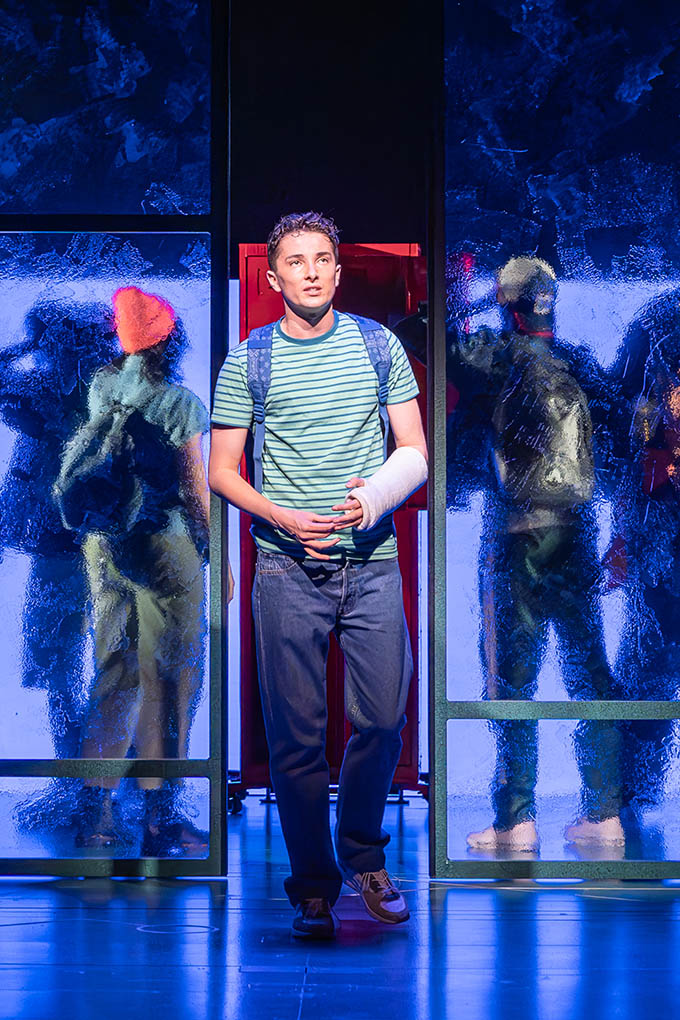
The stories we tell ourselves are powerful, never more so than when they determine our sense of self-worth. This sentiment lies at the heart of Dear Evan Hansen, a musical about a high school boy who twists the truth of a tragedy to suit his own needs.
Written by Benj Pasek and Justin Paul, its story of struggle is timeless and universal, from wrestling with mental health to navigating interpersonal relationships to simply striving to be seen. The musical opened on Broadway in 2016 and went on to win six Tony Awards before arriving for the first time in Singapore this month, presented by Base Entertainment Asia at the Sands Theatre at Marina Bay Sands.

Without veering too much into spoiler territory, the main conflict of the musical kicks off early, when the titular protagonist lies about being the friend of Connor Murphy, a classmate who committed suicide. Evan Hansen is a shy, socially awkward high school senior who just wants to fit in. Unfortunately, by lying about being closer to Connor than he ever actually was, the monkey’s paw curls. He becomes more popular than ever, but his deception opens a veritable Pandora’s box of scandal, where unlikely friendships are forged (and broken), ill-gotten love blossoms (and wilts) and family dynamics are turned inside out (and upside down).

At the Sands Theatre, this story played out to thunderous applause. The whole affair, from start to finish, was beautifully paced, produced and performed. Its many accolades are clearly deserved, as the musical is a masterclass in portraying serious mental health struggles with a delicate, level-headed touch, as well as all the triumphs and heartbreaks of adolescence. Each characters’ struggle was felt as intensely as they were our own, treated with equal parts earnestness and solemnity, an impressive feat given how serious the show’s themes are. Loneliness, isolation, desperately wanting to be seen and heard and loved—it’s all filtered through a riveting, wholly believable performance by a wonderful, well-rounded cast.

The cast in question for the show’s Singapore run includes Ellis Kirk as Evan Hansen; Rhys Hopkins as Connor Murphy; Zoë Athena as Zoe Murphy (Connor’s sister); Helen Anker as Cynthia Murphy (Connor’s mother); Hal Fowler as Larry Murphy (Connor’s father), and Tom Dickerson as Jared Kleinman and Olivia-Faith Kamau as Alana Beck. The latter two are Evan’s friends who play an instrumental role in spreading his web of lies. While Evan is the protagonist, Alana in particular fulfils an important, possibly even underrated, proxy role for everyone else at their school who feels the same as him.
In the spirit of one of this musical’s most prominent themes, Vogue Singapore interviewed Olivia-Faith Kamau to find out more about the beautiful fragility she brings to the stage as Alana, a character that directly speaks to what it feels like to be invisible in a sea of people.
Hi Olivia-Faith, thank you so much for taking the time to answer these questions. I understand you were in Manila before this, but how does it feel to be performing in Dear Evan Hansen in this part of the world?
I feel incredibly lucky to be here. The weather’s obviously quite a bit different to what I’m used to in London, but it’s just so beautiful here and the people are so kind and welcoming. I’ve had a few days to explore and there’s just so much to experience, I can’t wait to see more of it!

From practicing to performing, how have your fellow cast (or crew) members inspired you along the way?
Our whole company is amazing but to name a few: Michelle Payne, our associate director, has really guided me on this journey from being an ensemble member/cover, to playing Alana full-time; and Sonny Monaghan, who leads our company every matinee, always brings fun vibes and his positive energy inspires me every day.
What sets Alana apart from the rest of the characters? And what’s been the most fulfilling part of playing as her?
Alana is similar to Evan because she is lonely and socially awkward. However, she’s always trying to make a connection and masks her flaws with a positive, outgoing persona. The fans’ responses have been overwhelming. So many people can relate to her and I’m so glad that I get to play this awkward black girl for all the awkward black girls out there.
Why do you think her character is so relatable?
Once Alana sees how knowing Connor helps her climb the social ladder at school, it’s easy for her to misremember and exaggerate their interactions. In the first act she can’t even remember whether he was in her English class or not. Then, by the end of the act she says he was “one of her closest acquaintances”, that they were “lab partners” and apparently did a whole presentation together. I’m not saying I think she’s a liar, but I think we all know someone who believes whatever narrative serves them. In Alana’s case, her being close to Connor opens a door for her to have a social life and maybe even friends.

What makes that struggle—of not being seen, but wanting to fit in—so universal, regardless of whether you’re in high school or not?
As humans, it’s in our nature to want to fit in with others, to feel seen and understood. And there are these unspoken social rules that we need to follow to be ‘cool’ or whatever, and honestly, it can get very confusing trying to play the game of social politics, whoever you are, let alone if you’re neurodiverse or have anxiety, etc. We all have the need to belong, so we try to adhere to social norms, but then we don’t want to lose our authenticity along the way… It’s a tricky thing to navigate.
Tell me what the Venn diagram looks like between you and Alana. Do you share any similarities? Are there parts of her that you admire?
When I first started playing the role I didn’t think we were that similar. But as time has gone on the line between Liv and Alana has blurred. She can be so excitable on her own wavelength that she can be annoying (I’m definitely like that). But she’s also not a very good listener, because she’s too involved with herself and concerned with how to be more likable and popular. I’d like to think I’m a better listener than her. (You’d have to ask the rest of the cast about that, though!)

How do you see the show’s story, its characters and its themes continue to hold cultural and emotional resonance in 2025 and beyond?
The thing that keeps this show relevant is the fact that the themes are universal. What I love about this show is that whoever you are, you can relate to one of the characters. It’s really a story that can be told again and again.
What do you hope the audience, but especially those still in school, might take away from the show?
I hope that students today watch the show and understand that being yourself is so important. Trying to be like other people is unfulfilling and exhausting. Also, no matter what happens at school with social politics and relationships, none of it will matter in the end. You might not keep all of your friends, but you will keep yourself—so it’s a good idea to get to know you and like you.
Finally, at its heart, so much of theatre is analogue—people on stage talk, laugh, cry and sing to people in the audience. What advice would you give to all the up-and-coming theatre kids who want to pursue this art, especially in a world increasingly dominated by digital influences?
Technology has its place in the arts, but your instrument is inside you, so it’s super important to tune into that and have a good relationship with your body, mind and voice. It’s fun to scroll on TikTok or watch videos of singers to feel inspired, but try not to compare your talent to what you see online. It’s not healthy.