The abiding warmth of Bhutan’s people still linger lovingly at the edges of my mind, following my trip there last February, courtesy of Vogue Foundation, luxury adventure brand &Beyond and luxury travel brand Tumi. Usually, the term ‘rent-free’ comes with negative connotations. In this case, though, the life that trip continues to lead in my mind has, thankfully, been all upside.
After all, it’s hard to come back from a trip to the world’s happiest country and remain unaffected by your time there. In all honesty, I don’t know if I’m necessarily happier for it. But that’s hardly the important part. What matters is the bone-deep kind of affirmation that trip facilitated—mental, emotional and spiritual. I still feel it to this day.
Bhutan’s air is, quite literally, special, as it is the first country in the world to go carbon-negative. And while I might not be surrounded by its brilliant blue skies now, the spirit of the country—my time among its generous people, surrounded by its vibrant land—will never leave me. I’m not alone, either.
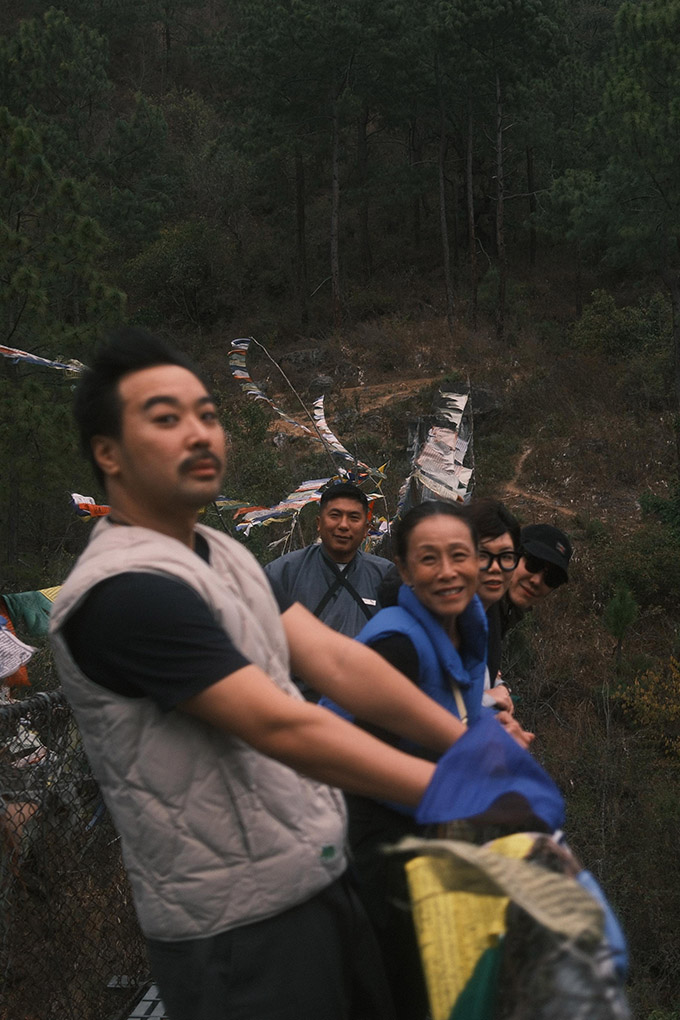
In the months since, I’ve reunited with the five creatives that accompanied me on the trip: editor-in-chief Desmond Lim, filmmaker He Shuming, fashion designer Bessie Ye and actresses Chen Yixin and Tan Kheng Hua. Like me, the trip has left an indelible mark on their psyche. Below, read their reflections in the wake of their deeply spiritual journey to Bhutan.

Desmond Lim, editor-in-chief, Vogue Singapore
It’s interesting how we’ve been conditioned to equate luxury travel with excess. A heated sink, a pillow menu to sift through in pursuit of that elusive, perfect slumber and meals that come with a spectacle—cue an accompanying fire show or a side juggle thrown in for that needed ‘wow’ factor. But truth be told, this trip to Bhutan felt like something else entirely.
I remember telling my co-host and senior lifestyle writer, Micah Phua, that true luxury lies in what I call stealth service—the kind that moves quietly, almost invisibly, yet leaves a lasting imprint. And that was where our &Beyond representative and guide, Jamyang, truly shone. His days began mostly at 5am, yet his energy never once faltered. From history to philosophy, to the fables that shape this mystical land, he carried it all with effortless clarity. But more than knowledge, it was his intuition that stayed with me.
The way he could read a room, sense when someone was emotionally overwhelmed or physically spent, and respond without intrusion. Sometimes it was as simple as walking beside you in silence, or gently offering to carry your belongings. Small gestures—the kind that truly make a difference.
On our final day, after a four-hour hike up Tiger’s Nest, we realised on the descent that time would not allow for a proper local meal. Without a word, Jamyang disappeared mid-way, only to return with two thermal containers filled with freshly prepared fried noodles and momos. It was, unexpectedly, one of the most memorable meals of the entire trip. There were no grand declarations—just an instinctive understanding of what really matters. And even now, I find that kind of quiet, human-to-human care profoundly beautiful and, dare I say, rare.

He Shuming, filmmaker
Closing the Year of the Snake in Bhutan was a blessing, and blessings were abundant on this beautiful trip with Vogue Singapore.
On one of the days, we hiked to Khamsun Yulley Namgyal Chorten, a magnificent Buddhist temple built by the Queen Mother to ward off negative energies and bring peace. We sat with a monk meditating in front of imposing deities on glass panels. We then climbed to the rooftop, bathed in sunlight and surrounded by stunning valley views. I pondered on how we need to sit with our negative thoughts before they dissipate in the light, and on the impermanence of all things.
As a chronically online creative, I’m constantly bombarded with distractions. Observing the local artisans’ responses to nature’s elements was quite moving. They create breathtaking colors and shades, seamlessly integrating them into their work. It’s a timely reminder to be present, listen and connect with our surroundings, which fuels our creativity and deepens our understanding of humanity. I’d still feel that sentiment even when I’d return to rest after the day’s adventures, at the &Beyond Punakha River Lodge—at one with, and surrounded by, the beauty of nature.
The people of Bhutan are generous and welcoming, and they take pride in preserving their sacred culture. Living in Singapore, Bhutan’s unhurried pace is welcomed. Gratitude is abundant, and I express it to everyone I meet with ‘Tashi Delek,’ meaning ‘May all good things come to you’.

Bessie Ye, fashion designer
Being a travel and architecture junkie, I am always in awe of countries that are committed to preserving their land and heritage. Singapore is a cosmopolitan city, and we are often driven by the constant pursuit of modernity. Bhutan, however, remains focused in their beliefs and way of living.
While there, we were always on the move, so the goods from Tumi were exactly what I needed—a perfect marriage of elegant form and effortless function. So too with the accommodations at &Beyond—the presentation of everything was incredible, but it was the sense of calm I felt immersed in the Punakha valley that granted such reassuring peace of mind.
A night that was particularly special to me was when I talked to fashion designer Tashi Zangmo. As with all other nights, I felt centred. Her approach to design felt focused and deeply rooted in the heart of tradition. It got me thinking: even in a world where there is so much pressure to chase newness and profit, nothing is more important than preserving tradition and putting your artisans first. Perhaps that is the true teaching of Buddhism—to stay grounded and never lose sight of who you are.
My time in Bhutan is best described as a kind of spiritual awakening and healing. Foregrounded by difficult experiences and grief, the trip ended up revealing something deeper about life. A kind of sacredness—subtle, hidden and not immediately given. Something you arrive at slowly and have unfold over time.

Chen Yixin, actress
Bhutan didn’t feel like a place I visited. It felt like something I stepped into briefly, like a scene that existed long before I arrived, and continued quietly after I left.
I kept noticing the pacing. As a filmmaker, I felt nothing was rushed, nothing performed for the sake of being seen. Even the way people moved felt intentional, like the kind of blocking in a film that doesn’t need to prove anything. There was a kind of confidence in the stillness.
As an actress, it made me question presence. I’m used to being ‘on’, aware of how I’m perceived, shaping emotion into something legible. But in Bhutan, I felt what it meant to simply exist without needing to translate myself.
And as someone who builds visual worlds, I was drawn to the textures. Fabrics, colours, the way tradition is worn so effortlessly. Not styled, not curated, just lived in. It made me realise how much of what we call aesthetic is often just memory, culture and time layered together.
Even something as simple as the absence of traffic lights stayed with me. People paying attention to people. Movement guided by awareness, not urgency.
It wasn’t loud, or overwhelming, just quietly precise. And somehow, that made it unforgettable.

Tan Kheng Hua, actress
My time in Bhutan was washed over with the thick, soapy liquid of memory. Perhaps the silence that is still very much the way of Bhutan today helped give space and voice to many of the memories flitting in and out of my mind and body throughout the six days spent there. I say washed over because as an actor, I am living and reliving, shaping and reshaping my memories all the time. Thankfully, packing is a form of therapy.
It offers a bizarre liturgy to engage in before travel. Put in, pull out, make match. Everything has its place—a mindset that Tumi has built into the DNA of all their bags (especially the tiny, yellow Tumi crossbody bag I carried everywhere).
So while Tumi’s generosity was one major point of difference between my last trip to Bhutan 16 years ago and now, many other things have changed as well. Then, I travelled in search of wanting to create some shared memory to heal, to bond. It didn’t work. Or at least, I felt that it didn’t work—then, and for many years after. And yet, on this trip, I have overturned that conclusion completely.
With this return, the spaces, smells, silence, solitude and social circumstances across this strange, beautiful land truly helped repair some of the major cracks I was facing in my life all those years ago. I also think about Bhutan’s major religion—in Buddhism, life is a continuum. That which we do in the past has a bearing on our present and our future, so we must make good intentionally. And I certainly intend to do just that.