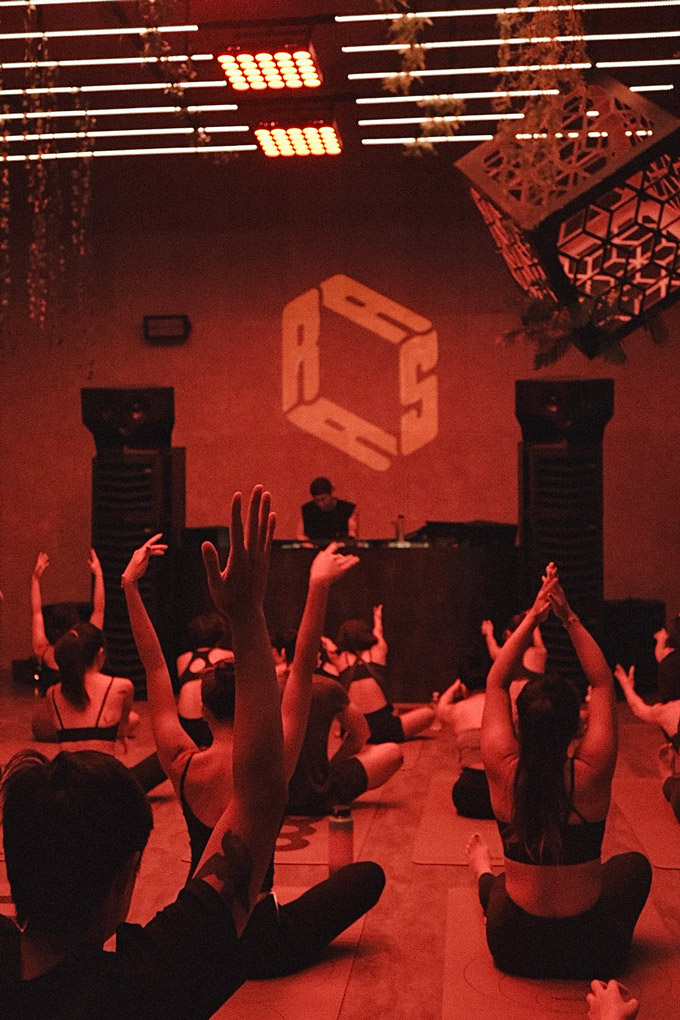
A Vinyasa class at Beam isn’t quite the same as what you’ll experience anywhere else. Whilst music is typically the accompaniment in a fitness class, here, music pours out of a live DJ set or is specifically curated for the class, switching up according to the movement. The man behind the console would be familiar to most—music director Manfred Lim (commonly known by his stage moniker Myrne), who is also co-founder to Beam. A labour of love co-founded by Wong Shi En and Josephine Bahari who takes care of yoga programming and design and branding respectively.
“Beam, at its very essence, is a multi-disciplinary movement studio that integrates music in all of our classes to a high degree. The idea came together out of our shared love for fitness and music, with the goal to create an immersive experience for both music lovers and practitioners alike. It’s more an ‘experience’ than a ‘class’, but the practice itself is rooted strongly in Vinyasa,” offers Lim.

Currently, four main classes are offered at Beam—all to cater to various fitness goals: Vinyasa Flow, Slow Flow, Mob + Flex (Mobility) and Submersion, which happens to be their signature meditative practice, that’s soundtracked on site by Lim, with music that mirrors the energy and flow of participants in the class.
Below, Lim shares more about the philosophy behind Beam and his process of curating music that moves and restores.
What goes into a class at Beam?
I’ve found that engaging multiple senses enhances the intensity of a sensory experience. For example, music sounds slightly better with visuals and mood lighting; a soak in the tub feels calmer with a peaceful song playing. When we have our classes at RASA, the artistic overhead lighting and their world-class, custom hand-assembled TPI sound system really puts attendees in a different headspace. And the view! It’s a little poetic to be in a soundproofed room in the heart of the CBD—the engine of Singapore’s success—doing yoga to ambient music, as if you were escaping from the world for an hour.
Beyond involving sensory elements like light and sound, our class philosophy is to create experiences that feel holistic and well-rounded. Many of our yoga classes stay fresh by weaving in elements from other movement disciplines—such as animal flow and calisthenics—resulting in a practice that is both dynamic and expansive. That really shines through in our space collaborations with unique venues like RASA Space (a world-class bar and nightclub), and AIR CCCC (a sustainable restaurant nestled in the middle of nature). So when we’re looking to collaborate with venues, we usually try to highlight something about the space that makes the experience really unexpected and unique.
View this post on Instagram
A typical movement class involves music. How does Beam’s differ and what is it meant to evoke?
This is one of the few classes where the music morphs to what you’re doing in class. If you’re hitting an advanced or unfamiliar pose, the music gets a little louder and more persuasive; likewise, once you’re done, it brings you back down into a calmer, familiar place. Structuring a class like that tends to put you in the center of attention, like you’re going on a deep personal journey. I collaborated closely with Shi En, who devised all of the class flows, to structure the music and sets to many of the ‘peak moments’ in each class.
As a musician yourself, how differently do you approach how the sounds you mix or curate for a Beam session? How would you classify the sounds at Beam?
It’s very different from preparing for a traditional DJ set. To start, the music I play during these sets include songs that have kept me grounded through the years, or pieces of music I find deep peace and enjoyment in.
Some of these tracks feel a bit more poignant when you’re really intently focusing on the music, which in our classes you can do during Shavasana (a pose where you lie on your back with limbs relaxed and eyes closed). In my opinion, the music in this genre occupies a strange space—it’s music that should be lively enough to be felt and focused on, but not too overbearing to take precedence over class flow. As for music genres, it’s a lot of musique concrète, ambient, neoclassical, downtempo, and meditative drones. The music is functional yet immersive; equally rewarding when focused on, or left in the background.

With the rise of wellness and recovery spaces in Singapore, more people seem to be slowing down and taking a breath—is that the aim of Beam as well? Why do you think people are gravitating towards these spaces?
I agree, somewhat. On the contrary, I think learning to slow down and be more in tune with your body is a conscious, intentional act that takes a lot of work to get good at. It’s very easy to stay out late for drinks, but it’s harder to commit to a 7:45am Sunday yoga class. To me, it feels like more of a re-direction of energy into activities that were previously thought of as unproductive. Also, as intense fitness activities become more popular (e.g. HYROX, trail marathons, etc), intentional recovery spaces will too. As the world grows slightly noisier and more chaotic, Beam’s place in that world is to find and nourish one’s sense of self.
What can we expect from Beam in the near future?
We’re going to be continuing our classes at RASA over the next few months, from Wednesdays to Fridays weekly. For September, we’re hosting yoga classes at Nowhere Baths so we’re really excited for that!
Book a class at Beam here.