I am treading up the side of a Swiss mountain, carefully placing one foot after another as gravel rolls under the soles of my shoes. The hiking poles I am clutching have been useful until now in helping me navigate the ever-changing terrain, but faced with a flowing stream of water between where I’m standing and the next stretch of grassland, my gait becomes increasingly unsure—eventually coming to a complete stop.
I feel an arm slip into the crook of my elbow and turn to see Olympic champion skier Bernhard Russi smiling at me. With an assured nod, Russi whisks me across the stream in a matter of seconds, seamlessly charting a path atop the open-faced rocks jutting out of the water. He knows exactly which ones to step on and which ones—sharp, shaky or slippery—to avoid.
We reach the other side and come face to face with a brown-spotted cow staring at us with big, gentle eyes. I notice its cowbell before Russi explains that for the local cows, mountains are only a temporary home for the summer when grazing pastures are at their best. Come winter, farmers and farmhands bring them back down to stay warm. “It’s like they’re on summer vacation,” he says with a laugh.

The sunshine warms my back pleasantly as we continue our ascent. I take a deep breath and the crisp, cool air feels like it’s reaching the very bottom of my lungs. At any given moment, the views around us are so picturesque it feels almost like a mirage—as if I might wake up any minute and find myself back in my busy hometown city, where the highest I could get is a rooftop bar on a skyscraper.
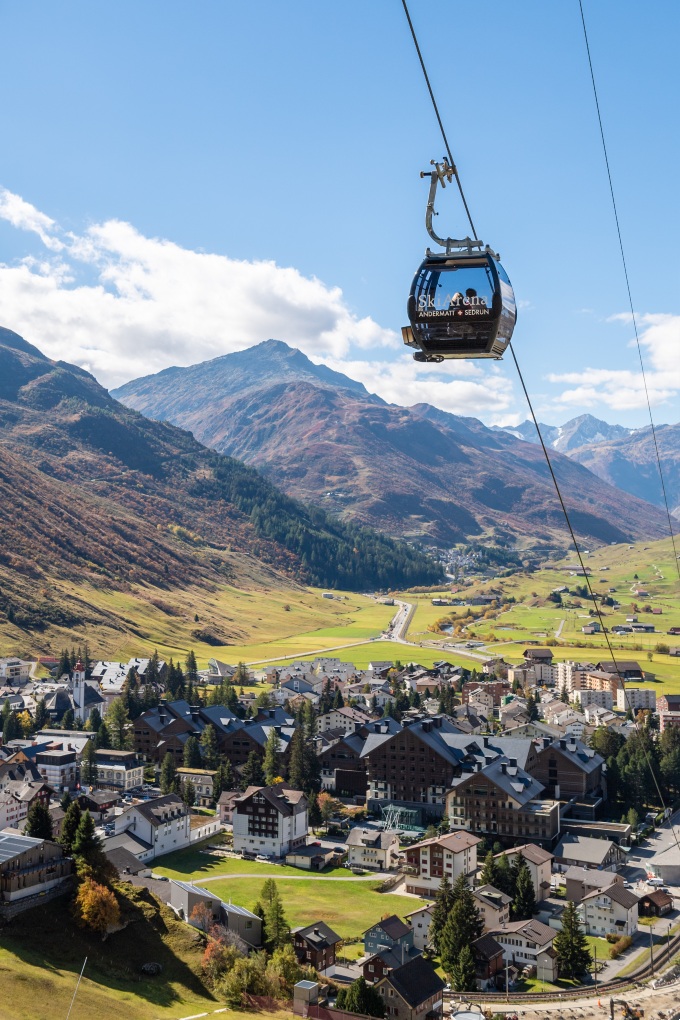
This sort of wistful sensation has gripped me since I first stepped foot into Andermatt a few days prior. A quaint alpine village nestled in Urseren Valley—a little over an hour from Zurich by car—Andermatt is home to fewer than 2,000 locals who live a simple but fulfilling lifestyle immersed in nature. What might come as a surprise, then, is that the village is also the site of a vibrant revitalisation that is steadily turning it into a captivating new home for a uniquely spirited global community.
A glance into Andermatt’s history reveals a fascinating past. In the late 1800s, the Swiss Army established one of the country’s most significant military training grounds in the village. Thereafter, for nearly a century, Andermatt operated as a strategic military site, surviving on the economic activity brought by the soldiers.
But to understand Andermatt’s relationship with hospitality, one has to look even further back. By 1830, the Gotthard Pass was made accessible for horse-drawn carriages, leading to an influx of tourism and trade into Andermatt. The village flourished and Grand Hotel Bellevue was opened as a haven of luxury, welcoming its share of well-heeled clientele from Russian aristocracy to Queen Victoria.

Today, what sits on the same plot of land as the long-torn-down Grand Hotel Bellevue is an altogether different gem of hospitality. Known to hotel and design buffs around the world, The Chedi Andermatt is a gorgeous vision of alpine luxury. Contemporary yet in perfect harmony with tradition, the Jean-Michel Gathy-designed enclave is a seamless confluence of warm wood, lush materials and mood lighting.
A soothing fireplace pops up seemingly at every turn, including in the rooms, which are sprawling yet cosy, with soft leather furniture and a sophisticated palate of black, deep red and chocolate. Large windows and balconies frame jaw-dropping alpine views from every angle.
The hotel is also home to The Japanese, a two-Michelin-starred contemporary fusion restaurant helmed by Fabio Toffolon and his twin brother Dominik Sato. The omakase menu, offered in a handful of carefully considered courses, invites you on a journey that’s as much about the experience as it is about the taste—marrying the elegance of European culinary tradition with the clean, precise notes of Japanese cuisine.

The Chedi, which opened in 2013 and drew new eyeballs to the storied village, is part of Andermatt Reuss, a larger development project featuring apartments, chalets, hotels, restaurants, a concert hall and an 18-hole golf course. The range of offerings—varied yet true to Andermatt’s quaint ambience—is slowly but surely transforming the village into a year round destination. The development also involved a major upgrade of the ski area and equipment, which is to the benefit of the throngs of winter sports enthusiasts flocking to the region.
It’s no secret that the Swiss Alps have always been the ultimate ski destination, with the more obvious hot spots (think Verbier or St Moritz) functioning as regular paparazzi circuits for celebrities seeking après ski indulgence. Spanning 180km of slopes, the Andermatt-Sedrun-Disentis ski route is, instead, a more attractive magnet for seasoned ski enthusiasts.
It’s life alongside the local community which makes the Andermatt experience so charming.
For advanced skiers especially, it is difficult to envision a more exciting canvas than the Gemsstock mountain, which is nearly 3,000m high. With excellent snow quality on- and off-piste, and plenty of interesting challenges to navigate, it’s widely considered the pinnacle of off-piste skiing. Russi confirms this—in this regard, I am inclined to take the Olympic gold-medallist and ski legend’s word as gospel.
It’s how the village continues to flourish throughout the year that is truly intriguing. Whether you’re a tourist or the lucky owner of one of the chic new apartments sprouting up in Andermatt Reuss, it’s life alongside the local community which makes the Andermatt experience so charming. Non-intrusive but warm, residents welcome new faces with open arms.

There is plenty to do during the warmer months. One early morning excursion brought me to the doorstep of two local cheesemakers (a mother and daughter who share that the family business has been running since 1979) living high on the Galenstock mountain. Their farm, overrun with chickens, pigs and an endless garden of lush flora and fauna, is a delight for the senses.
Taking me through the intricate process of cheesemaking before we sit down to chat over a plate of fresh cheese, the pair also shed some light on how the locals feel about the new development. Their enthusiasm for the project brings to mind another interesting fact I had earlier learnt about Andermatt’s history.
Back in the 1940s, Urseren Valley came dangerously close to being drowned beneath a hydroelectric reservoir. But in 1946, the residents of Andermatt stood their ground, voting against the proposal. In a striking act of resistance, the local community drove the lead engineer out of town, making it clear that their valley would not be so easily surrendered.
The story reflects the fiercely independent spirit of the local community. It also reveals, perhaps, that their majority vote in favour of the present-day redevelopment counts significantly for Andermatt.
“For Andermatt, nature will always be number one.”
It’s this context that allows me to view Andermatt as a compelling example of modern sustainable hospitality. While environmental considerations remain central to the village’s transformation, what stands out even more is the social impact: the hundreds of new jobs created, and the growing community of global residents—some seasonal, others permanent—who now call this alpine village home.
Their presence has opened new economic possibilities, offering tangible benefits to local business owners and residents alike. The deliberately dense nature of Andermatt Reuss has also allowed for the maximum preservation of the region’s natural bounty—something everyone, from developer to resident, holds sacred.
“Andermatt will always be a small destination,” Russi says emphatically. “We are never going to be huge. I’ve been asking myself, why are people from all over the world choosing to buy homes here? It’s because they have a certain guarantee: Andermatt will always remain the same. Of course, we have a beautiful development in Andermatt Reuss, but nature will always be number one.”
The 18-hole, par-72 championship course designed by renowned golf course architect Kurt Rossknecht is one example of this philosophy. With the expansive, deliberately unmanicured natural landscape carefully preserved, it not only serves as a valuable biodiversity habitat for thriving flora and fauna, but also provides a breathtakingly scenic and uniquely challenging game—perfect for seasoned players. As with other new construction projects, locally sourced materials are favoured, directly benefiting local businesses and construction companies.

The rest of my time in Andermatt is spent exploring a great breadth of experiences, which exemplify how there is something here for everyone. For a taste of alpine glamour, I live out my James Bond fantasies one afternoon with a spin up the legendary Furka Pass in a Morgan 4/4 to see the spot where Goldfinger was filmed. With the wind flowing through my hair and a dozen photos snapped, it is a thrilling experience I won’t soon forget.
That same day, I take the gondola up to the Gütsch mountain, where Michelin-starred restaurant Gütsch is nestled 2,344m above sea level. Sitting on the patio, acclaimed Swiss chef Markus Neff’s delicate, locavore-focused cuisine tastes even more delicious when paired with the panoramic views of the Swiss Alps. For more rustic flavour, we stop by Restaurant Sonne for dinner, where traditional local cuisine is served in a warm, homely atmosphere. Here, we indulge in a feast of fondue, rosti and veal chops.
What my mind keeps wandering to, however, is the one blissful lunch I share with Russi in his mountain cabin, sitting high on Wildenmatten. It had taken me three hours to hike to this picturesque enclave which functions as a lovely meeting place for family or a quiet spot for him to enjoy in solitude. At 76, he can still easily make it up there in under an hour. He hospitably puts out a simple but soul-satisfying meal of fresh bread, cheese, butter and dried sausage, which we dig into heartily as we chat about Andermatt’s history, evolution and promising future.
I ask him how he feels the local community will respond as the village becomes increasingly popular to visitors and he responds with a laugh. “Well, this is what I can tell you. We are mountain people. Mountain people are not easy, but they all have a very big heart.”
Discover Andermatt here.