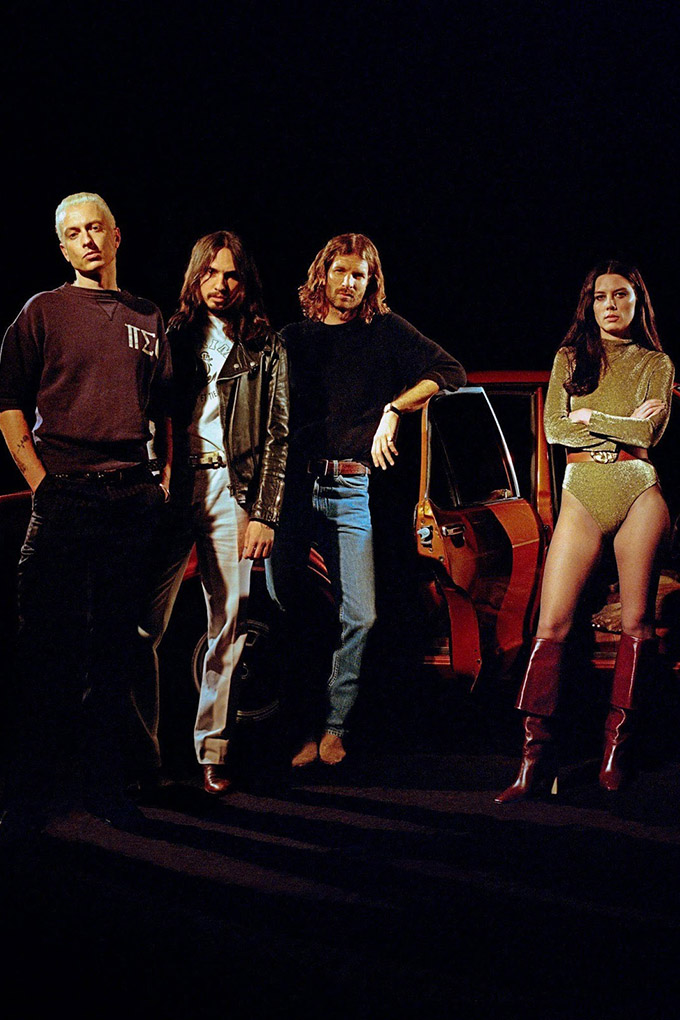
Wolf Alice are one of the United Kingdom’s biggest rock bands. The release of their 2013 debut record, My Love Is Cool, put them squarely on the path to stardom. Single ‘Moaning Lisa Smile’ netted them an early Grammy nomination, which was quickly followed up by a Mercury Prize win for their second album, Visions of a Life.
Now, their latest album, The Clearing, released last August, has raised the stakes yet again. It’s a rollicking good time—a little less shoegaze, a little more punch, power and pop, full of uncompromising performances and tight production (helped in no small part by producer Greg Kurstin’s capable hands and ears).

When lead singer Ellie Rowsell’s soaring vocals aren’t dancing with the feathery gloss of the ethereal, they’re piercing through the mix with all the dramatic force of a solar flare. Of course, the rest of the quartet—guitarist Joff Oddle, bassist Theo Ellis and drummer Joel Amey—are as reliable as ever, expertly constructing and executing the musical arrangements that continue to form the bedrock of the band’s sonic hallmark.
That sound? A delightfully uncanny sense of sheer emotion and feeling. All this is buoyed by lyrics that cut right to the heart of the human condition—sometimes bold, sometimes brash, but always with a touch of incisive wit. With Wolf Alice, you just can’t help but be moved.
To find out what’s been powering the Wolf Alice machine in 2026, Vogue Singapore sat down with the members of the band ahead of their live performance at the Capitol Theatre.

The last time you were in Singapore was at Laneway Festival 2018. How do you feel about being back in Singapore and playing your own solo show?
Joff Oddle: It’s amazing. It’s been a while, but the last time we played at Laneway, Billie Eilish was there, so there was quite a bit of buzz. While that was a minute ago, it’s great to be back. When you go somewhere far flung, you kind of pinch yourself. You think: I can’t believe we’re here. And then to be able to come back again—it’s fantastic.
Self-discovery, love and loss, the passage of time and its role in shaping womanhood—The Clearing is an incredible work of art. How would you personally describe the album?
Ellie Rowsell: I think we had trouble even just writing and approving the press release. It can be so hard to describe your work, and often it doesn’t feel like it’s your job to do it, and especially in such a short amount of words. So I feel frightened to take on the task.

Your previous albums all had different producers. How did collaborating with Greg Kurstin this time around help shape your approach to recording and writing the songs?
Joel Amey: In our experience, every album working with a different producer gives you different takeaways. You find yourself asking: what’s the experience going to be like? What sounds can they make? For Greg, he has a skill set that goes beyond what you can do just behind the desk. There are quite strong personalities in the studio, so it’s also how you can make people feel comfortable, and how you communicate with each other.
He can do all of that, in my opinion, as well as know some crazy chords on the piano. It’s super inspiring to be around. For someone to make you feel comfortable enough to do your best, but also potentially show you a different route to what you thought you could do? To not necessarily shoe-horn you into a specific project but simply suggest things? That’s a gift. I look back on it so fondly every day, it was great.

Since your earliest records, you’ve stayed grounded and self-assured. How have you stayed true to yourselves?
ER: At the start, I think that we didn’t even know what we were ourselves, and what it meant to be true to ourselves. When I look back, I feel like we just spent quite a lot of time exploring and being curious and trying stuff out—rather than thinking “we have to stay true to ourselves”.
When it comes to figuring out what we do, who we are, what we sound like, the one thing I come back to every time is that if I’m enjoying the music, then everything else becomes easier. So while I don’t always do this, I just try to write music that I want to listen to myself. That’s easier said than done, of course, but that’s the goal post that doesn’t really change. I think that keeps me grounded because then you’re not considering what other people might expect from you.
The ‘Brit rock’ genre is very different now compared to before. Would you say other bands in the scene have inflected your sound in any way?
JO: Obviously, you’re influenced by just what’s around you. When you turn up to festivals, you’re surrounded by so many different bands and some of their sound sort of seeps in through osmosis. But I feel like it’s a real mix of everything. American music especially looms so heavily in the alternative guitar world, so that’s probably more of an influence than just the stuff in the UK.
All these years later, do you think you’ve found your rhythm? Or are you always looking to change the game?
JO: It’s just comfortable to try new things, you know. There’s so much good music out there. There are so many different avenues to explore and things to do. We’re definitely not a group of people that just want to find ‘the formula’ and stick to that. We’re just having fun trying to explore and grow.

How have you grown as musicians over the years? What do you do to hone your individual crafts outside of what you play on the stage?
ER: This is a bit of a boring answer, but for me one of the most helpful things is to just learn other people’s songs. If you like something, you should try it for yourself. If you like the way someone else sings, see if you can do an impression of them. If you like a song in a particular genre, maybe try writing something like that, or just learning the song itself. It sounds really obvious, but maybe when you’re younger and just starting off, you’re just trying to find your own sound. And it can be easy to not want to be like someone else, because then you might sound like you’re copying them. But I think that learning other people’s songs is a really amazing way of expanding how you see music—learning new chords and stuff like that. Especially if you don’t have a teacher.
Theo Ellis: In the beginning, I learned a lot of stuff just by performing live. But then I took that approach to playing bass into the studio and without the chaos of the live setting, it suddenly became awful to listen to (laughs). So I realised I need to learn how to get my practice to a point that I can play in different contexts, on and off the stage. And then I think, like Ellie alluded to with listening to other artists—for me, it wasn’t necessarily looking to specific people, but rhythms that I really liked.
So it would be more of a holistic thing between the drums and the bass, with songs where I really like the groove and the pocket. I practiced a lot before we did this record, to make sure we didn’t over complicate things. And I realised it can be really inspiring to just engage in the practice of learning. I kind of didn’t believe in that my whole life. I wish I could go back to school now, because back then I was such a twat. I mean, I’m still a twat now, I’m just willing to sit down for longer.

JA: Because I don’t have a drum kit in my house, I just try and stay curious about rhythms. My goal as a drummer is to create something that supports the songwriting. I’m not going to be a virtuoso. I’m not that good (laughs). But if I can sit out and just shake the tambourine, which is another thing you learn over time, and provide something that’s minimal—that can do way more for the music than just soloing all over the drums.
TE: Playing the tambourine in time is so hard.
JA: It is! It’s like, physically, the most punishing thing.
JO: Oh, I think everyone who’s been around me has been annoyed, because I’m a compulsive guitar player. If there’s a guitar in a room, it’ll be a real struggle to not just constantly be fiddling with it. That being said, I do trying play a lot of guitar on a daily basis. Although, on tour, I sometimes feel that, weirdly enough, they’re not around when you need them. I only get time with my instrument when I play live on-stage. In recent years, I’ve been playing a lot of what I call ‘passive guitar’—I’m not thinking about specific arrangements, I’m just trying to find sounds.
Who are some artists that are inspiring Wolf Alice right now?
JA: I just found this artist called Sekko. It’s a strange, really unique blend of instrumental music. It’s got quite twangy guitars, but it’s also got these huge hip-hop drums underneath it all.
TE: Talking about rhythms and stuff, I was thinking of Big Thief the other day. Their album from a few years ago had bass and percussion that was really inspiring.
JA: He was the producer, the drummer.
TE: Is he? That would explain it.
JO: I love that record.

Any tour bucket list locations?
TE: Brazil. Argentina. Chile.
ER: Edinburgh.
TE: Oh, I want to play at the Minack Theatre, in Cornwall. I’m obsessed with pictures of it.
JO: It’s gorgeous. Well, when it’s not all wind and rain.
What does the future look like for Wolf Alice after Singapore? Are you going on a much-deserved break, or is the studio calling your name?
TE: The studio is calling our name.
JO: Well, wait a second- (laughs)
TE: But yeah, life as a band is quite counterintuitive sometimes. There is always the kind of hum of what’s to come next, which is quite nice. But yeah, nah. We’re going on tour in Australia, to Laneway Festival.