On 1 February 1929, one of the most storied hotels in history opened its doors on Sunset Boulevard, Los Angeles. Perched on the edge of the Sunset Strip, the glamorous Chateau Marmont offered its clientele tooth-aching luxury and discreet privacy in equal measure, becoming an instant Hollywood favourite. The hotel quickly became known for the legendary incidents that happened on its castle-like grounds, featuring an eclectic cast and crew of some of the most famous people to ever exist—from Marilyn Monroe to Courtney Love.
Some of these stories are robed in scandal—like Lindsay Lohan running up a bill of more than US$40,000 and refusing to pay—while others, like Beyoncé and Jay-Z’s A-list-only Oscars afterparties in the garage, reflect the nearly century-old hotel’s emblematic status as a home to the Hollywood elite.
But this story is not about Chateau Marmont; neither is it about its ultra-famous clientele. Instead, it is more interested in where the loyal entourages of these celebrities (their publicists, assistants and make-up artists—anyone they couldn’t travel a mile without) would stay when their famous bosses were trashing thousand-dollar hotel rooms.
The original Standard Hotel in Hollywood was incredibly down to earth, but it became a place where interesting people would come to party.”
Cue: The Standard. In 1999, the first Standard hotel opened on the Sunset Strip in Los Angeles—a stone’s throw from Chateau Marmont. This proximity in location was where the similarities between the two hotels ended.
It quickly became obvious that The Standard was designed for a younger, hipper, cooler guest. Modern art was embedded in every inch of the hotel: Andy Warhol’s iconic flower print was transformed into drapes, and a permanent installation in the lobby invited performers to sleep in view of the public. While guest rooms were pared back, the common spaces felt like nightclubs thanks to rebellious design and lighting choices. Music reverberated throughout the lifts; the front desk doubled as a DJ booth.
The hotel instantly became a hit among the up-and-coming creative crowd, turning into a brewing ground of culture. Soon, the celebrities who had booked in across the road started slipping in, drawn to The Standard’s laid-back and effortlessly quirky ambience like moths to a flame. With its more approachable price point and boutique model, The Standard redefined—and elevated—the idea of an inexpensive hotel.

Twenty-five years on, the original hotel in Hollywood may be closed, but its spirit lives on in the other Standards that have opened since, from New York to Bangkok. The latest iteration comes in the form of The Standard, Singapore, a high-rise building tucked away on the picturesque Orange Grove Road.
Positioned in the heart of the city, the Orchard district has always been a hotbed of luxury hotels in Singapore. Still, the last few years have seen a nearly unprecedented number of openings. What’s worth noting is in comparison to nearly every one of them, The Standard boasts significantly lower room rates. As you step in through its doors and take in the high-concept design and custom mid-century modern furniture filling the lobby, it’s difficult to reconcile this price differential.
“The original Standard in Hollywood was an incredibly down to earth and simple hotel. It was super basic and there was no fuss. There was no doorman—there wasn’t even air-conditioning!” shares Verena Haller, chief design officer at The Standard Hotels.
“But it had this cool vibe. It became the place where all these interesting people and celebrities would come to party. The hotel had created an environment where people felt comfortable enough to let loose and still felt safe. And that’s what we continue to try and do with every new opening.”

The Standard, Singapore is the brand’s third hotel in Asia—the first two being in Bangkok and Hua Hin. Haller shares that before each new hotel is conceptualised, the team spends time immersing fully into the new destination, absorbing its essence and trying to distil what makes it unique.
As recognisable as the brand is today, she emphatically points out, no two Standards look and feel exactly alike. “We want each Standard hotel to capture the local spirit and the neighbourhood. In fact, the public spaces are designed not only with guests in mind, but the local community too. We want them to come and hang out, and for this to become a neighbourhood hotspot.”
Singapore’s reputation as an urbanised garden city inspired the hotel’s design, which was led by lauded local design studio Ministry of Design (MOD) alongside Haller and The Standard’s in-house design team. “The Standard brand is, at its core, anything but standard. While we wanted to incorporate Singapore’s tropicality into the hotel’s design, it had to be this quirky, fantastical version of tropicality,” says Colin Seah, founder and director of MOD.
You’ll notice what Seah means the minute you enter The Standard, Singapore, pushing past its stark modernist facade. It might take you a second to locate the reception counter, which instead of the conventionally formal-looking desk, takes the form of an oversized terrarium, with a transparent screen revealing a tongue-in-cheek botanical-inspired installation by Thai artist Eric Tobua—complete with miniature animal figurines. Who says checking in has to be boring?
A delightful sense of irreverence permeates the hotel in ways big and small. The best example of the latter is probably a pair of small puppy figurines sculpted in chrome, which move around the lobby from time to time, and sit alongside cheeky little silver pebbles fashioned to look like their droppings.
“We think of them as hotel pets, and of course, these things are bound to happen with your pet,” a member of staff tells me with a conspiratorial wink when I gasp upon noticing that detail.

Most of the 143 guest rooms, like in many newer Singapore hotels, are on the compact side. Still, tactical manoeuvring of the layout and design elements open up a good amount of space. Vintage-looking leather pouches are mounted on the wall as space-saving storage options, while a stuffy closet is eschewed in favour of quirky wall hooks. “Flaunt your fashion!” Seah jokes.
Two squat, modular cabinets are flushed together to form an unobstructive minibar, which offers welcome shelf space and adds an eye-catching pop of red to the room. Even in the smallest rooms, there is a comfortably spacious workspace consisting of a terrazzo table and a plush, circular couch. In the twin rooms, this set is cleverly slotted in between two beds, acting as a quaint shared nook during the day and doubling up as handy bedside storage at night.
One of my favourite touches of design is a timber ribbed canopy that sweeps across the ceiling, covering the width of the bed and anchoring the room. It’s a feature also found in other iconic Standard properties like the one at New York City’s Highline, Seah explains. “It’s a nice point of difference from an all-white ceiling,” he adds. “It makes the room feel cosier and it makes you feel contained.”
The bathrooms take a Wes Anderson-ish turn, with white and yellow subway tiles wrapping from walls to floor. It feels joyful—a quality that, in toilets at least, is certainly rare. “Our goal with the guest rooms was to make them punchy but still restful. The design isn’t in your face, and it walks that fine line between being artsy and offering comfort,” Seah observes.
Float down to the signature restaurant, Kaya at The Standard, and you will be met with a moodier ambience and more audacious design. Creepers drape down from the ceilings, intertwining with pendant lights of varying shapes. An eclectic custom wallpaper mural by Saran Yen Panya titillates with its blown-up ’80s glassware print paired with 3D brocade florals. “The artist’s mother and sister actually made the flowers, which he later stitched on,” Haller shares.

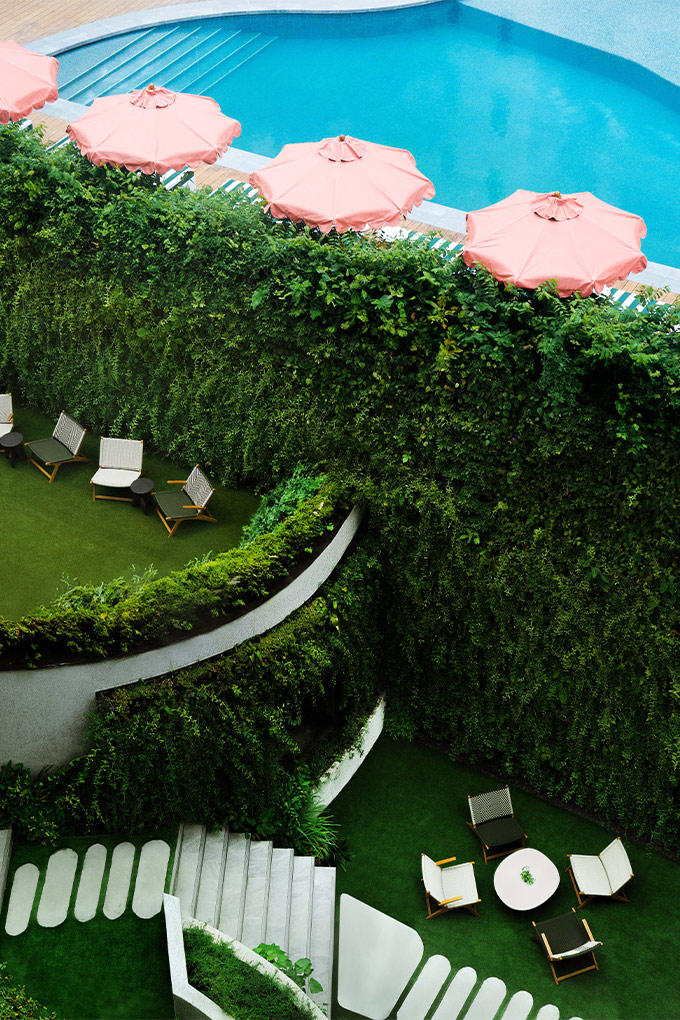
The restaurant, which serves a curated menu of creative Japanese-inflected dishes with a focus on fermentation, leads seamlessly out to the hotel’s lush open-air courtyard. From here, you can head straight to the pool, with its reflective wall installation, submerged lounge chairs and swim-up bar (sure to be a hit). Or, you could turn to what I find to be the most charming and unique section of The Standard, Singapore: the garden.
A multi-tiered marvel of landscaping, the open-air courtyard gradually moves guests upwards or downwards through a central winding staircase shrouded in lush greenery. Along the way, there are several off-shoot spaces of varying sizes and shapes, each one inspiring the imagination with a multitude of ways to occupy and enjoy.

A breezy brunch with friends with cocktails from Café Standard (a street-facing, buzzy bistro-style lobby bar that also doles out heaping plates of burgers and fries); an evening dance party on the grass—“this area will be decked out with a DJ booth,” Seah informs me—or even a solo afternoon of people-watching that ends with a stunning sunset, as you sprawl across any one of the idiosyncratic lounge chairs and hammocks that line the various levels of garden. The possibilities, quite literally, are endless.
“Oh yes, that beautiful garden is definitely where all the action will happen,” Haller agrees happily. “Right from the start, we knew that the focus had to be on the greenery, which is why we wanted to have all the food and beverage outlets be connected to the outside. So we’ve been designing from the outside in, really.”
“The goal was to create an oasis in the middle of the city,” Seah adds, referencing both the abundance of green spaces within the hotel and the palpably warm service each member of staff delivers. “Even outside the rooms, there are tons of public spaces where guests should feel comfortable spending time in. It’s an intimate sort of stay, filled with friendly faces and moments of art and design that I think are going to make people smile.”
Vogue Singapore’s January/February ‘Resolution’ issue will be out on newsstands from 7 January and is available to preorder online.