The new Dyson PencilVac is a true testament to the brand’s innovative spirit. With a body that is the same width as the handle of a Dyson Supersonic hairdryer, it is the world’s slimmest vacuum, and weighs only 1.8kg. Coupled with a cleaner head that swivels in all directions and cleans from both front and back, it practically floats across the floor with little to no effort. In the meantime, four fluffy conical brush bars at the bottom work to quickly untangle long hair so that they don’t get stuck in the process. When the cleaning’s done, a new hygienic bin emptying system allows you to thoroughly clear out the dirt without getting your hands dirty at all. All this to say, the PencilVac makes the act of vacuuming as easy and painless as it can get—at least until Dyson eventually dreams up something new down the line.
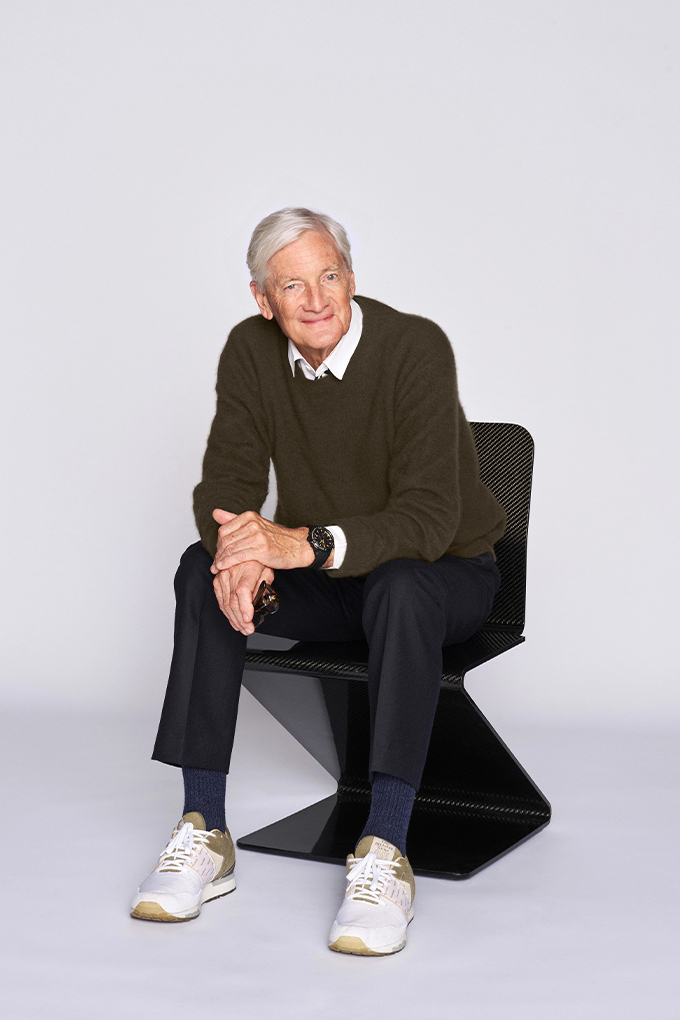
None of which is surprising, of course, given that Sir James Dyson himself founded the company in 1991 by inventing the world’s first bagless vacuum. Created to solve the problem of bagged vacuums losing suction as they picked up dirt, the seminal product took five years and 5,127 prototypes to perfect. Since then, the brand has grown into an empire that is constantly pushing the boundaries of technology as we know it—built on James Dyson’s revolutionary vision. In a rare interview whilst in town for the launch of the Dyson PencilVac in Singapore, he opens up on his design ethos, the future of innovation and the legacy he hopes to leave behind.

Dyson is constantly making breakthroughs when it comes to appliances—how do you decide what technological boundaries to push, or what problems to solve next?
We’re all consumers, using things every day. As an engineer, you judge whether it’s good or not, and when you can see something’s being done badly, you want to do it better. Mostly, it’s pretty obvious, like how a vacuum cleaner with a bag is a bad idea. I knew it was a bad idea when I was nine and my mother made me vacuum the house, but people weren’t expressing this because that’s all there was back then.
In breaking the mould, is there ever a fear that consumers will not respond to a product well?
If you’re doing something different and new, sometimes it’ll catch on, sometimes it won’t. You can’t guarantee a new product would be successful. Nobody can, and that’s what makes it exciting. I never want to be a gambler, but I do gamble with products. I didn’t know whether people wanted a vacuum cleaner without bags. All you can hope is that people think in the same way that you do.
What was the thought process behind creating the Dyson PencilVac?
Everybody complains that vacuums are too heavy. Everybody complains that hairs get wrapped around the brush bar. By the way, I love complaints, because they give me ideas. But the PencilVac is designed to solve those problems.

Over the course of your career, do you feel like your approach to design and innovation has evolved?
Conceptually, not much. What was slightly unusual about my approach at the beginning was that I trained as a designer and then became an engineer. But at the time, in the 1960s, that was quite a bold decision. There were engineers on the one hand, and industrial designers on the other, and never the two shall meet. They were opposing camps. One wore white coats and the other wore pink shirts and drew things with felt tip pens. But I decided that was wrong, and that how something looked and how it worked were strictly mixed up and should be done by the same person. So I figured that out, and went against the flow, and that hasn’t changed during my life. I’ve gone on doing that. Of course, everything else has changed. Software has come a long way, and all sorts of things like that, but my basic approach is the same. I’m not splitting design away from engineering—it’s the same thing. The principle I started with has stayed with me.
How do you know when the design is truly done, especially when innovation is ongoing?
The lovely thing about engineers and scientists is they’re never satisfied. So if you left it to them, they would never produce a product, because they just go on improving it and changing it. You set out to produce something, and halfway along, you have another idea, or you discover a better way of doing it—which is great, but it mustn’t stop you from bringing out the thing you set out to develop. So you have to have a goal, and when you meet the goal, then you put it into production.

As an inventor, do you believe that new is always better?
Not always, but as the world changes, we’ve got to try and improve things, even if sometimes we don’t succeed. I hope that most new things are an improvement, otherwise they couldn’t sell. But regardless, we should move forward.
You are 78 this year. You’ve been designing for five decades now, and have grown Dyson into an empire. What is the legacy you hope to leave behind?
Nothing stands still—not time or technology or design. The world changes so fast all the time. But inside I still feel young, even as the body starts failing. I’ll go on doing this as long as I can. It’s a bit like planting trees. I plant trees now, and I might never see them grow fully in my lifetime. But it doesn’t mean I shouldn’t do it. I’m doing it for other people. The goal is to set something up so that things can change and grow way beyond your own lifetime. I’m really lucky because I have a son who loves doing what I’m doing, so the company will carry on, and he’ll do it in a slightly different way—and probably better than me.
Find out more about the new Dyson PencilVac here.