Watching a runway show is an immersive experience, to say the least. Each element of the show space is designed to entice and enthral, working in tandem with the collection to convey the vision of the creative director. The show is a feast for the senses as no detail is left to chance—from the moment you open the invitation to the time you enter the venue, where light, sound, structure, movement, model and, of course, the clothing come together to create a fleeting moment that orchestrates a brand’s own world.
Amidst the extravaganza sits the anchor of the show—the space. “Maisons must sell a vision, a lifestyle, an experience, and set design is the first medium for their storytelling,” Livia Grigori and Dan Ricciardi explain. The architect duo run Atlas of Shows, a platform dedicated to the art and science behind runway show set designs. Over the years, scenography has become an increasingly central part of how brands communicate their image, revealing the intention behind the show.
View this post on Instagram
It is imperative, they note, that the set answers a fundamental question: how should the audience feel? “The intended experience determines how the collection, the models wearing it, the guests watching it and the architecture interact and, ultimately, how the show will be remembered as a single, iconic image,” Grigori and Ricciardi elaborate. At Saint Laurent’s spring/summer 2027 runway, gold was the language of the show, draped languidly on the models as they walked beneath monumental candlelit chandeliers against the backdrop of the glimmering Eiffel Tower at dusk. It made for a grand, beautiful love letter to the house as creative director Anthony Vaccarello bid adieu to the maison after a decade. At Diesel, euphoria, hysteria and desire ran through the room. Glenn Martens collaborated with Studio Dennis Vanderbroeck for his final collection to create the brand’s very own club, complete with performers moving in an artful chaos as they sat amongst guests.
View this post on Instagram
Fashion always reflects the current zeitgeist, and the show space is no different. While intention comes first, a sense of the times naturally finds its way into the inspiration. Grigori and Ricciardi see familiarity and reassuring environments come to the fore amidst times of global tension: “We have seen a recurring preference for natural elements, flowers, warm materials and inviting, comfortable atmospheres.” Wilted blooms captured the scene at Maison Margiela, as Dior presented 65 looks in the Jardin des Tuileries amidst an oasis.
Beyond the emotion and experience undoubtedly lies a high-performing team. It takes a village to raise a set, one that gathers the expertise of the creative director, set designer, lighting and sound designers, technical directors, production managers, engineers, builders and craftspeople. “Each brings a different kind of expertise, helping translate an initial idea into a space that can actually be built and experienced. There are countless practical and creative decisions to make,” the Atlas of Shows pair expands.
Scenography is also where creative collaboration shines through. A show’s unique accents are often created in partnership with a fellow artist. Louise Trotter’s recent Bottega Veneta set was filled with a bright airiness that was accompanied by the works of artist Illya Goldman Gubin, whose cardboard box seats were crumpled by the artist’s embrace. A step into Acne Studios’s show and you’re instantly transported into Vasa, an ornate 17th-century Swedish warship. The cherry on top hung from the ceiling at the end of the hall, as Azerbaijani artist Faig Ahmed transformed traditional carpets into sculpture.
View this post on Instagram
Peek behind the scenes of a runway set and you’ll constantly run into one name: Bureau Betak. The French set design and production agency is the mastermind behind the spaces of fashion’s heavyweights with the likes of Dior, Saint Laurent, Valentino, Fendi, Celine and Burberry, to name a few. “The digital age has drastically changed the way scenography is designed, as it demanded greater attention to minute details and how the space would appear both in person and on-screen,” Grigori and Ricciardi comment. This evolution was something Bureau Betak innately understood. A single snapshot of the worlds they built became a strong spatial gesture, elevating the standard of contemporary fashion shows through material, technical production and guest experience.
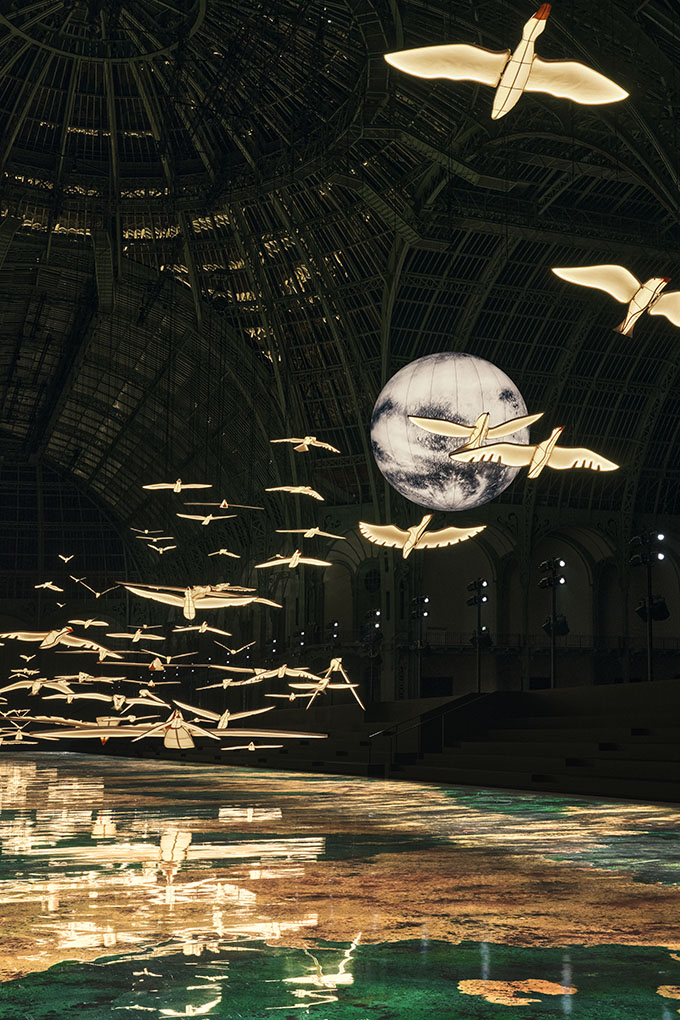
The set is where creativity truly runs free. From the fantastical flight of birds at Chanel to Louis Vuitton’s metropolitan highway, spy the best runway set designs of the spring/summer 2027 season below.

1 / 12
Diesel
Staged in Milan, Diesel transformed its venue into a club space, inspired by the anatomical theatre. Amongst the audience sat performers from artist collective (La)Horde, engaging with the guests and one another in a constant performance, creating a liminal space that was strange and sensual.

2 / 12
Fendi
The audience was met with a hall of infinite mirrors at Fendi. The models were surrounded with their own reflection and rows of lights that multiplied their bodies into an endless maze.

3 / 12
Bottega Veneta
A sense of lightness ran through Bottega Veneta’s set. The space was left bare, aside from the rows of chairs created by artist Illya Goldman Gubin. The seats were crafted from cardboard boxes crumpled by Gubin’s embrace before it was coated in resin. The interlocking flaps are reminiscent of the maison’s signature Intreccio pattern. A handcrafted leather flower from Bottega Veneta’s atelier made for a finishing touch.

4 / 12
Chanel
Held in the Grand Palais, creative director Matthieu Blazy imbued the show with a sense of freedom through the flight of birds that hung above the runway. The set was inspired by Blazy’s own trips to southern Italy as a child, where he bore witness to migrating birds over the river he stayed by.

5 / 12
Gucci
Gucci’s set is a hint of what’s to come. Titled ‘The Store Show’, the set displays creative director Demna’s personal vision for the brand’s retail stores in the future. The runway explores different facets of personalities that represent Demna’s Gucci: The Rebellious Aristocrat, The Snob and The Eccentric.

6 / 12
Prada
Prada’s spring/summer 2027 set is identical to its Menswear 2027 show held earlier this year. Womenswear was staged in the Deposito of Fondazione Prada, building a concise structure built with an LED grid underneath transparent panels, plexiglass joints and cables. The naked lights created a neutral space, leaving the clothes to express what Prada wished to say.

7 / 12
Dior
Dior’s set was a sanctuary away from the city. Hosted in the Jardin des Tuileries, models walked down a runway amongst lush treescapes, with the audience seated around the garden’s basin, creating the illusion of a floating haven.

8 / 12
Loewe
Designed in collaboration with Casper Mueller Kneer Architects, Loewe’s set mimics the spherical structures of amphitheatres and arenas around the world. White scaffold and sheer white fabric was arranged in two circular tiers, reminiscent of spectator sports, ritual drama and performance.

9 / 12
Valentino
In Alessandro Michele’s eyes, fashion and the antilibrary run deep parallels. Just as the existence of books testify a world of knowledge that extends far beyond its primary duty of being read, fashion, in likeness, exists well before it reaches the body. Both forms of art serve to expand the imaginable realm. It was only fitting that Michele transformed the 19th-century Bibliothèque Sainte-Geneviève into Valentino’s spring/summer 2027 runway.

10 / 12
Acne Studios
The vaulted ceilings of the Collège des Bernardins made for the perfect backdrop of creative director Jonny Johansson’s vision for the show. Inspired by vast, faraway places—like the 17th-century Swedish warship Vasa—the set was draped with fabric and haphazard chandeliers, lined with chairs in a myriad of shapes and sizes. At the end of the hallway hung an artwork by Azerbaijani artist Faig Ahmed, who transforms the humble carpet into melted sculpture.

11 / 12
Saint Laurent
Anthony Vaccarello’s Saint Laurent swan song was emulated in a striking gold show. Models were dressed in shades of gold, illuminated by colossal candlelit chandeliers hung against a scenic backdrop of the glimmering Eiffel Tower and a nearly full moon.

12 / 12
Louis Vuitton
Creative director Nicolas Ghesquière collaborated with American production designer James Chinlund to create an avant-garde metropolitan highway in the Cour Carrée du Louvre. Models walked in between hovering cars around the museum’s courtyard.