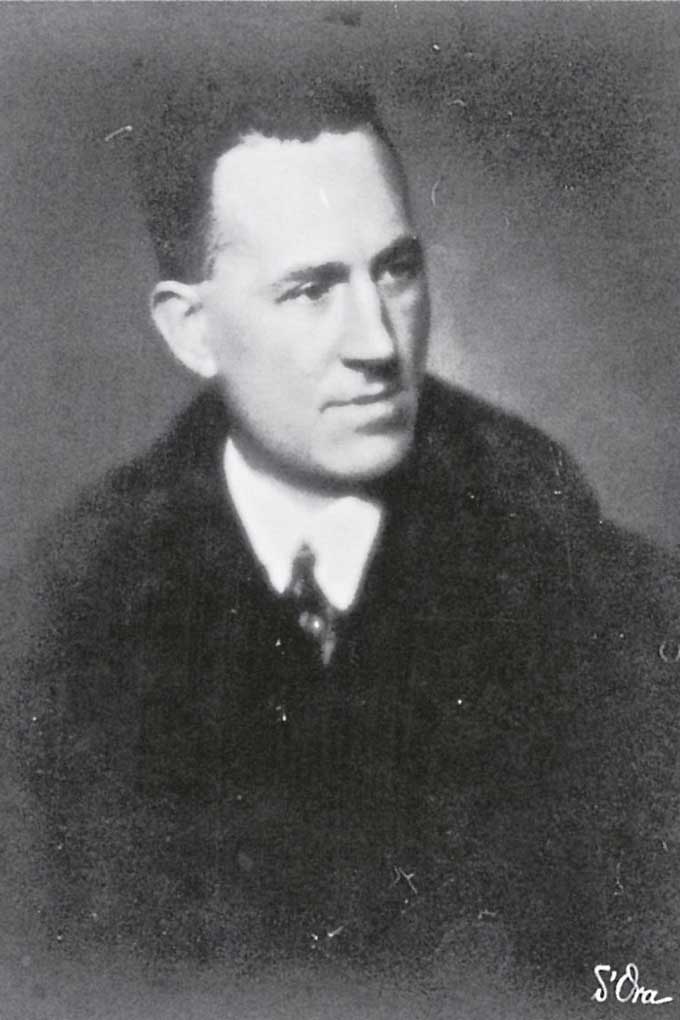
Many people today describe themselves as multi-hyphenates, but more than a century ago, working across different disciplines was groundbreaking in itself. That is just one of the ways to describe Pierre Legrain, a legendary French designer who worked across bookbinding, furniture and interior architecture.
A leading figure of the art deco avant-garde, Legrain translated the radical geometry of cubism into a tactile design language. His influence is evident throughout the history of the decorative arts, from his influential collaboration with Jacques Doucet to his design of La Coiffeuse, the first piece of furniture created for Louis Vuitton. As renewed interest in art deco following its 2025 centenary brings Legrain’s legacy into focus, a new generation of creatives is revisiting his vision. Louis Vuitton’s Objets Nomades collection is also introducing his designs to a wider audience. We sat down with his great-grandson, Florent Cristol Barthés, to discuss the preservation of this distinctive heritage and why Legrain’s fearless spirit remains relevant to the future of design.
Growing up, what family stories, objects or memories shaped your understanding of your great-grandfather beyond his reputation as a designer?
What everyone who knew him remembered first, and what was passed down to me, was his kindness and generosity. Pierre Legrain was a deeply kind man, with a constant ingenuity: he always had an idea. This inventiveness was his most notable character trait, from his earliest bindings to his latest research.My family inherited rare artworks, some of which are highly experimental and quite far removed from his early work. They remind me that he never stopped searching, and that he was not afraid to move away from what had made him known. He also trained my grandfather in the art of bookbinding, in beauty, in the knowledge of materials. That is what I remember of him, beyond his genius: a generous mentor who gave enormously to others.


What has it meant for your family to inherit Legrain’s creative legacy? How have you approached preserving his work and introducing it to new generations?Inheriting a legacy like this one means, first and foremost, inheriting a presence. We grew up with Pierre Legrain and with our grandfather, who carried on the work of book binding for a time. We were no doubt unconsciously inspired by them, long before we understood what we had received.Today, this legacy leads us towards research to better understand the work as well as towards preservation, so that it remains accessible for future generations. As time goes on, we feel this transmission increasingly becoming a responsibility: To ensure the work is accurately understood, in all its diversity,and that future generations can in turn discover it. Moments like the art deco centenary in 2025 are precious for this—they reopen our gaze onto creators that history has sometimes left in the shadows.
Pierre Legrain moved freely between bookbinding, furniture and interior design. What connected these disciplines and what made his visual language so distinctive?
For Pierre Legrain, there seemed to be no hierarchy between a binding, a chair, and an interior: everything stemmed from the same demand for composition. More than a jack-of-all-trades, he was an artist-decorator and assembler, for whom every object belonged to a whole. Throughout his work, one finds the same rigour of construction, clean volumes and noble materials, at times disruptive for the period. His vocabulary draws on cubism, yet he makes something deeply personal out of it: A geometry that is sometimes severe, softened by the sensuality of his materials. It is this tension within his work that makes his language immediately recognisable.
Jacques Doucet played a pivotal role in Legrain’s career and gave him considerable freedom to experiment. How did that patronage shape the work Legrain was able to create?
Jacques Doucet was a collector and a patron, not merely a client. He gave Pierre Legrain a rare freedom: The freedom to experiment, to make mistakes, to search for a new way of expression, first with bindings, then with furniture and interior design. Without this trust, a large part of the body of work would likely never have existed.This is why we are committed to ensuring that his name always remains associated with that of Pierre Legrain.


Louis Vuitton is bringing Legrain’s work to a new audience through the Objets Nomades collection.What does it mean to you and your family to see that relationship renewed?
It is a source of pride and emotion to see our great-grandfather’s name find its place once again within a house with which he worked as early as the 1920s and for which he designed La Coiffeuse, the first piece of furniture ever produced by Louis Vuitton. This revival brings his work to a much wider audience than that of specialists and collectors alone, and this means a great deal to us. There is one thing we remain attentive to:that the spirit of the work be respected and that Pierre Legrain’s name remain associated with the pieces. A century later, it is a pleasure to see this relationship between a creator and a house carry on.
When you see the Kubic armchair today, what feels unmistakably Pierre Legrain and what do you think your great-grandfather might make of his ideas finding a new audience more than a century later?
What strikes you first is just how recognisable Pierre Legrain’s work is in the Kubic. The armchair takes up the structural elements and signatures of the chairs he created for Jacques Doucet: the geometric construction,the trapezoidal backrest, the sawtooth legs, the faceted armrests, and that contrast between the severity of the lines and the warmth of the material. As for what he would think of it, we believe he would have been curious and demanding: happy to see his forms continue to live on and attentive to the way they are made. He always had an idea and he would no doubt have wanted to propose one more.

Your great-grandfather passed away at just 39 years old, leaving behind an extensive body of work. Where do you see his influence most clearly in contemporary design?
I say this with humility, but when I look at Pierre Legrain’s work, I find that his influence on contemporary design has been profound and far-reaching, without his name ever being put forward. Almost forgotten, and yet so present. I would also say that turning to his work is, in fact, turning towards the future. There was an avant-garde spirit in Pierre Legrain’s designs: a boldness in materials, a radicalism in forms and a harmony across his ensembles. His language was ahead of its time and it seems to me that it can still nourish design today and tomorrow. In the age of artificial intelligence, it seems essential to draw inspiration from the boldness and daring that Pierre Legrain embodied in his own time.