At first glance, the premise of Paradise seems simple enough. The series follows United States Secret Service agent Xavier Collins, played by Sterling K. Brown, as he investigates the killing of sitting president Cal Bradford. But the simplicity ends there. What begins as a whodunnit slowly unravels into something far more unsettling, with grief pulsing coursing through the heart of it all.
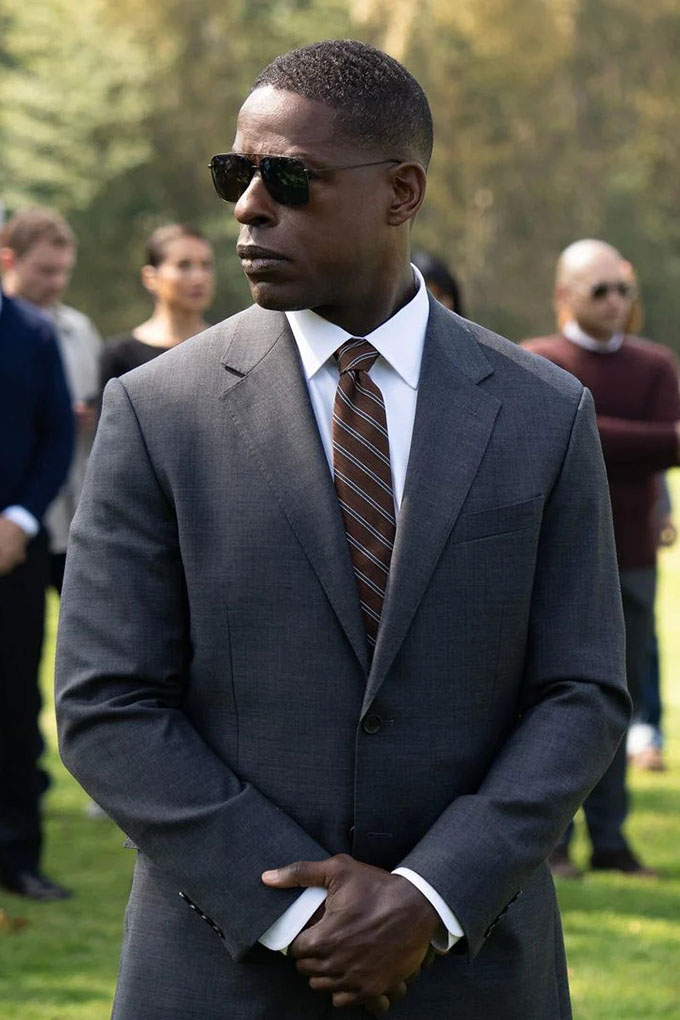
Three years after a supposed extinction-level event devastates the planet, Xavier is living in a sealed underground bunker in the Colorado mountains. Inside, life is orderly, curated and eerily pristine. The chosen 25,000 residents live in sprawling homes with manicured lawns, insulated from the chaos they believe destroyed the outside world. Xavier, steady and composed as the president’s lead security agent, appears to be part of that stability. But privately, he is still grieving his wife, Teri, presumed dead in the catastrophe. That grief drives him as much as duty does.
Presiding over this subterranean society is tech billionaire Sinatra, played by Julianne Nicholson. Her authority is absolute, her vision meticulous. Having lost her young son before the apocalypse, she built the bunker as both sanctuary and monument—a controlled world where loss could never intrude again. For a time, the illusion holds. Then, the president is found dead.

As suspicion falls on Xavier and he begins digging for answers, the investigation exposes far more than a single act of violence. The carefully maintained narrative about the end of the world starts to unravel. Whispers of life on the surface grow louder. The bunker, once framed as humanity’s last refuge, begins to feel less like salvation and more like containment. Safety starts to resemble surveillance.
By the end of Season 1, the foundations crack completely. Xavier learns that Teri is alive—proof that the world beyond the bunker is not what they were told. Even more destabilising is the revelation that Sinatra may not be the ultimate architect of this reality after all. There are larger forces at play, hidden hands shaping events from the shadows. The murder that set everything in motion begins to look almost incidental, a distraction from a far more unsettling truth.

In the Season 1 finale, the illusion of Paradise is shattered when the sky goes down, and the residents are forced to confront the reality of where they’ve been living. What kind of emotional and psychological aftermath can fans expect in Season 2 now that that sense of safety and control is gone?
Brown: Oh, shit’s crazy. The world as we know it has been flipped upside down. Sinatra’s been shot. The sense of who’s in power and who’s in control is in a state of flux. Things are a lot more chaotic than they seemed at the beginning of Season 1. So be ready for a ride. It’s a ride when we get back to the bunker.
Throughout Season 1, Sinatra emerges as a very unconventional antagonist—often vulnerable and morally grey, especially in the final episodes when she tries to protect Xavier’s daughter. As the bunker begins to fracture in Season 2, how did you approach Sinatra’s emotional choices?
Nicholson: In Season 2, Sinatra’s defences have been stripped away. She’s been shot, she’s been laid out, she’s been made completely vulnerable. So it’s about coming back from her bottom. But how do you get back on top? She still has the same goals, which are protecting the people she loves and protecting this world she’s created. It was really about going deeper into the things we learned about her in the first season.

A lot of fans have questioned Xavier’s decision to leave his two children behind to search for his wife. How did you emotionally justify that choice?
Brown: The idea that his wife could be alive is really the only thing that would inspire him to leave his children behind. It could mean that, for the first time in three years, his family could be whole again. If he stayed, knowing she could be out there and did nothing, I think it would be harder for him to live with that inaction than to take the chance. It’s a rock and a hard place. There are no easy choices. But he’s hoping for the best. He’s thinking, if I can have all of them together, that would be ideal. So I’ve got to take a chance on that. Also, I think Robinson encouraging him to go out—not just to find his wife, but to see what the world is like for all of us—was a big deal. And her agreeing to take care of his children meant there was someone he trusted, someone who had gone through something with him, looking out for them. And it doesn’t hurt that it was a Black woman doing it.
Will Season 2 dig deeper into the implications of that decision and how it changes the way people see themselves and each other now that the truth is out?
Nicholson: I don’t think we go too deep into that in Season 2 in terms of repercussions. There’s still room to explore that aspect. Who gets chosen and why?
Brown: But I will tell you, that’s a great question. And if we’re lucky enough to have a Season 3, it’s something that gets explored then.

With Xavier coming into contact with people who have lived on the surface, how does Season 2 explore the tension between those who were “protected” in the bunker and those who were “left behind”?
Brown: He encounters a lot of different people—some more magnanimous than others. There’s this inherent feeling-out process when people meet for the first time. Some agree to just leave each other alone. Others decide maybe they can pool their resources and do something better together. But when people see Xavier, they’re like, “You look well-fed. You look nourished. Where have you been, and how can I get some of what you’ve been having?” And all I can say is, I’ve got the best cheese fries made out of nut cheese that a man can have. Just don’t eat too much nut cheese, because there is such a thing as too much of a good thing.

Season 2 shows the surface as liveable, making the bunker’s control feel even more oppressive. How does the series explore that tension?
Nicholson: It’s like golden handcuffs, right? They’re in this world set up to protect them and keep life going the way they knew it, or as much as possible. So what do you choose? Your safe prison or your dangerous freedom? It’s a question we could all ask ourselves.
Brown: It’s the devil you know versus the devil you don’t. The world has come to an end as we know it. So maybe it’s better to have something safe and secure that gives you some semblance of normalcy, rather than explore the unknown. That’s one way of looking at it. But if everybody’s not on the same page, and if everybody’s not there by choice—if they’re trapped rather than opting in by their own volition—that’s what makes it golden handcuffs. You have to give people choice at each moment.
Nicholson: I also wonder about the repercussions of survivor’s guilt for the residents of the bunker. Where do you put that? Where do you place that in your body, in your life—that you were picked, that you agreed to be one of the people who remain alive, while the rest were not?
Stream Paradise on Disney+ here.