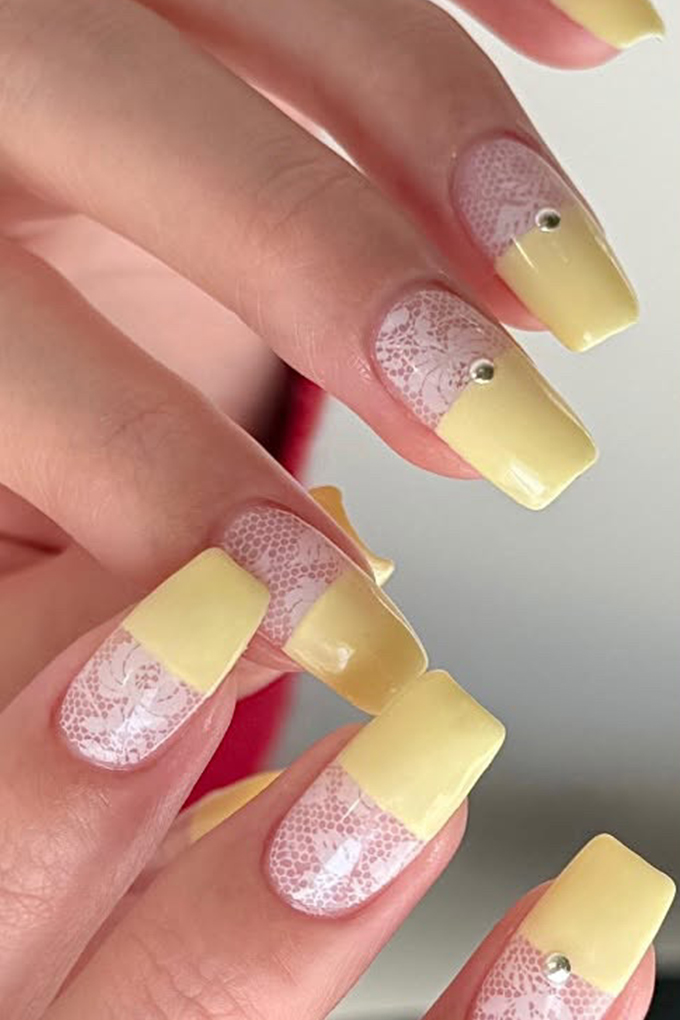
I am running late again. But this time, I had the wherewithal to message Nikki Chan, owner of Nail It Too, beforehand, to give her a heads-up. There was, as always, no change to the brief. The brief. That is our running joke, Chan’s and mine, except that it has over the years become less of a laughing matter and more of an unfortunate reality. Before every appointment, I send her a proper document detailing the concept behind the nail art I am thinking about, the colour schemes and sometimes, the symbols I want to play around with.
I had moved back to Singapore to start a new job in 2022, only to land almost immediately in a hospital. Scans and tests confirmed something I had quietly suspected for months: that all was not well with my left breast. At the age of 31, I was diagnosed with stage 2A breast cancer. What was meant to be the start of a brand new life turned into a nightmare: two surgeries, one round of IVF, four rounds of chemotherapy, five rounds of radiation.

There were many things I reckoned with that season. But one of the more quietly ubiquitous griefs, which I felt almost embarrassed to name, was the inability to do my nails. There were two reasons for this. The first was practical: I was in and out of treatment, and the logistics of life had collapsed into a narrow tunnel of medical appointments. The second was physiological. Chemotherapy effectively destroys the growth of hair follicles and nail matrices. My nails, like most other parts of me, had entered a strange state of stasis, not really alive, but not completely dead either. They had become, in their way, a small and faithful mirror of the rest of me: unreachable and unrecognisable.
Mind and body
Kathy Gabriel, craniosacral therapist and founder of Soma Haus, has a term for what I was experiencing. She describes a cancer diagnosis as creating “a profound rupture in the body-self relationship”. The body, suddenly, becomes a site of betrayal rather than belonging. Many of her clients in recovery describe feeling alienated from their physical selves, and even in remission, she notes, there can be persistent, lingering disconnections and a protracted reluctance to trust the body’s signals. “If the body has only ever been a source of criticism,” she tells me, “it’s hard to experience it as a site of pleasure, curiosity or agency.”
I recognise this sentiment. For the better part of two years, my body was something that happened to me, something to be managed, and on terrible days, endured. I had stopped thinking of it as mine to own and enjoy, and in doing so, had lost sight of my authorship over myself, and more specifically, my sense of aesthetic.
I had never quite articulated before that period what my nails and nail art meant to me. They were not just a vanity project. They were language. Each time I went to get my nails done, I was exploring another aspect of my psyche: my fears and desires, how colours and symbols reflected feelings I could not yet name. Incidentally, they were also the one part of my body I could curate completely.


Art therapist Vaishnavi, founder of Ayana Art Therapy, offers a framework for why this particular canvas carries so much weight. “We see our hands constantly while we work, gesture, touch, create and move through the world,” she says. “Nails don’t only shape how others see us, they also subtly shape how we experience ourselves.” Unlike a tattoo or a major haircut, she points out, nails offer a relatively safe and accessible space to experiment with identity.
Chan, who has watched this dynamic play out across her salon table for years, puts it more simply: nail art, she says, is like flowers—not everyone loves or buys them, but those who do understand the beauty and value of something fleeting. “Nails are very personal,” she tells me. “They’re obvious to the individual, but not always to others, which makes them a subtle yet meaningful part of someone’s identity.”
Minority report
What I realised over time is that my nail briefs were less about aesthetics and more about dispatches from within. And perhaps something more specifically political was also at work. I am Singaporean Tamil. I grew up understanding, in the way that minority women come to understand things without ever being explicitly told, that the appropriate relationship between my body and the world around it was one of careful management. Not too much. Not too loud. Presentable, but not excessive. Feminine, but within limits. I learnt to see myself, as Vaishnavi puts it, “through the eyes of others”, calibrating my appearance in order to have a place in society.
This, both practitioners suggest, is not accidental. “Colonial ideas often positioned women’s bodies as either excessive and in need of control, or as symbols of tradition that had to be carefully regulated,” Vaishnavi explains. Within diaspora communities, there can be an added pressure to stay small, to represent one’s culture respectably. Gabriel frames this somatically: the internalised weight of the patriarchal gaze, the cultural gaze, the gaze of colourism, producing what she calls “a somatic response of shrinking, hiding”.

And yet, long before colonialism reshaped these narratives, adornment meant something else entirely. Vaishnavi reminds me that henna has long been used across South Asia to adorn the nails, hands and body as a symbol of beauty, ritual and celebration. Historical accounts suggest that women of higher social standing in India, Indonesia and China wore long or elaborate nails as a sign of their removal from physical labour. Seen from a decolonising perspective, she argues, reclaiming adornment is not about becoming more beautiful in any conventional sense. It is about reclaiming the right to take up space in one’s own body. There is something, too, about the sharpness. Vaishnavi is thoughtful on this: “Sharpness can symbolise boundary, protection, power and even anger, qualities many women are taught to suppress in order to appear softer or more agreeable.” A long, pointed nail is inconvenient by design. It quietly refuses the idea that a woman’s body should always be organised around practicality or other people’s comfort.
When I am finally given the all-clear to resume the daily vanities of my life after treatment, I sit across from Chan and share my brief. I want something extravagant, I say. I want to explore the story of Medusa and Athena, the monster and the martyr, the juxtaposition of ugly exterior and luminous interior. “I have just the thing,” says Chan, “something that can mimic the stony texture to depict Medusa.” Naturally, I choose to keep my nails intolerably long. When Chan is done, Medusa’s stone-hewn face reflects the light off one perfectly shaped almond claw.
Get your copy of the June ‘Embody’ issue of Vogue Singapore online.