Some musicals are as classic as they come. And no matter how familiar or unfamiliar you are with the theatre scene, Les Misérables stands unrivalled. Perhaps it was its award-winning screen rendition, popularised by its A-list cast of Hugh Jackman, Anne Hathaway and Russell Crowe. Perhaps it is its enduring storyline, and characters that still feel relevant despite its backdrop of 19th century France. The throes of poverty and revolution may have underscored it all, but when met with the compelling character development of Jean Valjean—pitted against the authoritarian voice of Javert—the production feels ageless. Suffice to say, the world will always have its dictators with warped moral codes.


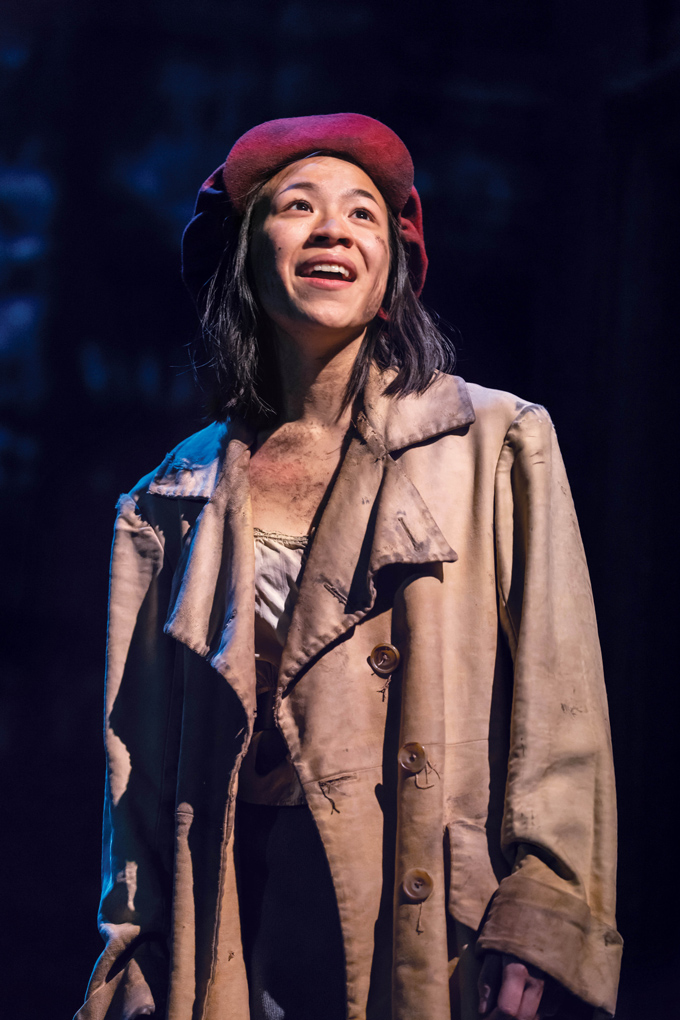
As one of the most renowned theatre productions, it has reached our humble shores many years past, with its latest run having played out in 2016. Some six years later, Nathania Ong became a name to know—for her associations with the long-running West End production. She had become the first Singaporean actress to play the darling Eponine in the beloved musical, a monumental feat for the arts scene here. So it only makes sense then, that for Les Misérables’s returning act to Singapore, Ong was called upon. To reprise her iconic role on stage—this time back home—and be a part of the wondrous ensemble of Les Misérables The Arena Spectacular.

One which, in its own whimsical way, takes on a different sensibility that sets itself apart from its usual, full-scale theatre production. This time around, the focus lies on its sheer musicality and emotional core, brought to life not just by the incredible cast, but also the phenomenal orchestra playing from the shadows throughout. With this manner of staging, the actors are also getting a leg up with the cameras that are being used to show their facial expressions, and the mics on stage that are projecting their voices during song.
“The cameras add an extra layer of depth and communication between us and the audience. The expressions are incredibly clear and I don’t feel like I need to project more actually,” explains Ong, on this fresh approach to staging.
Yet experimenting with the format is not all that the stage production offers. Also returning to the cherished musical is theatre legend Lea Salonga, who has her own history with Eponine. Seminal career sweeps with Miss Saigon aside, she was, after all, the first Asian to ever play Eponine in 1993, before returning to the musical to take on the role as Fantine in 2006. A couple of decades on and more self-assured than ever, she is Madame Thénardier. Comic relief she may be, but her delivery acutely sends the crowd roaring.
“I’m finally not one of the dead girls this time around! Madame T is so much fun to play. I also lucked out with an amazing partner-in-crime (Red Concepcion as Thenardier) who’s generous, gifted, and incredibly funny,” quips Salonga.
True enough, she’s been a joy to watch come alive on stage since Les Misérables arrived in town. Between her and Ong’s precious portrayal of Eponine, Vogue Singapore got to hear a bit about their continued ties to the beloved production, below.
Lea, your ties to the musical feel infinite. You were once Eponine, once Fantine, and now you’ve taken on the role as Madam Thénardier. Les Misérables is such a classic, what do you think keeps drawing people back to it—and why do you personally love it so much?
LS: Personally, I love the music (it’s a sweeping, epic score!), the poetry of the lyrics and the images they conjure up, and the redemption story of one man who’s paid his debt to society and has dedicated his life to doing good for others. There’s also a lot of drama and comedy. It makes the tear ducts go nuts. Dreams held and dreams dashed, hope encouraged, then trampled underfoot. It’s just such a great show. And that might be why people keep coming back to it; there are characters anyone and everyone can relate to at every age, not to mention these characters’ songs and stories.

What was different about your time on stage this time around?
LS: I’m finally not one of the dead girls this time around! Madame T is so much fun to play! I also lucked out with an amazing partner-in-crime (Red Concepcion as Thénardier) who’s generous, gifted, and incredibly funny.
You’re an icon of the theatre world. From your perspective, how far has theatre evolved for Asian representation? What do you think still needs to be done?
There’s more of us now! The landscape on stage is far more colourful. However, what I’d like to see more of are stories written by people of colour. If the success of Maybe Happy Ending shows anything, it’s that these very specific stories do work. It gives me hope that there’s room for plays and musicals whose origins are anywhere in the world.
Nathania, this is full circle for you. How does it feel being able to share your world with everyone back home?
NO: So incredibly blessed and incredibly privileged to be bringing back this role. It’s a really special role to me and it was one of my first jobs, so I have really seen her through thick and thin, and she has seen how I’ve grown as an actress as well.
I’m just very excited to be able to bring it back home for everyone to see. I feel like I’ve grown so much as a performer and I’ve found even more details with this current version of Eponine. I’m very excited for all of my friends and family, and people whom I don’t even know yet—we might bump into each other with how small Singapore is—to watch it. But I’ve felt incredibly supported in this time that I’ve been playing Eponine so far. So it just fills me with pride.

How did it feel returning to the character? Do you feel you had more to bring to the table as Eponine four years on?
NO: I’ve actually jumped on and off this tour three times already. So the first time was for a short stint in Milan, Italy. I was playing Eliza Hamilton on the West End in the Victoria Palace Theatre. It was such a breath of fresh air to be able to take a break from a long contract. Later on, I got to go around Asia, in Japan and Taiwan and Shanghai. Throughout all these processes I feel like I’ve grown and now, I’m in Singapore. It’s been such a journey, but I actually haven’t done work in front of a camera for a musical before, so getting this opportunity to try this style of staging has really just been so exciting.
I love it; I do feel like my detail as Eponine has really grown. Currently my Eponine is at its most mature in terms of my life. And I feel like I’ve made some incredible discoveries about her, and there are more details now. With the cameras, because you can see my eyes, there is another extra layer of truth that I can add that I wouldn’t necessarily be able to communicate with a regular stage setting.
What feels different about The Arena Spectacular? How did you have to adapt to this new format?
NO: Think the big difference in this style of staging is the use of cameras. I feel like it adds an extra layer of depth and communication between us and the audience because you really see every freckle, pimple and wrinkle on our face, so the expressions are incredibly clear. And I’m not having to push any kind of emotion overtly, because it automatically translates based on the words I’m saying, the sounds I’m making and the expressions on my face. And I feel like that has been such a blessing, that you genuinely would not normally get. I kind of prefer it to regular theatre and I kind of wish I could take one of these cameras and put them in every single production that I’m in. But that is not up to me!
The in-ear monitors have also been incredibly important for us as singers to regulate our voices and to make sure we’re not overpushing. They were a very new concept when I first started this production but I’ve really fallen in love with them. Because of the extra layer of regulation, the quality and standard of my singing feels married to the music, because I can just sing and just tell a story—and not have to think about other things.
You once cited how Lea Salonga—the first Asian performer to play Eponine—was crucial in shifting perspectives. How is it now, being able to share the stage with a theatre icon?
NO: Honestly, I think Lea is hilarious. She is so funny and so humour-filled. And she’s so wonderfully talented and genuinely such an inspiration to us—especially to us Southeast Asian communities. When she first came out, she was really breaking boundaries and was such a trailblazer. I really admire her, and I feel so blessed to be breathing the same air as her and working with her!
Book tickets here.