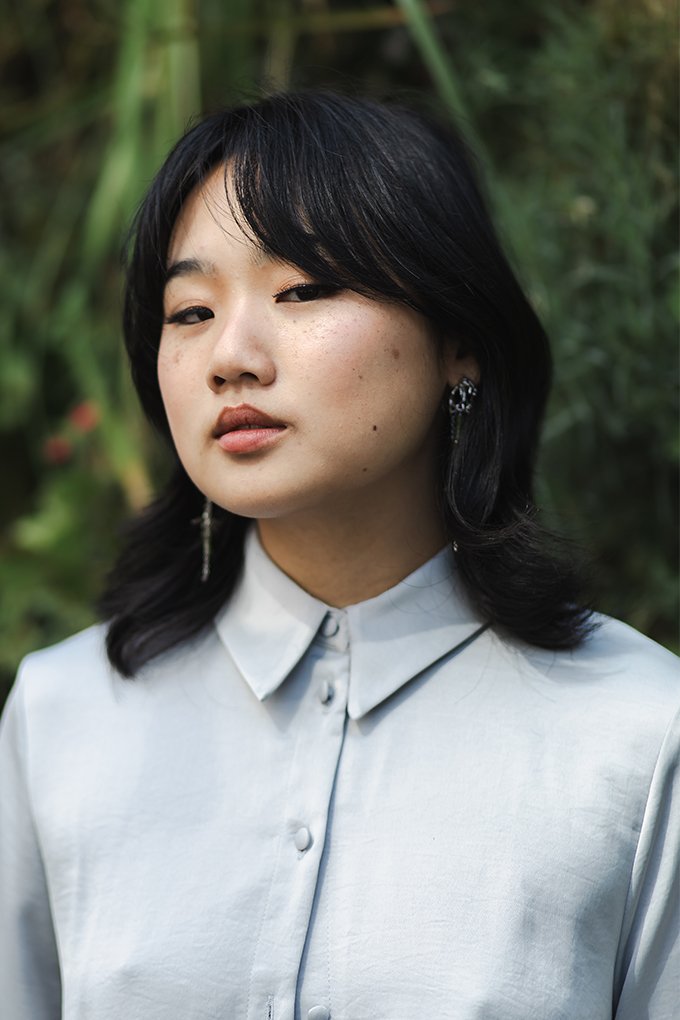
It’s past 10pm in New York City when Helen J Shen jumps onto the Zoom call for this interview. I ask if she has just finished a show. She cheerfully tells me that she has just done two. Still, there’s no trace of exhaustion in her manner—quite the opposite, in fact. Throughout the call, she is all smiles, with an earnest and infectious enthusiasm whenever she speaks.
Shen plays Claire in Maybe Happy Ending, a new romantic musical comedy that follows two retired HelperBots in a near-futuristic Seoul as they form a precious connection. First staged in Seoul in 2016, a new production of the musical premiered on Broadway at the end of 2024. Originating the role, Claire is Shen’s Broadway debut. Starring opposite her as Oliver is Emmy and Golden Globe-winning actor Darren Criss.
“It’s a pretty hefty show, and it’s unrelentingly honest. It touches on topics like what it means to have a shelf life or an expiration date,” Shen shares. “The story is so completely new and original, and yet it feels nostalgic. There’s something familiar about the music and the plot, but it twists and turns in unexpected ways.”
Half a year into her brilliant run, Shen opens up on what drew her to musical theatre, acting opposite Darren Criss in Maybe Happy Ending, and what she loves most about her character.

How did you get started in musical theatre? What drew you to it?
I actually started out as a classical pianist. I began playing classical piano under a Russian teacher when I was five years old, and simultaneously doing community theatre. Something that I’ve always been really drawn to in theatre is working together to create one product. This is not to disregard the extreme accomplishment of pianists, but for me personally, I found it to be pretty isolating. I just enjoyed building things with my friends and being a part of something bigger than myself from a really young age, and I found that in theatre.
What was it like to make that transition? Do you feel that your training in classical piano influenced the way you approached doing theatre?
I think that the education and the discipline I had doing classical piano is a huge reason why I succeeded. I knew what it felt like to have things be difficult and also persevere through that. When I went to musical theatre college at the University of Michigan, I found myself, for the first time, having my hobby become the focal point of my life, and that was an extreme shift in mindset. When I was doing theatre on the side, it was my haven and my safe space. But suddenly I was doing it 24/7, and I got very overwhelmed. My voice was tired, my body was failing me. I had to learn how to do musical theatre sustainably as my job, and to use my voice and body as my instruments. I’m thankful I went through all that in school, because doing eight shows a week now, I have those tools in my toolbox to fall back on.

What were the reactions of the people around you when you decided to make the switch from classical piano to musical theatre?
For my parents, there was a lot of surprise and fear. Both of my parents are Chinese and moved from China to the United States. They’ve always been very supportive of me growing up, but they didn’t know much about the world that I wanted to go into, and they had invested a lot of time, money and effort into a path that seemed divergent from what I wanted. They were really scared about whether the musical theatre world would be able to welcome me, and rightfully so. But I think this has been a really great indication that the musical theatre world is ready and excited for new faces and new voices.
I also got a lot of crazy looks from the family friends and aunties and uncles who listened to me play the piano growing up. There was a lot of skepticism directed towards my parents, asking, “You’re going to let your kid do this? Are you sure?” But it was mostly out of concern. If they could have a crystal ball and see where I am now, they would be 100 per cent supportive, but you don’t want your kids to get hurt. You don’t want that disappointment to be something that they feel for a really long time. I appreciated their concern, but it also fueled me to continue and prove the naysayers wrong.

What was the audition process like, and what was it like finding out that you got the role?
I had one self-tape, and then one callback with Darren for a chemistry read. At that time, I was doing what people call double duty. I was in the middle of rehearsals for an off-Broadway show I was doing called The Lonely Few, while also doing performances of another off-Broadway show called Teeth during the night. I was in the ensemble for Teeth, and also understudying Dawn, the lead. So when I got the email about going in for the chemistry read, I already had so much on my plate. In hindsight, that really helped, because I didn’t have time to overthink or freak out about the callback. It was just like, “Just get through it, do your best, and what will be will be.”
The day after the callback with Darren, I got a call from my stage manager saying that I was going on for the lead for both shows that day. Any actor will know this—the first time you go on for your understudy part is probably the scariest moment of your life. You kind of black out. You’re prepared, but you’re also not prepared all at the same time. So the matinee happened, and it was a whirlwind. Then the evening show came, and I did the show, and it turns out that the writer of Maybe Happy Ending, Will Aronson, just happened to buy a ticket for that night.
At the end of that crazy day, my manager came up to me and told me that I was going to be making my Broadway debut in Maybe Happy Ending. At that point, I think I was already at capacity for the amount of news I could receive in a day. I had already left my rehearsal early to prepare for this mammoth of a show and tried to do it to the best of my ability, and I had all of my friends coming to support me in the role—so they all watched me receive the news that I was going to be making my Broadway debut. I can’t even really explain the feeling. It was like winning the lottery, and then winning a separate lottery all in the same breath. I couldn’t believe it.

Tell us a bit about Claire. Which parts of her character resonate with you the most?
I relate to her in a lot of ways, and I admire her. She has a cynicism about her, but with that cynicism comes release. She is so okay with the fact that things will end—that is something that is true from the very beginning for Claire—and she has learned to maintain a lot of peace in pretty unpeaceful scenarios. In my portrayal of Claire, my favourite thing to do every night is make people laugh. That is something that I have loved doing since I was a kid. Claire has a really dry humour and a very straightforward way about her that I really resonate with. She’s really funny and charming, and she’s just absorbing and taking in stimuli from the world and shaping her outlook on it. It actually becomes a pretty positive and bright outlook, even though it doesn’t have to be. I find a lot of strength in her that I think I could mirror in my own life.
This role isn’t just your Broadway debut—you’re also originating the role on Broadway, which is huge. What was it like for you to step on stage on opening night? What went through your mind?
It was beyond my wildest dreams. I always imagined what my Broadway debut would feel like, but I couldn’t have even prepared myself for this. The Broadway production is its own separate show, but there have been other versions of this beautiful musical, and other Claires in the world. I’m originating the Broadway production of it, but I also feel like I’m standing on the shoulders of other actors who have played Claire before. Our director Michael Arden and our writers Will Aronson and Hugh Park gave me a lot of latitude to bring my own original self to the character, so a lot of the jokes in the show were bits that I would try in rehearsal, and they just ended up landing. To be on Broadway in this gigantic show, and be able to bring my authentic self to the table, is an unbelievable honour, and I felt really humbled by it.
What has it been like working with Darren Criss on this musical?
It’s really lovely. We have such a great rhythm, and he’s a great scene partner. He’s a really passionate actor and someone who cares deeply about this piece. So much of the show is just the back-and-forth Oliver-Claire dynamic, so we’re always trying to find different things to keep the show feeling alive. He’s similar to Oliver in some ways, but also completely different. We all want this piece to be better than ourselves as individuals, and so the team effort is really amazing. It’s really wild to look back on our initial chemistry read, and wonder if people could have seen this kind of chemistry and alchemy from that one session. We got lucky in finding the piece when we did, and finding each other when we did.

What are you most excited for audiences to see with this show?
I’m excited for audiences to see something new on Broadway. Very often now, shows are adapted from movies or books, or they are revivals, or they are based on some kind of known spectacle. It’s become a rare feeling to sit in a theatre and not know what to expect. I think it’s magical when audiences come in with no preconceived notions about what they’re going to see, and they just get to sit and listen and be affected by the art.
Are there any types of roles that you’re hoping to try in the future, or any types of roles that you’ve always wanted to play?
I’m really hoping to dip my toes into the TV and film world. I haven’t gotten a chance to do that yet, but there are elements of on-camera work that we did for this show. It gave me a taste of it, and I’m hungry for it. I’m also hoping to do a revival of some sorts, in a role and a show that I didn’t think that a person like me could fit into. I’d like to break some boundaries there.