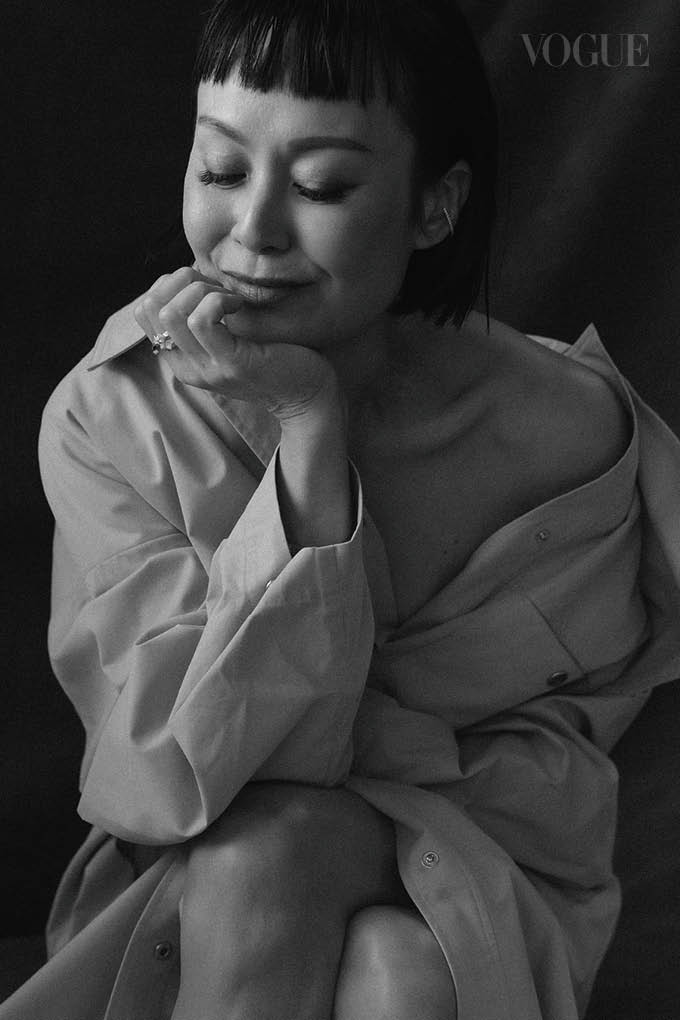
Singaporean actress Janice Koh likens her speech to a paint palette. An acclaimed performer both on stage and on screen as well as a former Nominated Member of Parliament who passionately championed the arts, she was diagnosed with oral cancer in 2022 and had to have more than half of her tongue removed. “An artist would typically have a full palette of colours and mediums to choose from. I now, physically, just have a much more limited palette to work with.”
Back then, she had no expectations of getting back on stage or in front of a camera. Acting was something she was slowly letting go of. But as homegrown theatre company Wild Rice brings back the acclaimed Supervision to kickstart its 25th anniversary season, Koh returns to the stage as Jenny—a role she originated back when the play was first staged in 2018 at the Singapore Theatre festival.
Darkly funny and deeply poignant, Supervision follows the relationship between grumpy retiree Teck, his no-nonsense daughter Jenny, and the young Indonesian domestic helper Yanti that she hires to look after him after he suffers from a stroke.
“I usually tell people that I’m coming back to the play, not necessarily coming back to theatre per se. While it can be marked as a return to the stage, for me specifically, it’s a return to this show which I have been a part of for a long time,” shares Koh. “It was a new piece of writing then, and I was very much involved in not just performing the role, but in working very closely with our director Glen Goei and our playwright Thomas Lim to flesh it out and bring it to reality. Therefore, it has a place in my heart.”
As she gets ready to step onto the stage once again, Koh sits down with Vogue Singapore to chat about what it’s been like so far to return to the craft that she practised for so long. In the midst of rehearsals, she opens up about what motivated her decision to take on the role, and how her relationship with acting has changed three years after cancer.
How have rehearsals been going for you?
It’s been challenging, physically. I play a character who is quite angsty, high-stress and harsh, so I do raise my voice quite a bit in the play. I’ve realised that, wow, it’s quite hard to school and lecture people when you don’t have the full vocal capacity. So as we rehearse, I have to build the stamina to go on and on for hours on end, and to talk at a much faster pace than normal, while being loud.

Was it a difficult decision to come back to doing theatre?
It took some time to arrive at the decision, but I really trusted Ivan and Glen and Thomas to support me through the process without any kind of overt pressure to go back to who I was. I also felt like I had to reach a psychological point in my journey where I could let go of what other people think—where I could believe that, as long as I’m serving the play and why the play was written, and as long as my director and producer feel that I’m the best person to do it, then I am.
Tell us how you came to take on this project. How did you feel when you were offered the role? Why this show?
My personal relationship with the play was one reason, but it’s also because it’s an ensemble piece. The work is a little more well shared amongst me and my co-actors, so I felt safe to come back. In the past couple of years, there have been companies who have been very kind to invite me to do work with them, but I don’t always feel confident going back into a leading role where I have to carry the whole show, so I took my time and waited for the right piece to come along.
This play talks about issues that are really meaningful and important to me—the concept of how we age, how we care for others, and our human right to live with dignity, whether as a foreign domestic worker or an aging person. Those things are still very much resonant and relevant today, and it’s important to keep putting the work out there to stimulate discussion or provoke thought around this area.
“Now that I’m going through the rehearsal process, I will more fully understand if this is what I want, without access to my full capacity”
How did it feel like to step back into the rehearsal room that first day?
I was very happy. I think I’ve missed the rehearsal room as much as I’ve missed the stage. Live interaction with an audience is electrifying, and to inhabit a character and allow them to be seen is a very powerful feeling. But, equally, I’ve also missed the fun of creating, and improvising, and being in the company of like-minded people who find just as much enjoyment from ideas and play. Theatre is a very collaborative art form, and even as I search for other ways to be creative, I cannot deny that theatre is addictive. There is a beautiful relationship that one can have in a very protected space where we can play with ideas, and I haven’t found that kind of community elsewhere at the moment.
What other creative outlets have you been exploring?
Right now, I’m midway through the Fitzmaurice voice teacher certification course that could allow me to teach voice. I am also midway through a workshop with Edith Podesta called ‘The Artist’s Way’, and it’s a rediscovery of creativity. I think I’m just allowing myself to entertain the possibility of writing, teaching or directing a lot more than I used to. Three years ago, when I said I might not act anymore, a lot of people said, “Well, you can direct, or you can write,” but I was rejecting that. I said, “No, that’s not me.” But why would I think so? I’m trying to unshackle myself from my own self-limiting beliefs, and what I thought my identity was.

What was it like stepping back into this role with fresh eyes? Were there any aspects of the character or the play that you were particularly keen to explore this time?
It’s funny, I was telling Glen a couple of days ago that Jenny’s pulse rate was a lot closer to mine four or five years ago. She is a very fast talker, very focused, very task driven and pragmatic. I understand that. That’s how I operated for a long time. But I’m in such a different place in my life now. To do this role again, I have to rev up my own engine to meet her where she is. On one hand, I understand her, but on a different level, I judge her a lot more.
Why is that?
She’s not an easy person to like at all. I have a lot of empathy for her struggles, but now more than ever, I am at a place where building relationships—whether it’s with your family or close friends or anyone who is important to you—is so much more important and prioritised in my life. I look at her, feeling like, “Oh, I wish you could see that”. Only now can I appreciate that, while she’s trying her best to fulfill her duty as a daughter by doing whatever she can and checking off the thousand things on her to-do list, all she had to do was to be present. I think that’s very relatable for many people. We don’t know how to just be there for someone without feeling like we have to do something for them.
“I’m trying to unshackle myself from my own self-limiting beliefs, and what I thought my identity was”
How do you feel your relationship with theatre and acting has changed after cancer?
What I’m experiencing right now in rehearsal is that it takes a lot more effort to be in the moment, and to be who I want to be, on stage. That alone does eat into the pleasure of performing—and I think pleasure is a very big part of why artists create. It’s a very interesting realisation, and it could influence the way I want to consider roles in the future. Or maybe this is my last hurrah, and I’m accepting letting it go, because now I understand what I’m feeling when I’m going through this process.
Talking about not performing without actually performing is one thing. But now that I’m going through the rehearsal process—and this journey is yet to be completed because I haven’t gone back on stage—I think I will more fully understand if this is what I want, without access to my full capacity. Maybe I’ll feel that it’s okay, or maybe it won’t be as fun as it used to be and I might not want to do it—or might not want to do it as often—but it was important for me to try.
Supervision runs from 27 March to 12 April 2025.