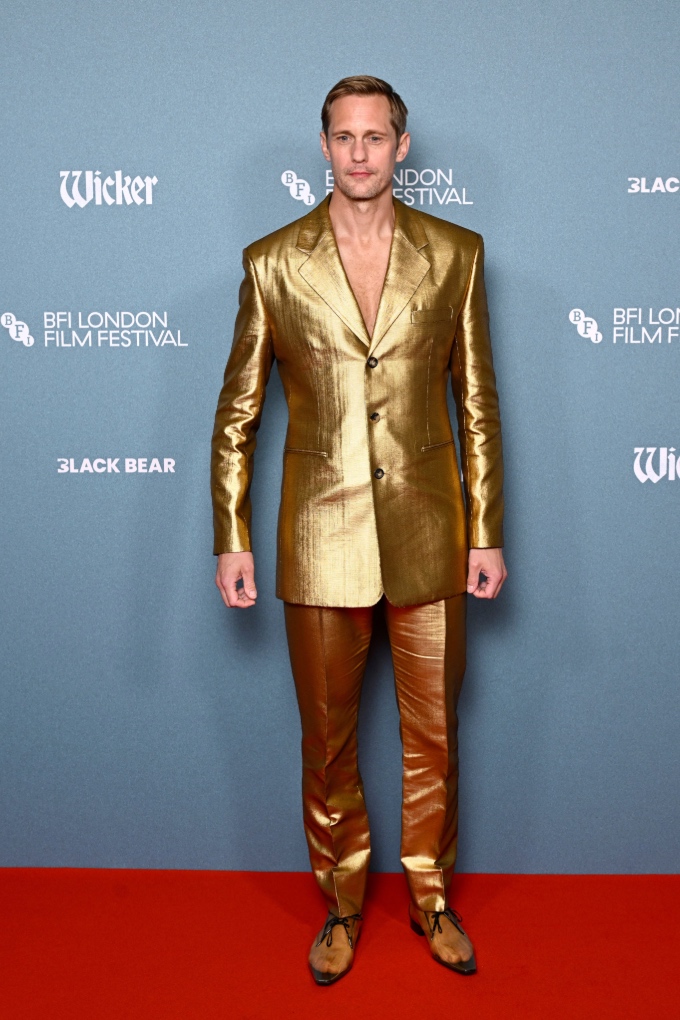
Who let the dogs out? At the 2026 London Film Festival premiere of Wicker, Alexander Skarsgård donned a full Saint Laurent ensemble—an all-gold suit, complete with a pair of PVC derbies. The actor stood ten toes down in the entirely-see through pair of shoes that were fresh off the spring/summer 2027 runway. A daring choice was made and the Internet was awash with close-ups of his feet almost immediately, divided over whether the choice was directional, or a sweaty faux pas. Either way, the reaction elicited is one central to this category of footwear: the freaky shoe.


Schiaparelli’s signature gold-toe footwear. The Margiela Tabis. Alexander McQueen’s Armadillo shoes. Fashion has had its fair share of shoes that demand a double take—footwear that is strange yet alluring all at once. Going beyond the shoe as a commercial accessory, this category of statement footwear embodies an unsettling yet uniquely compelling air; one cannot help but stare at the wearer’s feet. A cheeky disruption takes place, subverting fashion norms: the eyes no longer rake over the entire outfit and are instead arrested at the very bottom. The act of imagining (or seeing) the wearer’s feet wedged into the shoe feels slightly intimate—and perhaps a tinge seductive—but is facilitated, if not encouraged, by the freaky shoe.
Fashion designers have always pushed the envelope, thinking well outside the box. The emerging frontier subject to this sentiment as of late, has been footwear. Shoes are reimagined not merely as a visual accessory, but as a conceptual and avant-garde object of its own. From anatomical irregularities to trompe l’oeil details and exposed toes, these shoes explore the foot beyond a conventional sneaker or plain heel. And once the previously unwearable becomes a staple of the street crowd, newer versions find themselves becoming odder and odder.
On the runway, brands are becoming more audacious, making extremities more and more ubiquitous. On their spring/summer 2027 runway, Rick Owens debuted a knee-high caged boot that featured metallic, industrial chain detailing and dramatic, sculptural proportions. In contrast, Susan Fang opted for a 3D-printed slipper reminiscent of footwear constructed from Minecraft building blocks.


Independent designers have been part of the fray as well, testing the waters on the sartorial set’s willingness to experiment. Antwerp based designer Yichun Liu twisted the stiletto pump to create the Reversed Heel. The sole of the heel rests atop the foot, the shoe’s leather is crumpled and the heel shaft is bent at a sharp angle. What remains is a certain elegance, now blended with the bizarre. A surreal, uncanny take on the silhouette of a familiar, everyday shoe, the Reversed Heel feels fresh and cool, yet entirely wearable and accessible.


And in a world where aesthetics and taste can feel overtly polished or curated, the weird and bold silhouette not only becomes an easy way to excite the eyes, but also becomes a marker of non-conformity. A quieter resistance is signalled through eccentric footwear, and a more confident wearer is born. To don a freaky shoe is to embrace your wildest ambitions—the notion that you own your style, not the algorithm.
Ahead, dip your toes into Vogue Singapore’s curation of the oddest of footwear to get your freak on.


8 / 11
Maison Margiela Tabi Ballerina, $1,725
Available at Maison Margiela.


11 / 11
Schiaparelli silk heels, $7,190
Available at Vestiaire Collective.