In 1972 the Milanese musician Adriano Celentano conducted an experiment: He released a song without meaning, its lyrics written entirely in gibberish meant to sound like English, to see if it could still move an audience. At first the song bombed. But two nationally televised performances featuring group choreography and Celentano’s own distinctive dancing—his nickname was Il Molleggiato, or “The Bouncy”—saw it rise high in the charts, first in Italy and then in multiple countries across Europe. Today that song, “Prisencolinensinainciusol,” remains famous and feels modern: in fact, last night it featured in Vogue World Milan.
One of those two TV performances featured another Italian pop progressive, Raffaella Carrà, whose immortal Italo-disco banger “Rumore” was mixed into the “Prisencolinensinainciusol”-dominated soundtrack at Maria Grazia Chiuri’s Fendi show today. You could see Celentano’s experimental approach in 1972 as a mirror of Chiuri’s in 2026. Speaking at a preview, she said: “Fashion is part of our language.… Clothes give another sense to the body.” She added: “Fashion is that. What do you like? What is your memory? Putting this together is like being a DJ. I think it is impossible to concentrate on only one aspect.”
The Fendi runway contained a mirrored box inspired by the artist Luciano Fabro’s “Cubo di specchi,” around which we sat. As the models passed within the box, we could sort of see them, fairground-style, in repeated, diffused reflection. The space was designed to put the audience into our own sight lines as we tried to look at the collection, transforming the mirror from an instrument of self-reflection into one through which we encountered others. I looked rough, as usual by this point in the season, and even more so in comparison with the soignée Vogue colleagues alongside me.
Chiuri’s experiment, a bit like Celentano’s, ultimately led to an unintended outcome that could be counted as successful. Her process did not necessarily leave you questioning the conventional language of clothes in relation to the body—which I think was the point—but it did leave you squinting in special concentration in order to make out her garments. I didn’t want to cheat that process by looking at these unobscured runway photos before reporting my impressions, but the collection seemed to be a marked evolution of Chiuri’s silhouette-driven and purposefully focused first few Fendi forays.
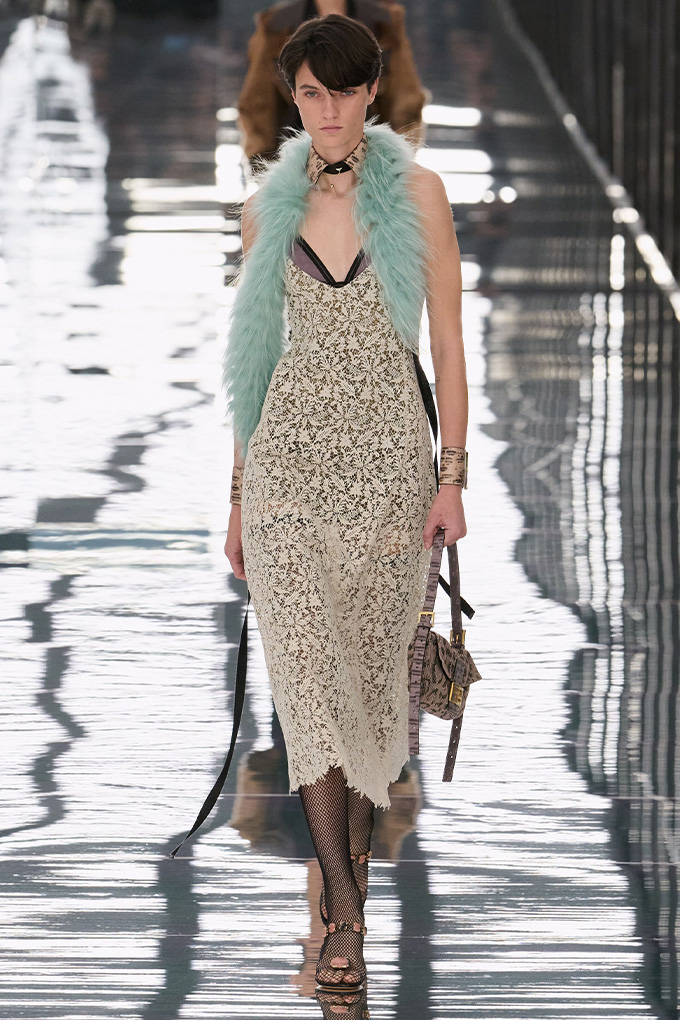
There was a touch more colour, and a dose of almost glam-rock hard-edged decadence: long black dresses with grommet-punched cutaways at the back; dresses fringed in beads and fur; an Afghan-style coat-dress parqueted in geometric Fendi patterns, possibly in-house brown astrakhan; and another in black with gold frogging. There were also silk romper shorts edged with lace under bralettes and fur; a menswear jacket in roughly cut pelts; and striped shirting that opened in a low tousle at the chest and seemed a Celentano reference. There was leopard. Chiuri mentioned that the collection also contained a new version of the baguette resized to hold only a phone, but I missed this, and probably many other things besides, on her runway. This was a collection to re-see.
Lining up to leave, I heard several people enjoying the fact that this show’s setup allowed them to include their own image in their footage of the runway. It also forced you to look at clothes a little differently, and see if they still moved you.

1 / 13
Look 1

2 / 13
Look 3

3 / 13
Look 7

4 / 13
Look 13

5 / 13
Look 22

6 / 13
Look 25

7 / 13
Look 30

8 / 13
Look 32

9 / 13
Look 52

10 / 13
Look 56

11 / 13
Look 61

12 / 13