Hong Kong has long been hailed as a global hub. It is the pre-eminent market not only for the financial, trade and tourism sectors, but also the art market. That spark brings an alternative side of the bustling metropolitan to life as it hosts its annual Art Week and Art Basel—for the latter, the city is its only stop in Asia.


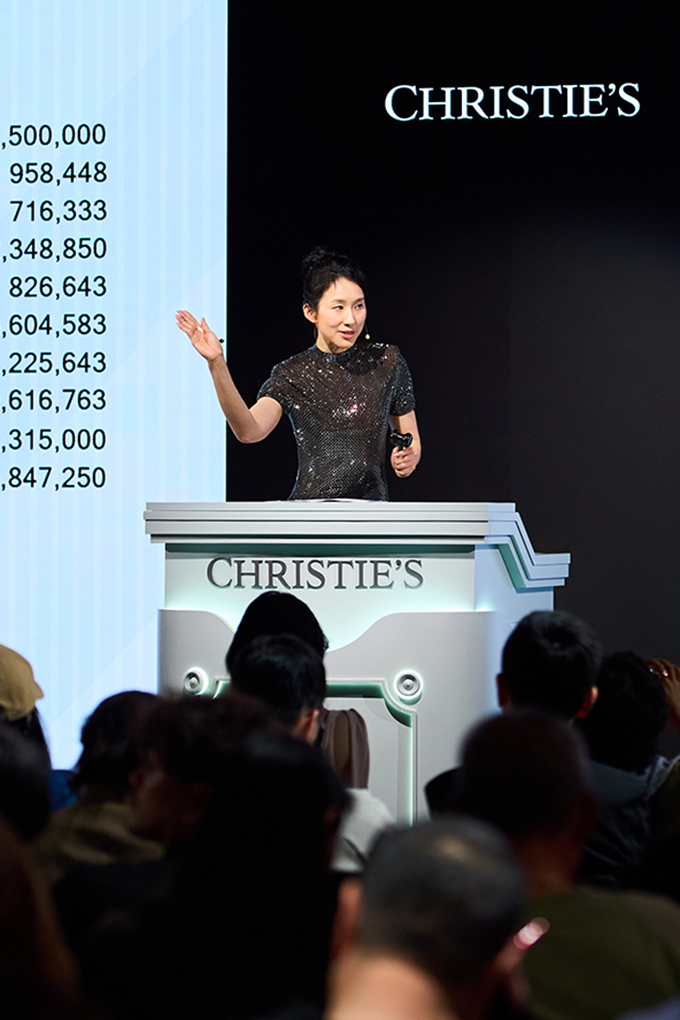
At the heart of it all in Central District stands Christie’s Asia Pacific, which celebrates its 40th anniversary this year. To commemorate its success, the world-leading auction house kickstarted its programme of activities for the year with its 20th/21st Century Spring 2026 Auctions. Held live at its Asia Pacific headquarters at The Henderson in March, the evening sale was electric. The rostrum gathered an exceptional selection of Western and Asian masterpieces, from the likes of Sanyu, Vincent van Gogh, Claude Monet, Walter Spies and Zao Wou-Ki. Then there was the highlight of them all: Gerhard Richter’s seminal ‘Abstraktes Bild’, its interest and demand driven by the German artist’s recent presentation at the Fondation Louis Vuitton in Paris.


Anonymous negotiations unfolded over the telephone, as bids were placed in sync with the auctioneer’s steady cadence. It was a grand success. All lots were sold, reaching a total of HK$655.7 million. For Emmanuelle Chan, associate vice president, co-head of the sale and specialist for the 20th and 21st Century Art category at Christie’s Asia Pacific, it was a clear signifier of what collectors currently look for: quality and diversity. Blue-chip artists seem to be the key, as “the market is a little bit more cautious now after it was so volatile a few years ago”, Chan explains.
It shows a shift towards buying fewer works, with each piece marked at a greater value. Established names build a strong foundation for their collections. But title is not the sole consideration. Provenance also plays a part. There is keen interest in the ‘resume’ of the work: its history, past collections and ownership. “Collectors are very much into the storytelling aspect of the piece,” shares Liang-Lin Chen, vice president and senior specialist head of sale of the Chinese Ceramics and Works of Art category.

Those collectors are deeply inspired by the Chinese history and culture behind every piece—the intention and purpose behind the craft and who it was made for. It’s part of the bigger picture that history paints, as ownership and preservation play a role in the continuation of the ceramics’ legacy. “They want to participate in the perpetuation of that history going into the future,” Chen adds.
While buyers stem from vast backgrounds, ages and nationalities, a common thread that unites them is, naturally, a passion for art. Big investment numbers often draw media attention, but a rare minority collects art as a pure asset. “The majority of buyers love how decorative it is and how it’s intellectually stimulating. They love having a statement piece that can spark a new debate and language around it,” Chan says. In this way, art gathers like-minded people with a shared passion, creating a sense of community around them.
Hong Kong continues to be the gateway to the art community in Asia, but a new force is on the rise among collectors. “I think the evolution of the Southeast Asian market is one that everyone should be paying close attention to right now,” Chan states. The art market energy has subtly been dispersed to this region and fairs like Art SG are proof of it.
Singapore has become a gathering place for world-class artists and international galleries. In the past, regional collectors only bought what was familiar to them: works by people of their own. But a new era of discovery has arrived as the Southeast Asian market expands to renowned artists like Yayoi Kusama, George Condo and Alexander Calder. “They’re still focused on their own market, but they’re open to buying anything in the rest of the world and creating dialogues with their own artists,” Chan shares excitedly. The result? An image-driven behaviour unlike any other, creating a new language and spawning a fresh way of buying art.
For Chan, this dynamic energy from the region stems from Southeast Asia’s climb to be an international driving force and not just a satellite market. In the era of immense globalisation, the upcoming generation of buyers have armed themselves with a keen sense rooted in dual cultures. The same can be said for Chinese ceramics and works of art. “There is definitely this attraction to their Chinese culture and lineage, a personal exploration of their heritage,” Chen explains. The past few years saw an increased participation from Southeast Asia, all gathered in one room to bid. “Sometimes they come all the way with their children, participating in the sale room,” she notes.
Here, the seeds are planted for a new wave of collectors. For a long time, it was typical to delve into collecting art at a mature stage of life. Only after someone had amassed a certain amount of wealth did art become a hobby to pursue. The spotlight has since shifted to a younger generation as their predecessors pass down their artistic interests, exposing them to galleries and museums from a young age. “We increasingly see this generation not only inheriting the collection, but building it with a new direction,” Chan shares on the rising trend. Works by contemporary artists of different regions are woven in with the Impressionist classics in their parents’ collection. A dialogue is created: not only between art movements and periods, but also between generations.
As for the next four decades and beyond, one thing is for sure: all eyes are on Asia. The revitalising passion of new and young collectors will continue to fuel the dynamism of the regional art market. Those who hail from this region have already lit the match, fanning into flame a cross-cultural dialogue that transcends borders, from one artwork to another.
The May 2026 ‘Nomad’ edition of Vogue Singapore is available online and on newsstands.