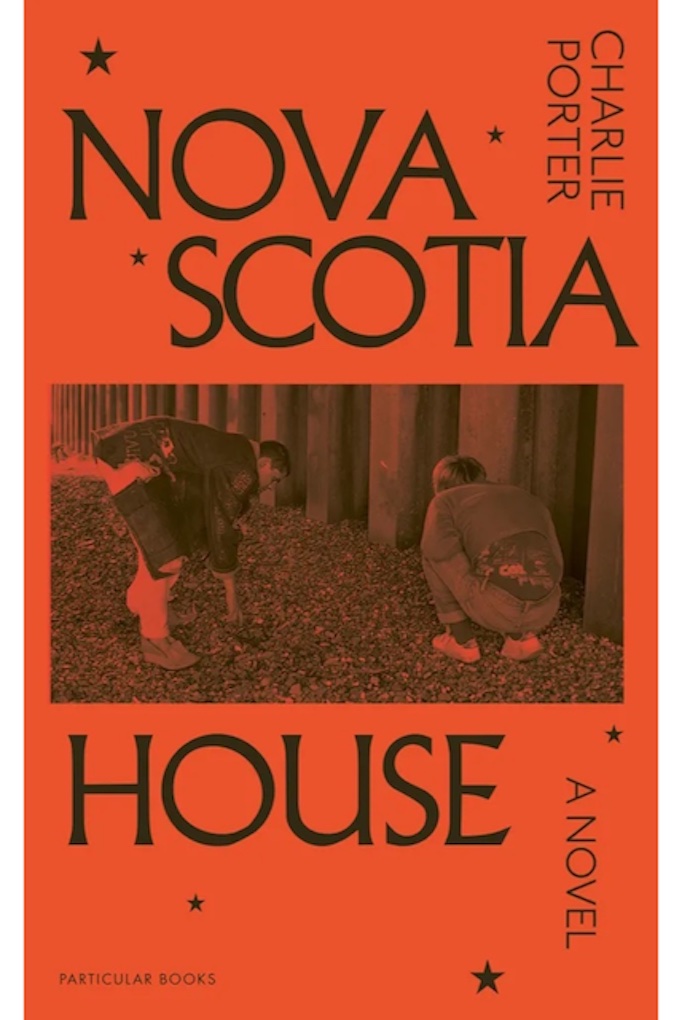
There’s a moment in Charlie Porter’s debut novel, Nova Scotia House, when a character relates that she has attended 14 funerals that year. It’s the mid-’90s in London, and the AIDS crisis is pulsating, but in 1996, anti-retroviral medications would be made available that meant it was possible to live a full life with an HIV diagnosis.
Until then, the lives of queer people—their emotional arcs, relationship dynamics, imaginations—were tempered by the looming death sentence of AIDS. When Porter first came to London in 1992, that spectre felt close.
Nova Scotia House finds its rhythm in an era of the AIDS crisis that has been less focused upon, delicately weaving together queer lives lived before, during, and long after it. Nineteen-year-old Johnny lands in London and falls for 45-year-old Jerry, who is HIV-positive. Their love story is traced with a golden thread of queer magic, from the ’70s gay activist movements that Jerry found his voice in to the fire of their love and Jerry’s courage through his illness. “What am I to do with this anger?” Jerry asks, before dying in 1995. Then, we meet Johnny again, now 45 and grappling both with his pain and the challenge of trying to carve out a more hopeful future.
As a fashion writer, Porter has often thought about the generation of creative minds lost to the crisis—the art, fashion, culture never realized. As the author of the nonfiction books What Artists Wear and Bring No Clothes, he’s also in tune with the importance of primary sources, something the AIDS crisis largely lacks. When Porter and I meet in an east London cafe, I share that my own uncle died of an AIDS-related illness in 1993, while his partner lived to be an old man. I often imagine the possibilities of their lives if only granted those three extra years, with just some old photos, letters, and his theatre playbills to remember my uncle by. The fiction of Nova Scotia House asks both its reader and its author: How can we connect again with radical queerness and countercultural ideas of living? How can we live life as fully, optimistically, and queerly as possible?

Vogue: Bring No Clothes and What Artists Wear are both so thoroughly researched and emotionally astute. They feel like historical documents, but also radical emotive arcs. How does your nonfiction practice differ from your fiction?
Charlie Porter: This book predates Bring No Clothes. I started it in the spring 2020, during the editing process of What Artists Wear. I was writing this in a very different way, though. My nonfiction books are very research-based. They happen during a day’s work in the British Library. Fiction is very much when I say, I’m going to do some fiction, or I need a pause or to do something different. One helps the other. It’s symbiotic.
They’re physically different as well. Bring No Clothes was laptop-based. I did all the image research, and that happens as I’m writing. My fiction is all handwritten in capital letters—that was just because my handwriting is terrible. But then the pace is so steady and clear: It allows me to breathe in the sentence, rather than [he motions as if tapping on a keyboard] breathing at the end of the sentence. We talk and think in ways that can be unclear—writing in capitals helps me to steer through that.
You’ve said that you approached Bring No Clothes like a lab technician, and the characters were in a petri dish—I wondered how you developed Nova Scotia House’s characters?
What interested me most about doing a project on the Bloomsbury group was that they weren’t an obsession of mine. It was a thrill to have the opportunity to explore and really interrogate them without any sense of fandom. Fiction writing, for me, is instead about letting people live. It’s like The Sims: I build the house, put people in them, and see what they do there. I know to some extent what’s going to happen, but how they spend their time with each other, how they are, happens during the writing. My hope is that the reader can feel that—what’s happening on the page is just happening. A lot of writers work with storyboards but, to me, that could become very stilted. They’re not alive. I let them walk around, I let them go to a party, see what happens. It’s an attempt to mimic an experience of living which doesn’t believe in predestination.
Did you look to other AIDS crisis-related art or media?
I very much didn’t seek it out during the writing process. I saw an extraordinary production of Angels in America at the National Theatre in 2017, and a production of The Normal Heart. When It’s a Sin broadcast in 2021, I actively didn’t watch it. I knew that it was a different story to mine, different intention and era. I just watched it for the first time last weekend, and I was completely broken by it. Before that, it was important to keep the world I was making watertight.