There are brands that dress the moment and then there are those that seem to shape time itself. Born in Vicenza in 1966, in a region cradled by the Palladian hills and steeped in centuries of goldsmithing, Bottega Veneta has always felt more like a philosophy than a fashion label.
From its infancy, the brand’s artisans worked with leather in a way that defied the logic of machinery. Lacking industrial sewing tools strong enough to handle their fine hides, they invented Intrecciato, an intricate lattice-like weave that remains the house’s enduring emblem. More than a technique, it is a metaphor signifying luxury without excess and a tribute to the beauty of invisibly meticulous work.
“Taken together, what stands out most in Bottega Veneta’s cultural initiatives is that there seems to be no attempt to universalise taste.”
This reverence for craftsmanship has, over time, translated into a broader cultural ethos. In 1983, decades before ‘brand philanthropy’ became a buzzword, Bottega Veneta underwrote the restoration of Titian’s ‘The Penitent Saint Jerome’ in Milan—an act of reverence not for publicity but for posterity. It is this commitment to legacy rather than branding that distinguishes the house’s cultural footprint.
As I linger at the entrance of Liminal in the Leeum Museum of Art in Seoul, this conviction becomes even more apparent. Housed in the sprawling expanse of a pitch-dark gallery where you can barely make out what is in front of you, French contemporary artist Pierre Huyghe’s first solo show in South Korea arrives with the support of Bottega Veneta.

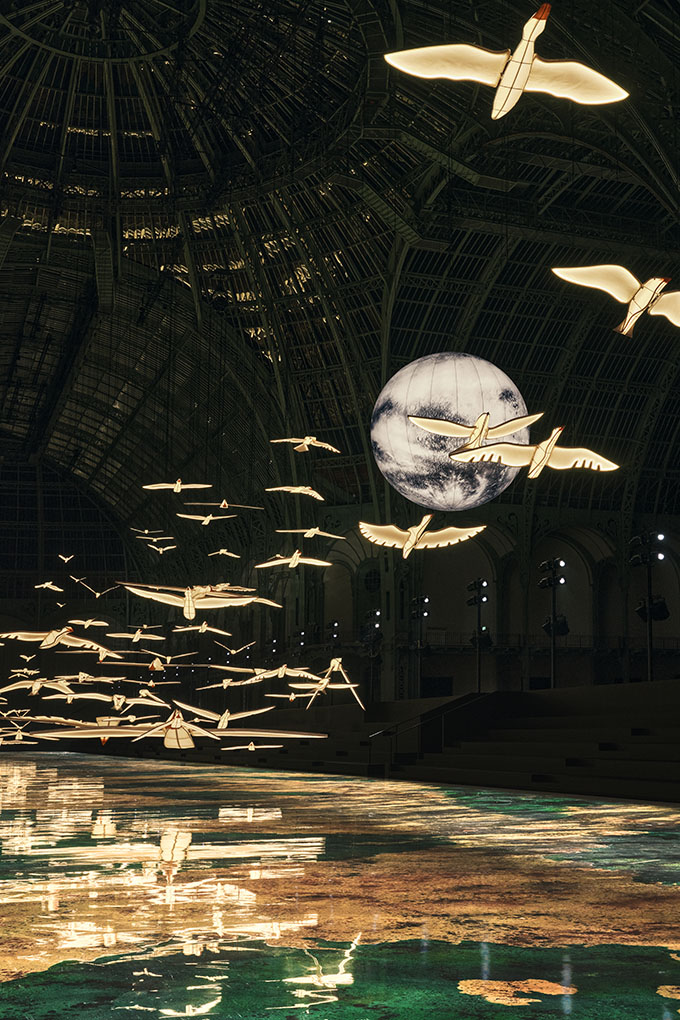
A wholly transportive universe spanning large-scale video, installations and even performance, Liminal has no prescribed route. Instead, what awaits is a shifting terrain of image, matter and mood: a masked monkey enacts uncanny rituals; an aquarium hums with artificial intelligence and crustacean indifference; and faceless figures dressed in Bottega Veneta garments glide through Huyghe’s constructed ecosystems—like apparitions with impeccable taste.
In Huyghe’s cosmos, the exhibit is alive (conscious, even), insisting that our outdated framework of separating nature and technology is no longer sufficient to capture our evolving cultural landscape. That Bottega Veneta has lent its hand to this effort makes sense. The house’s legacy is one of tactile mastery, yes, but also of subtle provocation. Here, in collaboration with the Leeum Museum of Art, it champions a wonderfully unsettling vision of the world.

As one of South Korea’s top artistic institutions, Leeum is, in itself, an architectural marvel—designed by Mario Botta, Jean Nouvel and Rem Koolhaas. Inside, a 12th-century celadon sits metres away from Yves Klein and Suki Seokyeong Kang; gold-threaded ritual robes glow under the same light as a Louise Bourgeois spider. The museum’s curatorial approach transcends both country and era, privileging nuance over narrative.
As a result, the museum represents less an institutional partner for Bottega Veneta than a kindred spirit. The brand’s relationship with the museum began in 2023 and has since been cultivated with care. What has grown between them is a cross-cultural dialogue on the value of craft. Just as the museum preserves the intricate traditions of Korean metalwork and ceramics, Bottega Veneta continues to honour its artisanal roots through Intrecciato and hand-finished leatherwork. The synergy lies not in sameness, but in the parallel belief that heritage is not a static thing. Instead, it needs to be re-interpreted and reimagined.
It’s a sensibility that extends beyond Seoul into the rest of the continent. Over the past few years, Bottega Veneta has steadily expanded its footprint across Asia—not through ubiquitous storefronts or monogrammed flash, but through a carefully calibrated localised presence. There are ambassadors, yes, but even these appointments feel unusually grounded. Instead of flattening its representatives into global campaign cliches, Bottega Veneta seems to prefer that they remain rooted in their own contexts, their own emotional registers.

This respect for specificity is arguably most visible in The Square, a series of intimate cultural programmes the brand has hosted in prominent cities around the world. Each edition brings together local artists and thinkers in a temporary space that functions more like a salon than a showroom. In Tokyo, guests encountered tatami rooms, ikebana installations and conversations on impermanence; in Dubai, there were Arabic calligraphers, poets and scent-makers in dialogue with one another, rather than orbiting a Western centre.
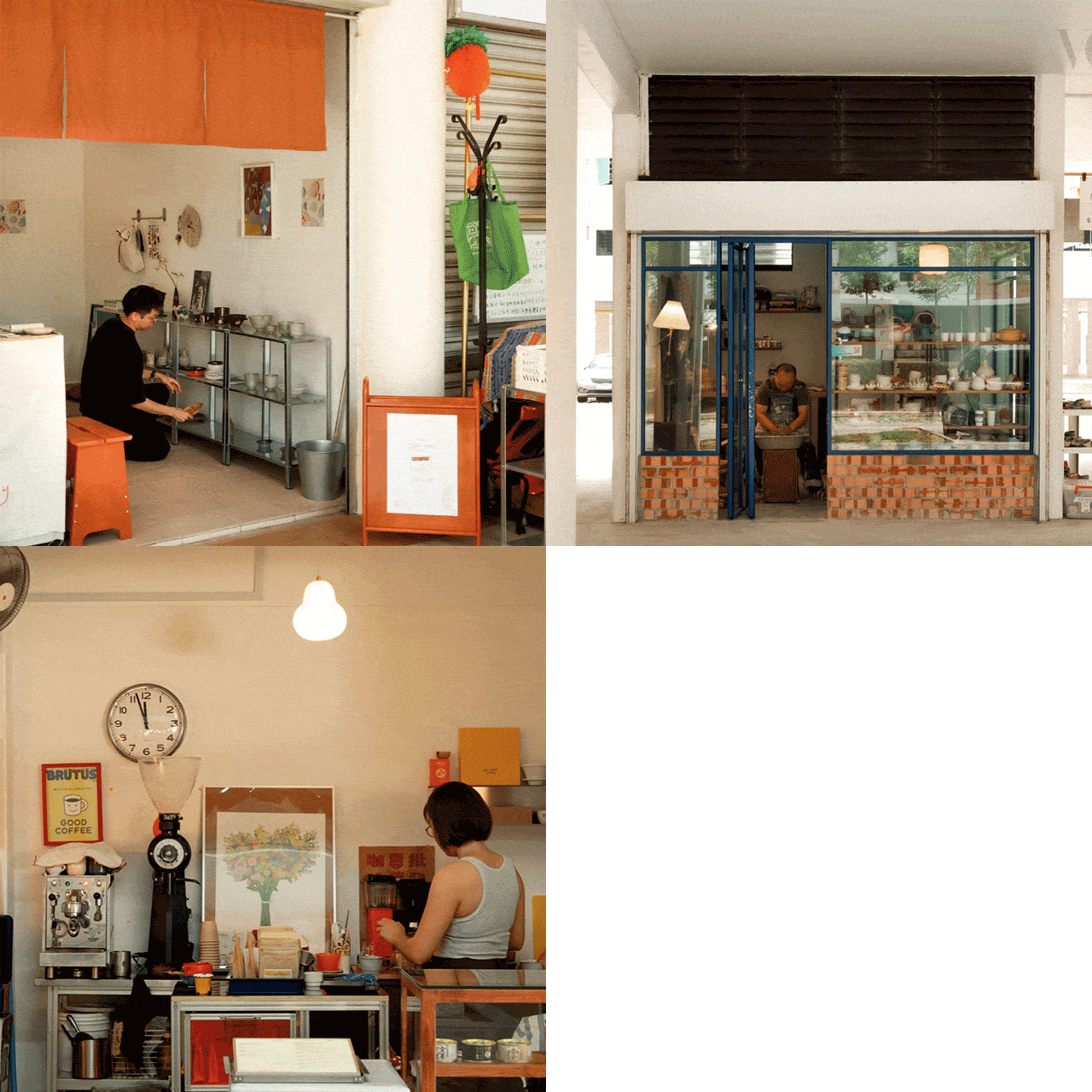
Then there is Bottega for Bottegas—an initiative that perhaps speaks most directly to the brand’s instinct for humility. Launched as a gesture of reciprocity, it spotlights small businesses around the world, ranging from florists and ceramicists to noodle- makers and bookbinders.
In its third edition, it featured three artisans hailing from Asia, each rooted in their own cultural histories and techniques: Taiwanese artist Cheng Tsung Feng, known for his elaborate bamboo installations; third-generation Korean kite-maker Kitai Rhee; and Chinese artisan Liu Wenhui, who makes modular sculptures inspired by classical joinery. Through these collaborations, Bottega Veneta offers not just visibility but solidarity—using its global platform to amplify the value of small-scale craft.

Taken together, what stands out most in the brand’s cultural initiatives is that there seems to be no attempt to universalise taste. Instead, Bottega Veneta seems content to become a guest, a student even, in the cultures it enters. The result is something that is quieter and perhaps more radical: a luxury house that doesn’t aspire to omnipresence but to intimacy. In an age when cultural capital is often confused with reach, there may be no approach more subversive than this.
Vogue Singapore’s June ‘Gold’ issue will be out on newsstands from 13 June and is available to preorder online.