Decorative hard stone dials made a big comeback in watches last year, and this year the trend is reaching a critical mass. What’s new? A fresh degree of creativity and innovation—both in how these stones are used in a design, and in the variety and range of unusual stones starting to grace watch dials.
One of the most sublime hardstone watches this year is the Établisseurs Galets by Audemars Piguet. It comes from the new Atelier des Établisseurs collection by the brand, which pays homage to how Swiss watches were traditionally made: discrete specialist craftsmen (case and dial makers, lapidaries and jewellers who cut and set gemstones, chaînistes and leather artisans who craft bracelets and straps, and the watchmakers who craft movements) joining forces to create a timepiece.

The Galets is inspired by the Lac de Joux in the Jura mountains, with decorative stones polished to round, pebble shapes as if they had been rolled and smoothed after centuries of water washing over them. The most impressive touch is subtle: a specially shaped movement that follows the pebble silhouette of the case—excellence both inside and out. Audemars Piguet has introduced the Établisseurs Galets first with a pairing of turquoise and tiger’s eye, with five variations to follow in the rest of the year.

Then there are those classics that are getting a stony touch. Bvlgari has enriched its Serpenti Tubogas with a new Studs Capsule collection, with three models featuring carnelian, sodalite and malachite dials—an uncommon detail for the Serpenti collection.

Cartier, meanwhile, introduced a subtle stone to its Santos-Dumont line. The more eye-catching novel idea might be the flexible mesh bracelet, but look a little closer at the yellow gold model and you’ll pick up on a dial of gilded obsidian. Cartier sourced this volcanic stone from Mexico, which shines with a mysterious iridescence thanks to tiny air bubbles trapped in the stone. The obsidian is cut to just 0.3mm in depth, and crafting it into a dial is said to be as challenging as working with glass.


One maison, however, has taken decorative stones and truly run like the wind. It shouldn’t be all too surprising, considering that stone dial watches are a cornerstone of Piaget design history. This year, the brand unveiled a veritable feast for the eyes. The dainty and pretty Sixtie watch receives its first stone dial with blue quartzite; the cult-favourite Piaget Polo 79 comes in white gold with sodalite, and the gadrooned aesthetic is carried over to the mainline Polo in rose gold with a blue quartz dial. The cushion-shape Andy Warhol, a perfect canvas for gorgeous stone dials thanks to its wide, open look, debuts some novel ideas: stormy blue quartz, gleaming bronzite, and bull’s eye—the latter a silky, red-brown stone that’s said to symbolise strength and courage.
There are, of course, high jewellery treasures too that embody the house’s dual expertise in crafting watches and jewellery. The manchette cuff style takes over a new, outsized Sixtie high jewellery model with the entrancing, spectral flash of an opal dial. It’s paired with lines of diamonds, and concentric bands of gold hand-engraved with Piaget’s distinctive bark-like Décor Palace motif.


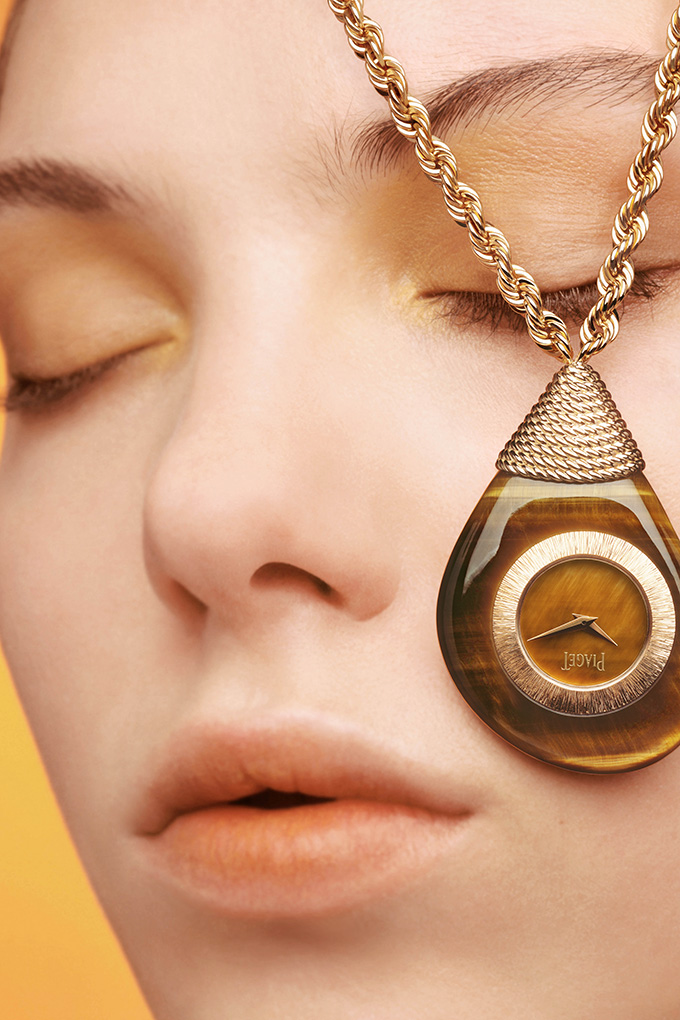
But the most outstanding stone watches from Piaget—and that’s saying a lot!—is a new line of Swinging Pebbles. It combines this mastery and expertise in using beautiful stones with one more house signature: the famous, fabulous Swinging Sautoirs. The Swinging Pebbles are cased entirely in drop-shape pebbles of polished stone. A gold bezel, dial and hands are worked into the stone, which is capped with a braided gold end to which a braided gold chain necklace is attached. The stones are gorgeous and rather rare: mottled, marble-like green verdite, the tempestuous blues and mixed shades of pietersite, and radiant tiger’s eye with the look of burnished, molten gold and caramel.
The June 2026 ‘Embody’ edition of Vogue Singapore is available online and on newsstands.