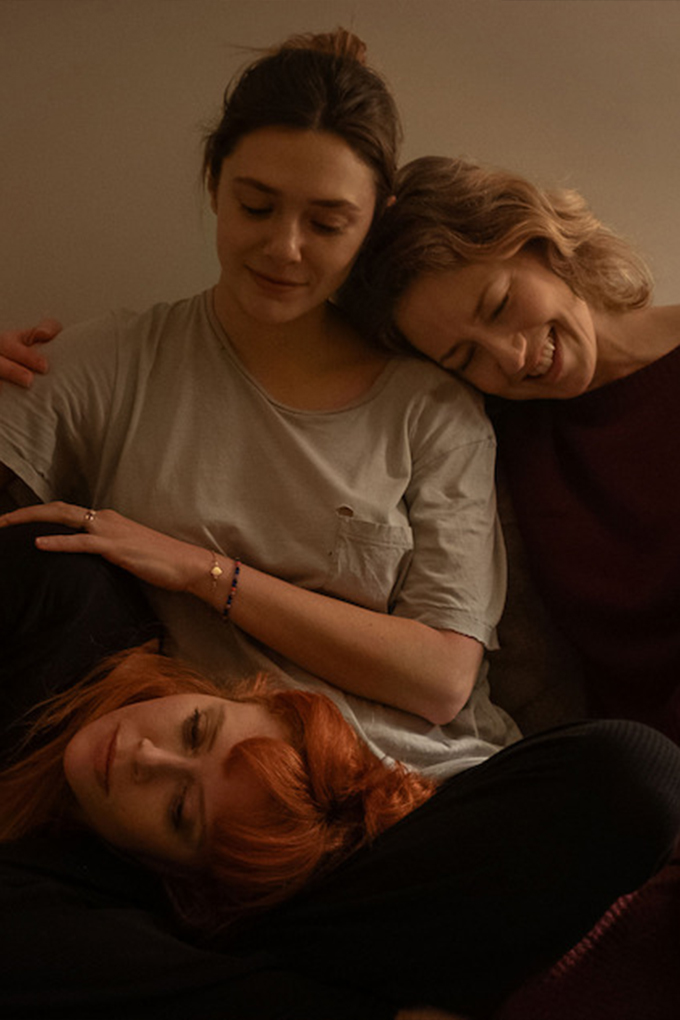
Earlier this year, my siblings and I witnessed our father and his siblings’ dynamics as they took turns to care for our ailing grandfather on his sick bed. As his days were numbered, the three of them often occupied each side of his homecare bed, providing their own understanding of what would comfort their father—from silly banter to massaging his favourite pressure points. On our way home, I deluged my father with questions, curious whether the siblings had always been this cordial and collaborative. My dad shared, “At the end of the day, a parent’s ultimate happiness is for all their kids to get along. If they all do, we can rest in peace.”
In Azazel Jacob’s new tear-jerker, His Three Daughters, I found my dad’s words to be especially profound—more so towards the end of the film, when the four share a laugh in a candid selfie, a remnant of their father’s very last moment.
The film first projects the initial isolation of each daughter—all with stories so different from the other. Katie (Carrie Coon) is a classic type A personality, erratic and desperate for practical order; Rachel (Natasha Lyonne) is the misunderstood but grounded middle sister perceived as a hopeless case; and Christina (Elizabeth Olsen), youngest of the three, she embodies the role of the gentle mediator who masks her hardships under a jolly disposition.
When they arrive to care for their ailing father, the three are confined in a tight downtown New York apartment that holds memories of their upbringing, albeit distinctively different. They are forced to navigate their complex relationship together, amidst their individual experience with premature grief interlaced with their father’s looming death. Nonetheless, even while they remain divided on screen, Azazel Jacob’s diegetic placement of the father’s rhythmic pulse wafts through the apartment—functioning as a singular thread that holds the three daughters together.

As they gradually unravel their truths and empathise with one another, the thread ties a knot of sisterhood that prevails even after their father’s death.
At the end, when the montage rolls, and the sisters part ways, the background plays a familiar nursery rhyme with a dark humorous twist where the sisters share a bittersweet laugh amid their melancholy—an act that doesn’t seem as twisted when shared with the people you were raised with. Truly, it’s a complex yet special bond, I can’t quite define it but I believe it’s a sentiment only known to siblings.
The bittersweet ending of His Three Daughters might just nudge you to hug your siblings afterward, and maybe indulge in a few more films that explore the different siblings’ dynamics. Below, we have shortlisted a few masterpieces that capture the complexities of this layered relationship.

1 / 5
Little Women (1994 and 2019)
A cult classic that sits timelessly with all generations of sisters. Louisa May Alcott’s literary masterpiece tells the story of the four March sisters—Meg, Jo, Beth and Amy—each with characteristics and hobbies that uniquely belong to them. The films intricately showcase the sisters’ life trajectory from childhood to womanhood, as they soon falter into their own separate paths in pursuits of their dreams. If you’re looking for an adaptation that stays close to the original literature, try watching the 1994 adaptation of Little Women, directed by Gillian Armstrong. However, if you prefer a bold contemporary twist, look to Greta Gerwig’s 2019 adaptation as the film embraces a new era with multi-dimensional perspectives on each sister. Our recommendation, of course, is to enjoy both.

2 / 5
Our Little Sister (2015)
Our Little Sister is an underrated Japanese melodrama directed by Hirokazu Kore-eda. It conveys a delicate and heartfelt story of three sisters who were abandoned by their father for fifteen years, only to be reunited with him at his funeral. To their surprise, they learn about the existence of their 14-year-old half-sister—the child of their father and the woman who he abandoned them for. One might expect the sisters to express some sort of pent-up resentment against the 14-year-old, but to the contrary, the film takes on a heartwarming direction—the three sisters save her from her selfish mother and adopts her into the family, where they collectively reside in the house left by their grandmother at Kamakura. Without being overtly saccharine, the raw and candid domestic film deftly dissects the intricacies of sisterhood with the unspoken heavy emotions entangled in their affection and responsibility for each other.

3 / 5
You Can Count on Me (2000)
A film that privileges familial relationships above all else, You Can Count on Me follows the story of a sibling duo, Sammy (Laura Linney) and Terry Prescott (Mark Ruffalo) whose lives are indelibly marked by their parents’ fatal car accident. Seeping childhood trauma into adulthood, the film captures the two leading different lives, yet subconsciously the common effect of their tragic loss still loosely threads them. The duo reconcile after two years of no contact, with Terry looking to his older sister for money and shelter. Delighted to have him around nonetheless; Terry fills the void in Sammy’s life and her son’s. However, as the film progresses, a series of events compel Sammy to choose between her brother and son.

4 / 5
What’s Eating Gilbert Grape (1993)
Being the anchor that holds the family stable is no easy feat. What’s Eating Gilbert Grape showcases the reality of this role through Gilbert Grape (Johnny Depp), a selfless son who is willing to sacrifice for the rest. The film invites viewers to live vicariously through him as he attempts to mould his own life but is frequently held back by his atypical family. Preoccupied by his worries for his unhealthily obese mother (Darlene Cates), and neurodivergent younger brother, Arnie (Leonardo DiCaprio), the film takes you on a tumultuous yet heartfelt journey that underlines the importance of empathy, seen in the beautiful bond forged between the brothers.

5 / 5
Taegukgi: The Brotherhood of War (2004)
How far are you willing to go to protect your siblings? In this tearful yet grim traditional war film, older brother Jin-Tae (Jang Dong-gun), known to be the rowdy and burly breadwinner of the family, does everything he can to have his younger brother, Jin-Seok (Won Bin), the scrawny vulnerable intellectual, sent home when they were both conscripted. However, in a dramatic slew of events, the two are faced with the conundrum of leaving one behind at an unfortunate crossroads with the North Koreans. For shin pa aficionados, this exquisite film on brotherhood is bound to leave you teary-eyed in your seats.