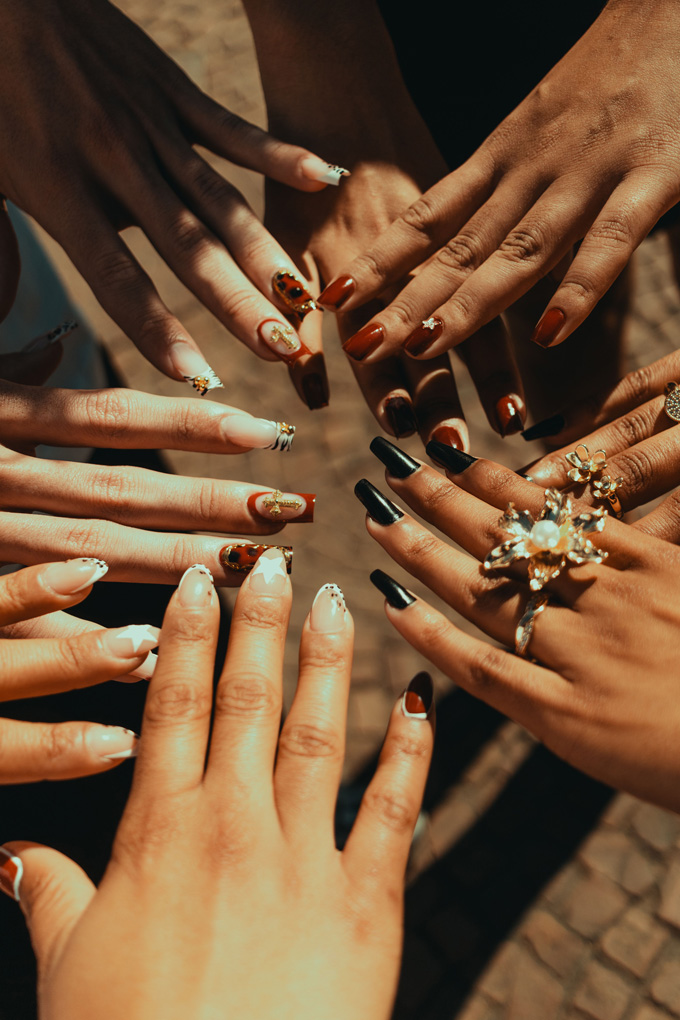
At the recent Google I/O conference, guests were exchanging details with a tap of the hand, instead of reaching for business cards or holding up QR codes. Embedded beneath carefully applied press-on nails, wafer-thin NFC chips linked directly to LinkedIn profiles, portfolios and newsletters. A CV on your thumb, LinkedIn on your index—why stop there? The remaining eight fingers, should ambition require it, are yours to programme.
The simplicity of it all means that these NFC chips can slip into any design—whether that be manicurists working the chips into gel nails, or slipping it beneath your press-ons.
With social media turning personalities into storefronts and wardrobes into affiliate links, NFC nails simply extends that logic to the handshake. After years of false starts, wearable tech finally appears to be finding its footing. Google’s intelligent eyewear collaboration with Samsung and Gentle Monster made waves following its unveiling at Google I/O; while Meta has doubled down on AI-powered glasses of its own, tapping into Kylie Jenner to give its assistant a familiar voice. The common thread is discretion: technology that slips into existing accessories rather than demanding new ones.

The concept itself is hardly new. Japanese brand 2LumiDecoNail has been producing NFC-enabled nail designs since 2014, with nail wraps featuring battery-free, NFC-enabled LEDs. But as conferences become increasingly digital-first—and networking increasingly measured by how frictionless it can be—the technology appears to have found its moment. At Google I/O, brand strategist Janey Park quickly became known for hers. “By day two, I was recognised as the girl with the NFC chips in her nails,” she says.
It’s not just a matter of aesthetics or novelty, but one of convenience. “You meet hundreds of people and everyone is fumbling with a QR code, digging for a business card, or waiting for an app to load,” says Park. “By 2023, I had started using NFC chip nails as a tool for targeted networking and haven’t looked back since.”
How to do it?
The process itself is surprisingly straightforward. A paper-thin NFC sticker is placed onto the natural nail before a press-on is applied over the top. Using a free app such as NFC Tools, users programme the chip with a URL. Tap the nail with an NFC-enabled smartphone and the chosen link opens instantly.
Park keeps her setup intentionally minimal: her left thumb links to LinkedIn, while her right directs visitors to her Substack. “I use both thumbs because they’re the easiest to scan,” she says.
“I’ve tried different types of nails, but personally I use press-ons because I like the chip to be more invisible. After doing what you normally do to prep your nails and cleaning the nail with an alcohol pad, you place the chip flat on the nail bed. To program it you open an app like NFC Tools, tap write, and copy and paste a link. Someone taps the chip with their phone and the link opens to connect,” says Park.
View this post on Instagram
Whether NFC manicures become as commonplace as smartwatches remains to be seen. But they point to a broader shift in wearable technology—one where the most sophisticated interface is the one that doesn’t look like technology at all.