Every Wimbledon asks the same question of fashion: what can you possibly say with white?
For tennis legend Naomi Osaka, whose walk-on looks have become one of the sport’s most anticipated style rituals, the challenge wasn’t how to make white stand out, but rather how to make it tell a story.
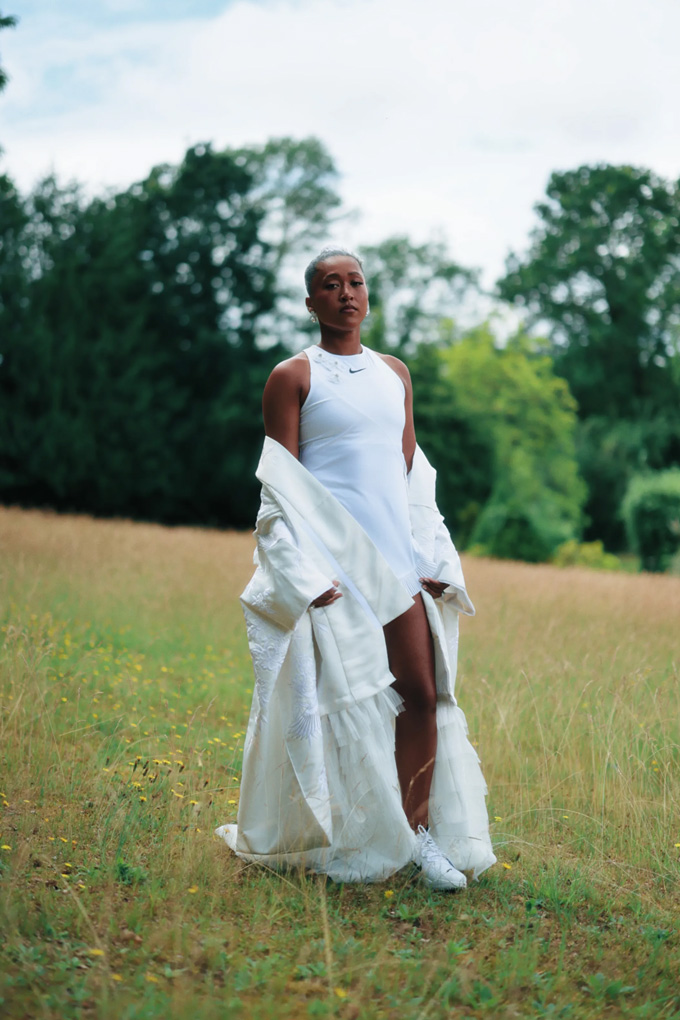
Working with Tokyo-based designer Hana Yagi, Osaka will walk on court at the All England Club today in a custom white creation inspired by Japanese ceremonial dress. Embroidered cranes stretch across the fabric. Cherry blossoms climb its surface. A dramatic trailing bow streams behind her, giving the silhouette an almost weightless quality before its layers peel away to reveal the Nike kit beneath. Finished with a traditional kanzashi hair ornament and Mikimoto jewelry, the ensemble transforms the walk from the locker room to the court into a fleeting performance of its own.

“I like to use fashion as a medium for storytelling,” Osaka tells British Vogue of her elaborate entrances. “Every walk-out is an opportunity to bring people into my creative world. The fact that people care about it and are excited to see what’s next is also pretty cool.”

Wimbledon is, in many ways, a tournament built on ritual – from its all-white dress code to the storied walk onto Centre Court. For Osaka’s longtime creative director, Marty Harper, those traditions provided the conceptual foundation for this year’s look.
“It’s one of the few places in sport where ceremony still feels inseparable from competition,” he says. “We wanted to acknowledge that while creating a dialogue with Japanese ceremonial dress.”

The goal wasn’t to recreate a kimono, but to reinterpret it. Borrowing its structure and symbolism, Harper imagined how those ideas might live on a modern athlete at Wimbledon. It was this idea that led him to Yagi, whose practice centres on working with retired ceremonial garments that, she says, “carry memory, emotion and history”.
“The starting point was the idea of ‘Evolving Ceremony,’” Yagi says of the concept behind the look. “The garment is constructed from vintage shiromuku [traditional Japanese bridal garments], kimono and wedding dresses—ceremonial garments originally created to mark important moments in people’s lives.”

The finished piece is composed of detachable layers that gradually disappear as Osaka prepares to compete, making transformation part of the garment itself. “I wanted the garment to exist as the moment before performance,” Yagi explains. “The walk-on surrounds Naomi in ceremony, while the Nike kit represents the athlete in competition. I thought about them as two chapters within the same story.”
That dialogue continues beneath the outer layer. Osaka’s Nike dress draws on kirigami, the Japanese art of paper cutting, with precise cut lines and a series of three-dimensional floral appliqués, allowing the walk-on and performance kit to feel like two expressions of the same creative vision.

For all of its symbolism and craftsmanship, each detail also had to perform in practical terms. “Unlike a runway show, these garments exist for only a few minutes, Harper says. “Naomi has to transition from ceremony to competition in well under a minute, so every creative decision also has to solve a technical problem.”
For Osaka, Wimbledon’s famously strict dress code proved unexpectedly liberating. “I actually didn’t feel limited at all,” Osaka says. “Obviously, the outfit has to be white, but aside from that, you can play with a lot of different design elements. In some ways, not having to think about the colour allows you to highlight other cool features like fabrics and textures.”

For Yagi, the absence of colour actually sharpened the concept. “Working entirely in white allowed me to focus on material, transparency, construction and silhouette instead of colour,” she says. “Sometimes the strongest creative ideas emerge from the clearest constraints.”
The collaboration also reflects the creative shorthand Osaka and Harper have developed over the past several years. When they begin dreaming up a new look, the conversation rarely starts with clothing.

“Naomi usually arrives with an instinct—an emotion, a cultural reference, or a direction she’s excited to explore,” says Harper. “From there we begin asking larger questions. What story are we trying to tell? How does it relate to the tournament? How does fashion support performance without competing with it?”
For Osaka, these conversations have become an extension of who she is. “I think everyone has the capacity to have multiple interests or hobbies and passions,” she says. “Two of mine are tennis and fashion; the next person might like painting and hiking, and there’s nothing wrong with that.”

The garment reflects the same philosophy Osaka brings to her career: you don’t have to choose. Fashion doesn’t come at the expense of tennis, just as reinvention doesn’t require an erasure of the past. The elaborate walk-on gives way to a performance kit that echoes its Japanese influences, allowing ceremony and competition, heritage and modernity, to exist side by side.
Or, as Harper puts it, “It’s about carrying history forward rather than preserving it unchanged.”