The tricky thing about interviewing Manolo Blahnik about his shoes is that he rarely ever talks about shoes (even though he talks–OK, we talk–a lot). There are ordinances on the correct flowers to send (“calla lilies or casablanca lilies or hydrangeas”) and London’s greatest architecture (Blahnik’s favourite: the house Walter Gropius designed at 66 Old Church Street, located opposite the site of his first ever shop), plus photographs to sift through. Many of the images have sizzling stories to accompany them, which are largely unpublishable here.
“This is my darling,” he says, pointing to a portrait of Diana Vreeland, his hand sheathed in the white felt gloves he wears to touch his most exquisite creations, which match the white poloneck he sports beneath a lavender double-breasted suit and his snow white hair. The legendary one-time editor-in-chief of American Vogue implored Blahnik to pivot to footwear after he presented her with ink sketches he’d drawn for a production of A Midsummer Night’s Dream as part of his art and set design studies in Paris. In the picture, Hippolyta wore a high-heel sandal styled as a vine of ivy decorated with cherries. It was 1969–the laid-back bohemianism of the late ’60s would later give way to the glittering excess of disco, and Blahnik was at the centre of the scene. (Bianca Jagger was wearing a pair of Manolo Blahniks when she rode through Studio 54 on horseback.)

“She’s the one that got me here,” he says of Vreeland. “Here” being the elegant office he keeps near Burlington Arcade after more than half a century at the helm of his independent British label. Whether you’re 21 and discovering his shoes secondhand on Vinted or a lifelong collector in your 70s, “Manolos” (as all fashion editors refer to them) fizz with a knowing glamour that code-switches between CEO, rock star and insouciant heiress. The way generations of women feel about their Manolos was summed up perfectly by Carrie Bradshaw: “Shoe soulmates.”
Today, at 82 years old, Blahnik’s aura is tipped in storytelling gold. We linger over a photograph taken by David Bailey in Corsica in 1974. Helmut Newton and Blahnik pose, bespectacled, in director’s chairs; Anjelica Huston is statuesque in a doorway. When I started at Vogue in 2011, the fashion assistants that I looked up to (feared) had a print of it tacked above their desks at Vogue House, I say. He lets out an “Oh!” with the wistful longing of a one-man Greek chorus.
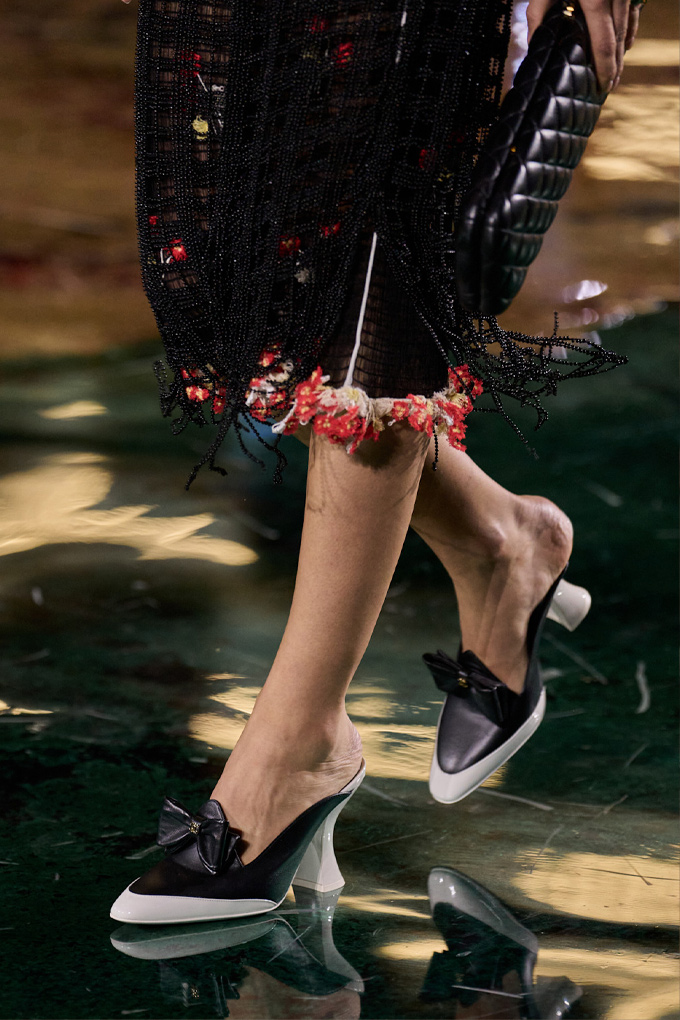
His right-hand woman seizes the moment. “Shall we talk about Marie Antoinette?” she asks politely, referring to the limited-edition collection of pumps inspired by the original pieces that Manolo Blahnik designed for Sofia Coppola’s 2006 biopic, Marie Antoinette–the reason for my visit. You can own them–a wearable piece of cinema history–from early autumn, when they’re set to be released in tandem with the V&A Museum’s must-see exhibit Marie Antoinette Style (curated by Sarah Grant and opening 20 September).
We turn to face a dresser papered with Blahnik’s signature sketchworks and a selection of hand-finished prototype slippers. “Can I hold her?” I ask, my voice hushed as though in the presence of a newborn. “Of course,” Blahnik says, honing in on the details. “This is a buckle from the 18th century–I got it in Paris–and this,” his white-gloved hand reaches for the powder puff pink Rohan shoe, “is vintage silk from Lyon.” The colour is a nod to Antoinette’s make-up, I learn, and the blue velvet ties mimic a garden trellis.
Coppola–who based her film on the 2001 book Marie Antoinette: The Journey by Antonia Fraser–gave the shoemaker a candid creative mandate: don’t be too academic, just do what you want to do. With that, Blahnik dived into his own childhood memories of growing up on the island of La Palma. “Since I was a boy of about 10, I had trouble sleeping,” he says, remembering how his mother would read to him in a bid to soothe his nightmares. One night she opened a book on Marie Antoinette and, soon enough, the young Blahnik was enchanted by the story of the ill-fated teenage Austrian princess.
When it came to costuming Coppola’s leading women, inspiration flowed. While the director was shooting Marie Antoinette at Versailles under special permission from the French state, Kirsten Dunst received weekly in-person deliveries of Manolo Blahnik shoes. As did Judy Davis, who played the Comtesse de Noailles.
“My shoes are not what I call ‘fashionable’,” he says. “They haven’t got time printed [on them].” I hadn’t realised I’d been tenderly cradling the pink pump. In my mind’s eye, I was on set in Versailles in the mid-noughties. There’s nothing about the way we dress now that is timestamped, I agree, snapping back to reality. The fun of the new season–of this September in particular–lies in how we augment our own fashion reality, borrowing from various eras as we please. These shoes would go rather well with Lucila Safdie capris and a love-worn Chanel tweed jacket, I think as I set the Rohans down on the dresser. Consider them a heartstoppingly beautiful invitation to pause time for just a moment…or a few hours.
This story was originally published on British Vogue.