“I would like to encourage you to repeat these statements after me,” gently urged Cathy Lee, my sound healer just yesterday afternoon during a session. What ensued was a series of declarations that affirmed the power of my manifestations into the universe. Lee’s beginning approach to a sound bath involved nidra yoga, a guided meditation practice that prepares the body and mind for relaxation, with the participant consciously and willingly entering a state of lull.
In that moment, one feels complete control of the body and soul but yet what follows next is to relinquish all that by ‘letting go’. A process that’s invigorating and subjective to the individual’s thoughts, consciousness and feelings. For myself, in that 40-minute sound bath, my mind travelled to many places. Eyes closed the entire time, my mind felt conscious but yet at certain points, alpha waves were part of my transition as I found the room entirely quiet and still, despite the bowls singing softly in the background.
When it was all over, my body and mind was sated—almost in the same way as how one would feel after a full-body massage. Of course, the experience and aftermath differs for everyone—depending on your intention for the session. As someone with a busy work schedule, I relished the moments when my mind was drained of all thoughts. When intrusive ones did eventually come through, I shunned them away and recentred my mind to be emptied.
“Sound healing can activate our rest and digest system and hence affect us at a physiological and emotional level. While many people feel relaxed or even fall asleep, it is also common for physical or emotional sensations to come up. Furthermore, at an energetic level, the vibrations can help restore balance in our energy, based on the fact that everything vibrates and emits frequencies that interact with one another,” explains Lee.
Her calling with the practice started years ago; feeling lost and in the midst of finding herself after leaving her corporate job, she attended a couple of sound healing sessions while on a solo trip to Bali. “I still remember to this day the vivid dreams I had, as I floated between states of awake and asleep as the sounds and vibrations went through my whole body. What I saw was vivid but also inspiring as I was able to tap into my deeper subconscious, and understand better what was causing some of my resistance to change. Some old knots and wounds felt softer as well, and that night I had one of the most peaceful sleeps I had in a while.”
That sparked a curiosity to learn more, which led Lee to acquire her first bowl and soon after, her certification. Undoubtedly, she isn’t alone on our shores, where burnt out city-dwellers seek out sound healing as a form of therapy. It’s a wellness phenomenon that has gradually picked up stead these past years, with many others, like Lee finding their own place in the practice.
Below, Lee alongside two other sound healers share their journeys.

1 / 3
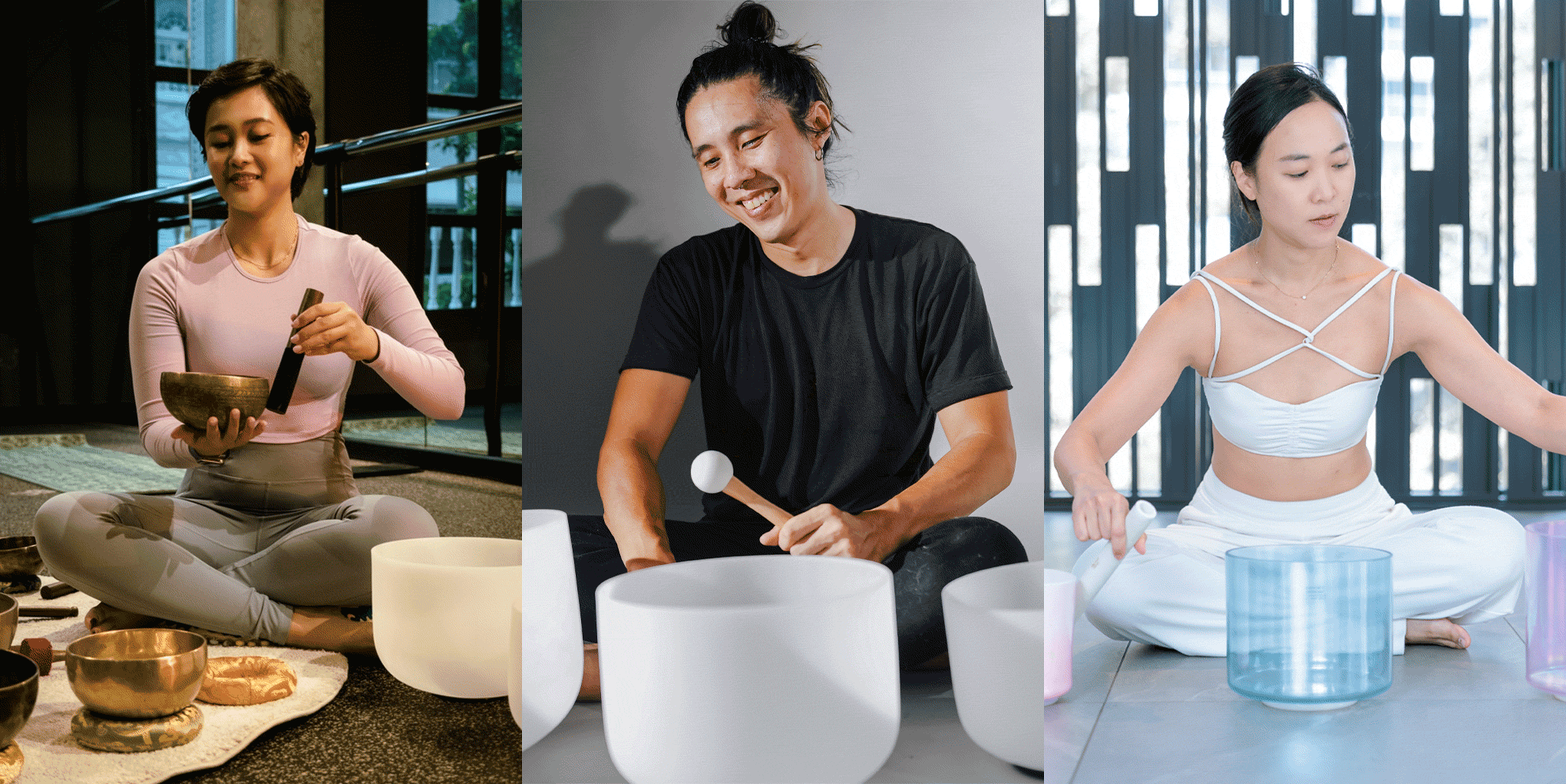
Cathy Lee, yoga teacher, crystal bowl practitioner and lagree instructor
How did you learn more about sound healing?
Coming back home from the Bali trip, I was excited to explore further. In my research I came across alchemy crystal bowls and was immediately drawn by their beauty, pureness and uniqueness from the elements infused with the crystals.
As I played some bowls for the first time, l felt the vibrations run through my body as I fell into a calm state – one bowl in particular felt so smooth and soothing playing it and I knew that was the right one for me but I couldn’t really explain it. I got my first bowl and decided to take my first certificate to dive deeper so I could understand sound healing better.
In your own words, describe what the practice is and how is it beneficial?
It is a form of meditation, practiced typically lying down (as a recipient) while listening to a type or many types of instrumentals like bowls, chimes and gongs. The sounds can bring our brainwaves into a more relaxed state, allowing for space to calm the mind and tune in with our own inner reality. Sound healing can activate our rest and digest system and hence affect us at a physiological and emotional level. While many people feel relaxed or even fall asleep, it is also common for physical or emotional sensations to come up. Furthermore, at an energetic level, the vibrations can help restore balance in our energy (based on the fact that everything vibrates and emits frequencies that interact with one another). Every sound bath is a unique experience for different people!
What is a misconception that you think most people have about sound healing?
That what you receive is only what you hear with the ear—there is more to it than that. When a percussive sound is played into a body of water, it ripples and makes shapes. Our body is made up of about 80% water, so sound can influence the body at a cellular level. Also, our own intention matters in a sound healing session—it is said our thoughts are a form of energy that can attract energy at a similar vibrations, bringing about experiences and opportunities you desire.
How has sound healing changed or impacted your life?
The principles I learnt behind sound healing and the quantum (energy) field changed how I view myself and my relationship to the world around me. I used to be someone that only relied on physical activities to help with my wellbeing. Now I feel more in tune with my own sensations, thoughts and emotions as I have noticed how it can affect my experiences and I pay more attention to the subtle energies and signs around me.
As a yoga teacher, I love to incorporate sound healing together with other practices like somatic movement, yin yoga and yoga nidra to help participants find relaxation, connect deeper within and set intentions.

2 / 3
Jamie Tan, photographer
Tell us about your entry to sound healing.
I first got introduced to sound healing during a retreat with my wife. Honestly, it wasn’t mind blowing or life changing, but what I felt after the session was so relaxing and soothing. The peaceful feeling actually lingered on throughout the day, I felt like I was well rested, better than if I had taken a normal nap. Along the way I was exposed to more sound healing sessions in various forms, and I was able to go back to that same feeling of restfulness, so I definitely got hooked.
How did it start and what made you continue the practice? How did you learn more or get certified?
My own journey really started when I conducted sessions with my wife. I saw how soothing it was for her too, and knew I wanted to explore further into this craft. I then went to Bali for a sound healing course and began to learn more in-depth techniques using multiple instruments. It also taught me that sound healing is not one long performance, but instead there’s benefit in introducing different phases and beats to evoke a different feeling each time.
In your own words, describe what the practice is and how is it beneficial?
Others may think you’re just paying for what’s essentially a nap, but it’s really more than that. I’ve found that it’s helped me ease my anxiety, and having a balanced mind can help anyone perform their best. I would describe it as massaging the body and mind through the sense of sound. In this age of hustle and bustle, anyone can benefit from sound healing.
What is a misconception that you think most people have about sound healing?
I think the first worry people have is if it’s tied to a religion, or particular spiritual practice. It makes you worry if someone’s trying to convert you, but I find that it’s a completely secular practice.
How has sound healing changed or impacted your life?
I’m a very pragmatic guy. The sounds around me serve a function, and that’s it. But with sound healing, it’s been a different way to use my senses to do interesting things like decompress or alleviate some anxiety I have. I particularly love the crystal bowl’s resonance, I don’t think it can be easily replicated with any other sound in nature and I love that.

3 / 3
Fitz Anugerah, business consultant and founder of Innate Health
Tell us about your entry to sound healing.
I did my Yoga Teacher Training back in 2018 and completed my Singing Bowl Certification in 2020. At the time, I honestly didn’t think much of it. I signed up purely for my own interest and personal growth. But everything shifted in October 2020 when I was diagnosed with lymphoma, a cancer of the immune system.
Because I had already experienced the benefits of sound therapy, I decided to host sound baths in my apartment in between cancer treatments. It became my way of both sharing something I loved and preparing my body, mentally, emotionally, and physically, for each round of chemotherapy or radiation. I went through eight rounds of chemo and 21 sessions of radiation. It wasn’t planned, but the practice became a powerful tool in my own healing journey.
In your own words, describe what the practice is and how is it beneficial?
My practice combines breathwork with active visualisation, a form of meditation that helps the mind and body drop into deep relaxation. When we enter the brainwave states of alpha and theta, that’s when the subconscious becomes more open, and real healing and reprogramming can begin.
With the addition of sound, especially from singing bowls, the body and mind begin to sync to the frequencies. This is a process known as brainwave entrainment. As the vibrations wash over you, the mind starts to quieten, gently guiding the nervous system from the “fight or flight” mode (sympathetic) into “rest and digest” (parasympathetic).
This exact process supported me through cancer. I would actively visualise my tumor dissolving while allowing my body to shift into calm. By my second round of treatment, my tumor had shrunk from 21cm to 4cm, and by the fourth round, I was technically in remission. That’s the power of the mind and of creating a safe space for the body to heal.
Since then, I’ve seen similar shifts in my clients. Some come in with physical symptoms like chronic pain or insomnia, others are navigating emotional stress, anxiety, or burnout. It’s incredibly humbling to watch how sound therapy, along with breathwork and visualisation, helps them find clarity, release emotional baggage, and reconnect with themselves in a safe and supportive space.
What are your favourite instruments to work with?
I use both Himalayan and Crystal Singing Bowls in my sessions. It’s hard to pick a favourite, but one bowl holds a special place in my heart. It’s a Himalayan full moon bowl, dated 31st October 2020, the very day I received my cancer diagnosis. That bowl reminds me to always pause, listen inwardly, and create space for stillness.
How has sound healing changed or impacted your life?
It’s a non-negotiable part of my morning meditation routine. It helps ground me and brings a sense of calm before I dive into the day. I juggle a few roles, running Innate Health, building a wellness community, and consulting for tech startups, so staying centred is key. Sound healing has taught me how to slow down, stay present, and listen to what my body needs. It’s been one of the most profound shifts in my life and something I now help others experience in their own way. Whether it’s a busy executive seeking stillness, a new mother craving rest, or someone recovering from illness, I feel grateful to hold space for people to remember their own capacity to heal.