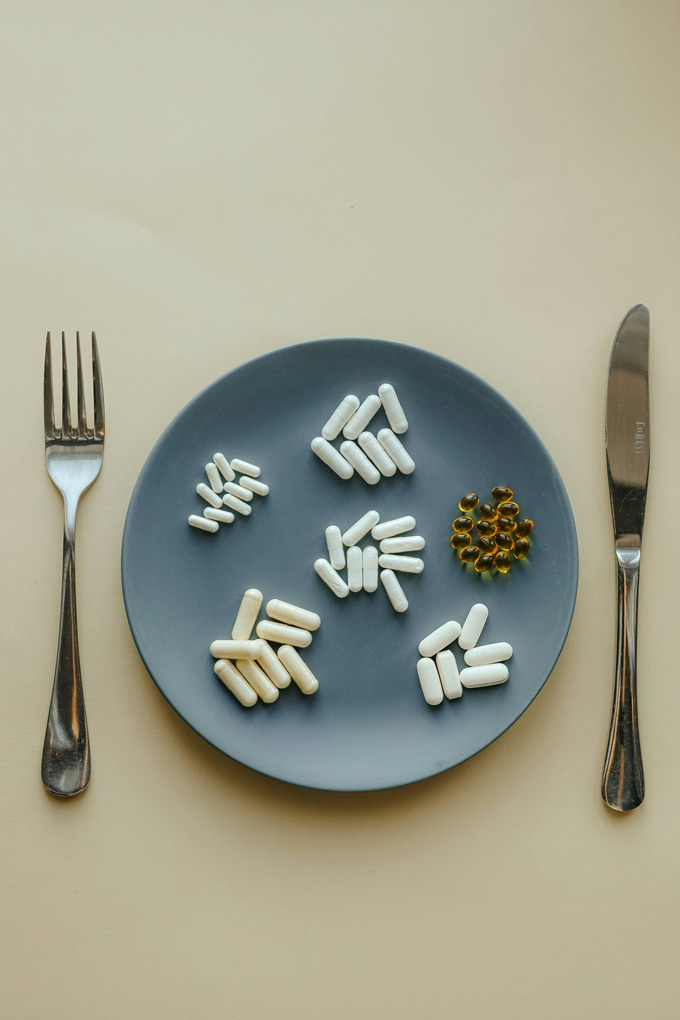
“Your plate is your foundation, supplements are the bridge when food alone, can’t meet your needs,” surmises Jodie Ang, dietician at Prologue. A simple statement that prefaces this common question: Should you be taking a health supplement? Whilst incorporating women’s health supplements into your daily routine has been societally normalised, do we know if we actually need them? Magnesium, Vitamin C, Omega-C, the list goes on… but with every body being uniquely different, how can we better apply supplements to benefit our own? Well, the stance from Ang remains: “We can get all vitamins and minerals from food. So from a dietician’s standpoint, supplements will not be taken as food but more to support your body. It means it can come in if you can’t get that specific nutrients from food.”
How do we know if we need a supplement?
It all comes back to a balanced diet. “First, look at your food plate to see what you are eating. Let’s take fruits for example, if you have been only eating oranges every single day, yeah, then that means you will definitely lack of other kinds of vitamins and minerals. Because different fruits comprise different vitamins and minerals. Are you eating a variety of fruits and vegetables? Different carbs like brown rice and meats? Because plant protein and animal protein both contain different vitamins and minerals.” However, if something still feels off about your body, Ang suggests to visit a doctor to get a blood test. “From there on, you can find out if your magnesium or Vitamin D is low. And then go through a dietician to see if they are eating enough before jumping to supplementation.”
Are supplements ‘healthier’ or more beneficial to anyone who’s concerned of calories?
With foods, come the add-ons like sugar, oil, fats and at times, the danger of other harmful things like mercury in fish. So does that make supplements a “better choice” especially for those who are weight-conscious? The answer is still a no when it comes to replacing foods with supplements. “If you’re calorie-conscious, it’s true that omega-3 supplements provide EPA/DHA without the extra calories from a salmon dish or added cooking oils. But whole salmon offers much more than just omega-3s, it’s also rich in high-quality protein, Vitamin D, selenium, and healthy fats that support satiety and overall nutrition. Rather than avoiding salmon, the better approach is to manage portions and use lighter cooking methods like steaming, baking, grilling, or air-frying to keep calories in check. Supplements can be useful if you don’t eat fish, but they don’t replace the complete benefits of whole foods.” The same goes for mercury, limit your intake of shark, swordfish, king mackerel, and tilefish (which tend to be high in mercury) and opt for fishes like salmon, sardines, and cod instead. At the end of the day, it’s all about finding a balance.
If you don’t need a supplement, what happens if you take it?
Ang firmly maintains: before proceeding to take a supplement, the best thing is to first consult a doctor. “Some vitamins like A, E, D and K, they are fat soluble. And what that means is that they will stay in your body longer. If you overeat it without even being deficient in the first place, it can lead to toxicity and a lot of other issues.”
Below, Ang sheds the light on some common supplements and what they each do for our bodies.

1 / 8
Magnesium
“While magnesium has many types, the common one for women is magnesium glycemic. To help with the sleep and improve mood swings and muscle relaxation—good for PMS symptoms.”
Available here.

2 / 8
Calcium
“From teenage years all the way to post menopause, we will need calcium because it helps us with bone density.”
Available here.

3 / 8
Vitamin D
While most assume we get our daily dose of Vitamin D just because we live in sunny Singapore, but it is all gene-dependent to whether your body is able to absorb it in. “Vitamin D is for bone density, immunity and mood regulation. Good for post-menopausal ladies as well as postpartum mothers to regulate themselves.” Another important tidbit to consider working in your diet? Vitamin D needs magnesium to be able to absorb into.
Available here.

4 / 8
Iron
“Iron is important for women when we are on our period as we tend to lose alot of blood. Teenagers will also benefit from this as they need every blood cell and they need energy.”
Available here.

5 / 8
Protein powder
“What most people don’t know before ingesting tons of collagen supplements is that collagen comes from protein.” In order to know if you need it? It all depends on what your current diet comprises of. Ang also advises that there is a danger with overtaking protein powder when it comes to individuals who are fixated on building muscle, and that can lead to kidney disease.
Available here.

6 / 8
Omega-3
“Omega-3 is required for all age groups: whether you’re pregnant, after pregnancy, perimenopause or menopause. It helps with bone health, heart health, brain function, as well as your hormonal balance.”
Available here.

7 / 8
Prebiotics and probiotics
“When we are stressed, our guts become stressed as well.” Prebiotics and probiotics aid gut health and vagina health. “The vagina has different bacteria too. It’s like our gut, where we have good and bad bacteria. That’s why there are female probiotics. It’s targeted for the vagina and the gut.”
Available here.

8 / 8
Folate
For women who are sexually active or trying to conceive, folate (and not folic acid), would be helpful to prevent any neurotropic effects in the early stages of pregnancy.
Available here.