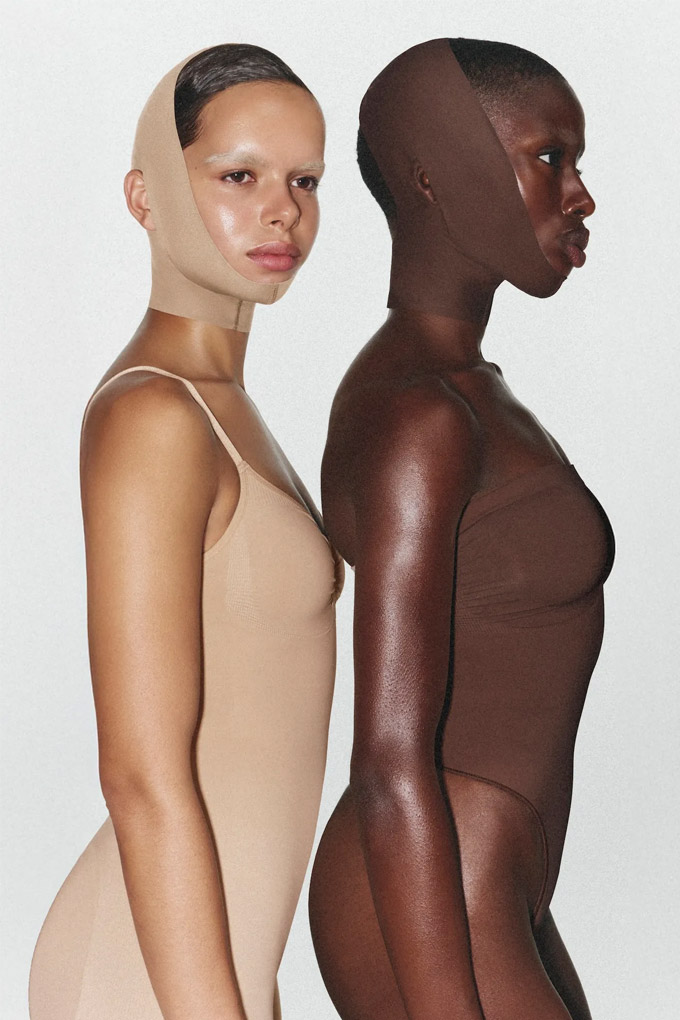
I’ll admit it, my first thought upon seeing the new Skims facial shapewear was not the most charitable. (How much more money does Kim Kardashian actually need?) I felt exasperated seeing a brand I respect do something that looked like a dystopian, cash-grabby April fool’s gag. The Skims Seamless Sculpt Face Wrap is a large, flat piece of compressive material designed to fit over the neck, around and under the chin, and be fastened at the top of the head with velcro. On either side, there’s a small slash to allow your ears to poke out. Yet to see it? Just imagine the bandaged up Tippi Hedren in The Birds.

Online, the response was mixed. Many expressed consternation at the item, with some going so far as to compare it to Hannibal Lecter’s prison mask (Anthony Hopkins couldn’t resist chiming in). Others (admittedly fewer, but still some), said that face wrapping had helped them eliminate water retention and puffiness in their neck, face and jaw.

Open to having my mind changed, I asked aesthetic doctors Dr Sophie Shotter, Dr David Jack, and Dr Dev Patel for their thoughts.
Honestly, is there a point to wearing facial shapewear?
In the long-term, no. In the short-term… maybe.
“Compression wraps can give a temporary de-puffing effect because they squeeze out lymphatic fluid and slightly shift superficial fat pads,” Shotter explains. This can mean that the face looks slimmer or more sculpted along the jaw, but the effect will fade within a few hours, she says. “Think of it like a sock imprint on your calf. The wrap cannot remodel fat, tighten skin or stimulate collagen in a permanent way, and there’s no scientific evidence showing sustained contour change from passive fabric pressure alone.”
Can facial shapewear increase collagen production?
No—no matter what the marketing says. “The Skims Seamless Sculpt Face Wrap is made using ‘collagen yarn’, a fabric infused with collagen peptides, which sounds appealing, at first,” Patel describes. “However, collagen in fabric cannot penetrate the skin or significantly impact collagen production. At best, it may offer some superficial hydration, but it won’t stimulate long-term structural changes.”
Could wearing facial shapewear harm the skin?
Yes. “Tight, non-breathable fabrics can trap sweat, oil and bacteria, which increases the risk of breakouts, clogged pores and irritation, particularly for acne-prone or sensitive skin types,” warns Patel. Unless you plan to buy enough to wear a fresh one each day, strapping the same bacteria to your face feels like an easy way to encourage skin issues.
“At best, you’ll wake up slightly less puffy,” Dr Jack concedes. “At worst, you could see indentation marks or a flare-up, if it’s not cleaned properly. Plus, there’s no evidence that this does anything structurally beneficial to the skin or underlying tissue.” If you want to improve jawline definition, his recommendation is to focus on things that are proven to stimulate collagen production: retinoids, fractional radiofrequency and a professional skincare routine. In his words, they’re all better uses of your money than “a £40 bandage from a fashion brand”.

When would someone wear compressive facewear?
Really, only after a procedure or surgery, all three experts say. “These sorts of garments can be useful post-procedure or post-surgery, such as [after] liposuction of the chin or fat-dissolving injections in the chin.” In almost every other circumstance, they say the effects are likely to be temporary, with the possibility of disrupting the skin barrier, introducing more bacteria to the hairline and face and, potentially, worsening fluid retention in certain areas.
This story was originally published on British Vogue.