There has never been a more expressive time in the world of beauty than the present. With a continuous stream of products touting new formulations, packaging and colours, beauty marches forward. But amidst the fray, one creator is holding strong in keeping vintage make-up relevant for today’s audiences.
The steadfast believer in question is none other than the intrepid Erin Parsons, whose convention-defying beauty looks have long captivated audiences. The ultimate chameleon, Parsons can often be seen transforming her mien with beauty products and techniques from yesteryear. Her latest look? A 1920s-inspired ensemble of pencil-thin brows and kiss curls courtesy of the era’s foremost starlet, Josephine Baker.
What strikes viewers most, however, is her extensive knowledge of the beauty history behind the products she showcases. Scroll through Parsons’s page, and you’ll be sure to hear her soft, sultry voice taking you through a cosmetic’s minute details—when it was released, who formulated it and what’s changed over time. Whether you want to know the exact shade of lipstick Marilyn Monroe wore, or what the ancient Egyptians used as rouge, Parsons is the one to watch. Beyond educating the masses on vintage make-up practices, her bread and butter also lies in finding dupes for discontinued products. And her efforts are not for nought—you might recall how Parsons was particularly eager to hunt down dupes that would emulate the original, cooler-toned shade of M.A.C’s Spice Lip Pencil from 25 years ago. Thanks in part to her more-than-passionate plea to restore the shade to its former glory, the brand obliged.
View this post on Instagram
While Parsons’s love for historical beauty first began in adolescence, it wasn’t until 2016 that she started collecting vintage make-up, after chancing upon a Maybelline cake mascara circa the 1950s on eBay. At the time, she was working with celebrated make-up artist Dame Pat McGrath. The next year, she would go on to become the global make-up artist for Maybelline—with her work seen on the likes of Gigi Hadid and other major fashion figures. Years of working in the beauty industry and creating content have only deepened her affinity for vintage beauty.
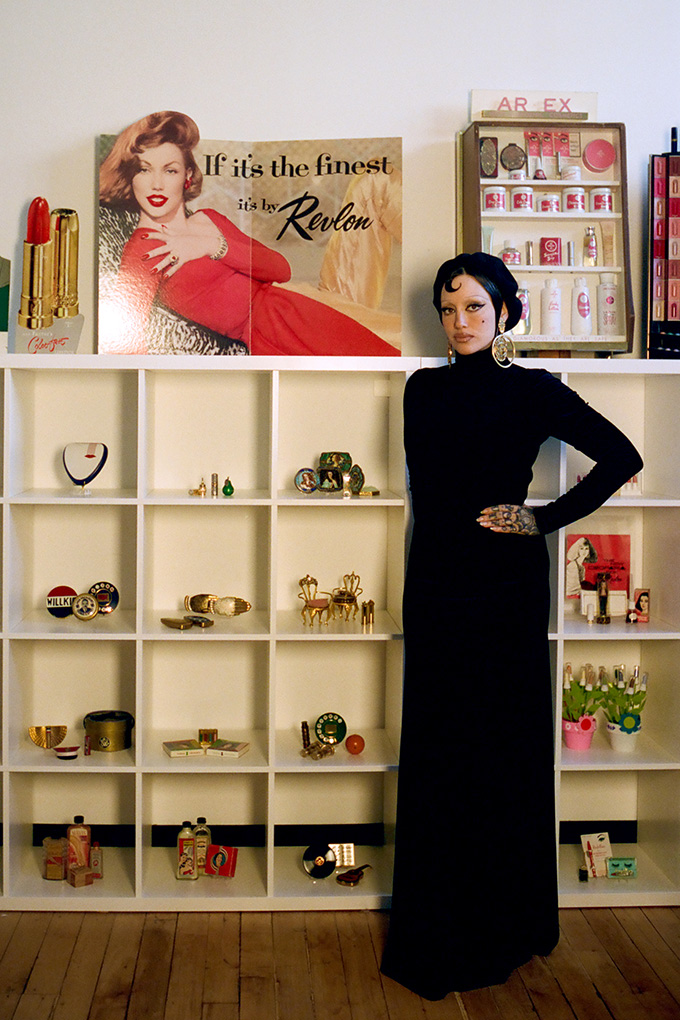
Today, Parsons has at least 4,000 unique items in her historic cosmetics collection—and she believes it’s high time its storied history reached more people. With help from archivists, Parsons has transformed this sprawling collection of vintage make-up and ephemera into the beauty museum she’s always dreamed of. Named The Makeup Archive, the digital museum showcases rare beauty artefacts that span centuries of cosmetics history.
In her continued efforts to chronicle beauty lest it be forgotten by time, Vogue Singapore caught up with the beauty historian to discuss how the landscape has changed over the years, what she hopes to achieve with The Makeup Archive and what beauty truly means to her.

Before you became a make-up artist, collector and historian of beauty, what did beauty mean to you, and how has that definition changed over the years?
At first, I used make-up to enhance my features, I suppose, to make myself pretty. But that changed through my work and in my own personal presentation. Make-up can be used as a form of self-expression—it’s your personal style. So if I’m enhancing my features now, it’s often through eccentricity or as an approach to looking unique.
You’ve mentioned that Marilyn Monroe was your introduction to beauty. What was it about her that first captured your attention, and why do you think she has remained such an enduring beauty icon?
It’s how Marilyn used glamour to create a sort of character that can so easily be recreated and yet never replicated. It’s through artifice like blonde hair, the pencilled-in beauty mark, her sleepy liner and lusciously drawn lips. For me, it was incredible to see the transformation of Norma Jeane into Marilyn Monroe! It made me look at make-up differently because I realised that it had so much power. I honestly think she remains because we never saw her age. She’s this moment in time in a glamorous era, giving everything she’s got to the camera.
Who is your ultimate beauty inspiration, and what is it about them that continues to inspire you?
Besides Marilyn, I’m a bit obsessed with Josephine Baker. Clearly, I’ve been inspired by her hairstyle, but I just loved how hard she worked to entertain all the way until the end. She was the ultimate diva who gave everything she could to the fans, and she always gave major looks from head to toe. A true feast for the eyes.
View this post on Instagram
You worked with Dame Pat McGrath for seven years. What is the biggest lesson you took away from your time working with her?
Pat always seemed fearless to me. She could talk to anybody, and she had this quality, this larger-than-life charm. Of course, I learned how to do make-up because of her. She wasn’t just creative. She had a real eye for beauty and for a refined aesthetic. Nothing she did looked cheap—it was always high fashion. I think that kind of eye can be harnessed, but by very few.
The ‘90s saw celebrity make-up artists transform the faces of supermodels, while the 2010s brought beauty gurus who democratised make-up through social media. What do you think is the next big shift in beauty and make-up?
There seems to be a shift back to the make-up artists. I think it took a lot of time for most of them to come around to social media, but it seems the public is interested in real talent and not just the ability to push products. I think people are leaning into the make-up artists now, especially since the 2010s really only taught one style of make-up. That era seems to be over, so instead of the constant overconsumption, people want real techniques.
You’ve said that make-up from the 1920s and 1990s are among your favourites. What draws you to those two eras?
These decades changed the landscape of beauty. By the 1920s, make-up had become acceptable and accessible. The colours were outrageous! The most vibrant shadows, rouges and lipsticks. Because we see films in black and white, it’s shocking to think women were wearing bright blue eyeshadow. I love finding actual make-up pieces from that time, not just empty compacts.
As for the ’90s, the colour stories were incredibly unique—some of these things no longer exist, like the M.A.C Frost lipsticks. This is an obsession for me because I cannot seem to dupe these colours or formulas with modern products. It was a real celebration of make-up artistry and inclusion! With all the indie brands that followed, there was a visible shift in how make-up was worn and created. The naming of the products is just as fascinating as the colours produced.
View this post on Instagram
You often compare ‘90s make-up with its modern counterparts. What did it feel like to see your content influence the conversation around products like M.A.C’s Spice lipstick—which eventually led M.A.C to re-release Cool Spice?
This still blows me away! It shows the real power of social media when a video can get the attention of such a huge brand. I’m honestly glad they’re listening and bringing back colours we love.
How can someone discover their own distinct beauty style?
If you look at the ephemera section of my website, there are booklets that teach you the best make-up and hairstyle for your face shape. Some pages explain colour harmony for your hair and eyes. There are even corrective techniques for certain features. These all work—I’ve actually tried many of them. They do not look modern, of course, because they’re from the 1930s, ’40s and ’50s. But I think they’re a great guide for someone who’s not sure what works best for their own look. Maybe start there. Sit down for hours, play, take photos and find the look that works for you.
That’s basically what I did, but through videos. I used to constantly change my hair and make-up, but now I’ve found a look that suits me and feels unique.
View this post on Instagram
Where are some of your go-to places to hunt for vintage make-up?
I’m fortunate to find most of the items online. eBay, Etsy, Ruby Lane, Julien’s Auctions—there are many sites to find vintage make-up if you know what you’re looking for. But of course, this comes with a price. Another place I love to shop is the International Perfume Bottle Association convention, which happens once a year. They have sellers who specialise in vanity pieces, and while they’re pricey, you will pay less than online. Once you get to know the sellers, they’ll reach out directly when they find pieces you’ve been searching for. You can also go to antique shops and estate sales. I know a few collectors who do this, and they have some of the rarest pieces I’ve ever seen.
What do you hope the make-up you collect and preserve will tell future generations about beauty, culture and the way we’ve adorned ourselves over time?
That make-up has always been relevant. It was always important. Even when it was subtle in the Victorian era, it was still used. Make-up is often seen as frivolous, but when you learn that ancient Egyptians were buried with it, how packaging was forever changed by World War II, or how a decade can be defined by the style of make-up worn, I hope people who may look at it with disregard realise its significance. Through The Makeup Archive, you can see how fun and intricate some of the 20th-century packaging were. It’s a fascinating peek into beauty history, and there’s so much more to share!