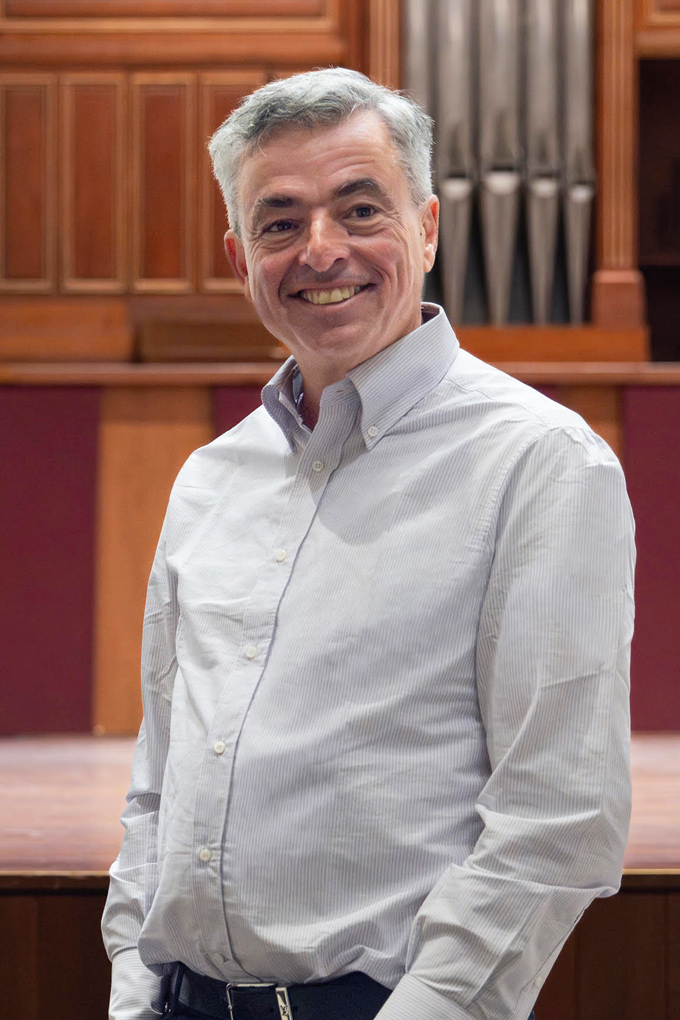
In 1998, the Apple online store was conceived. A platform that served up its products and services collapsed on a single url, so people from all around the world could get access. Since that milestone, the tech giant has gone above and beyond to form its own ecosystem, one that expands year on year, with services that we’ve since integrated into our lives: like Apple Maps, Apple Pay, Apple Music and the game-changing Apple TV. One instrumental individual behind all of this is Eddy Cue, Apple’s senior vice president of Services—a maker of innovation who created the online store and spearheaded all the services that most consumers now call essential.
All too cognisant of how far Apple has come, Cue wistfully shares: “Sometimes you have to pinch yourself to believe it’s true. Because early on in my career, it was pretty rare to find somebody else that was using something from Apple, and now it’s great that we’ve been able to build all these products in a very unique way. I think the secret to it is that we take our hardware, our operating systems, and our applications and services, and we build them together. That’s what makes it so much more fun, because we’re engaged, and it’s all combined together.”
We’re seated in Victoria Concert Hall, after a riveting private performance from Singapore’s most promising violinist Chloe Chua. Young, bright and brilliant, Chua is one of the many users and beneficiaries from Apple Music Classical, a service that sprung as a subset from Apple Music. “Music has been a part of our DNA from the very beginning. Our founder Steve was a huge music fan and it was always a big part of his life. So since the early days, we’ve been doing things with MIDI and then went on to create Logic and GarageBand. But I guess one area in particular that we found was disappointing was classical music, because it never really quite fit in with Apple Music. And I remember there was a point in time where we thought we needed to do a better job, and the only way to do that was to build something separate and unique, because the way that you search and listen [to classical music] is not the same as a pop song.”

To create the best experience for classical music, they started with the sound, one that goes beyond mono to stereo. Lossless audio of up to 24 bit/192 kHz aids listeners to peel back the nuances of every performance and even raise the hairs on your arm. Crisp, clear and doubled with Spatial Audio and Dolby Atmos, you’ll be immersed in a 360° soundscape. Cue continues: “I think what’s great about it, for people who love classical music, is that when you sit and listen to Chloe, I mean you can hear every note, and you can feel every note. And so being able to do what we’ve done in the app and with the sound, I’m incredibly proud of.”
The service segments different pieces into different periods, Chua later tells me as a crucial part of the listener’s experience. “The user will have a clear understanding of which piece is from the Romantic era or Classical or Baroque. There’s also a listening guide that gives a lot of background knowledge on the piece for new classical music novices to understand and appreciate the genre more.”

Certainly, as I pored through varying symphonies in varying minors, even as a non-classical music listener, I understood how the sheer scope and depth of the genre would demand its own silo domain, one that could do it justice. I also appreciated how Apple Classical carves out a space for the modern and new-age to rise up, such as Chua’s pieces. A desire that Cue, too hopes can reach more people, even if they might not be able to appreciate Bach or Mozart.
The extent to which Apple devotes to its services never comes up short. To which Cue remarks: “We don’t do a lot of things. We do a few things. And if we’re going to do something, we want it to be great. If not, it’s not worth doing.” He speaks of this in relation to Apple TV, the company’s great leap of faith into streaming services. On the platform, one can easily list the number of Apple-made titles with two hands but most of them, if not all are well-lauded and award-winning.
“We don’t do a lot of things. We do a few things. And if we’re going to do something, we want it to be great. If not, it’s not worth doing.”
What might have seemed out of pocket for the tech giant that was most famed for its handy devices, has now generated its own phenomenon—amid waters that were evidently stacked with competition. But it wasn’t the happenstance or the weight of its name that Apple owes its success to. Cue continues: “It’s kind of crazy. We had never done a TV show or a movie. We didn’t have a library. We didn’t go out and rent or acquire a library. We decided that we wanted it from day one to feel like whenever you watch something, it did come from us. We thought there was a real opportunity to tell incredible stories so we built a great, incredible team and here we are now talking about these incredible movies and TV shows that are, I think, as good or better than anyone else in the world.”

What vividly comes to mind? The dystopian world-building that Silo has conquered. The infectious, uplifting heart that is Ted Lasso. The trippy brilliant arc that Severance normalised. As Cue surmises: “There is nothing like it out there. But think about how it was like when you heard the pitch: ‘let’s create a show where you have innies and outies.’ A lot of vision and belief is needed to create an amazing show like this.”