For a jeweller as relatively young as Pomellato, staging a debut retrospective is a major step. So when it unveiled Art & Jewellery, its first major exhibition, in Shanghai at the Fosun Foundation, the brand made a bold statement of its confidence in its heritage and identity.
“This exhibition is a thoughtful moment for Pomellato,” mused creative director Vincenzo Castaldo, speaking with Vogue over email. “It’s our first comprehensive showcase of our journey from 1967 to today. Working with curator Alba Cappellieri, we’ve created an immersive experience that weaves together our revolutionary jewellery designs with our groundbreaking advertising campaigns.”

Pomellato was founded in 1967 by Pino Rabolini with a sense of youthful verve. He was inspired by the revolution of ready-to-wear and the pulse of the youthquake. In the introduction to Pomellato’s 50th anniversary monograph, Rabolini wrote: “Women were changing before my very eyes: they were dynamic, they travelled, they drove cars. I sensed that dynamic jewellery was ideal for them.” The resulting Pomellato was, per Rabolini, “the prêt-à-porter of jewellery, which transforms gold into pure modernity”.

This analogy with ready-to-wear guides the brand. Instead of laden status symbols, occasion pieces that spent most of their time in a safe or things chosen by men for women, Pomellato jewels are precious accessories that women choose for themselves. Like the go-go boot or the mini skirt did at the time, they represent liberation. In Art & Jewellery, photography—that modern form of immortalisation—leads the flow of the exhibition.
On the walls and throughout the show are pictures of Pomellato advertising by photographers such as Gian Paolo Barbieri, Michel Comte and Lord Snowdon. These complement more than 100 archival and contemporary jewels. The jewels themselves are arranged in three sections, one for each formative decade in the Pomellato story.

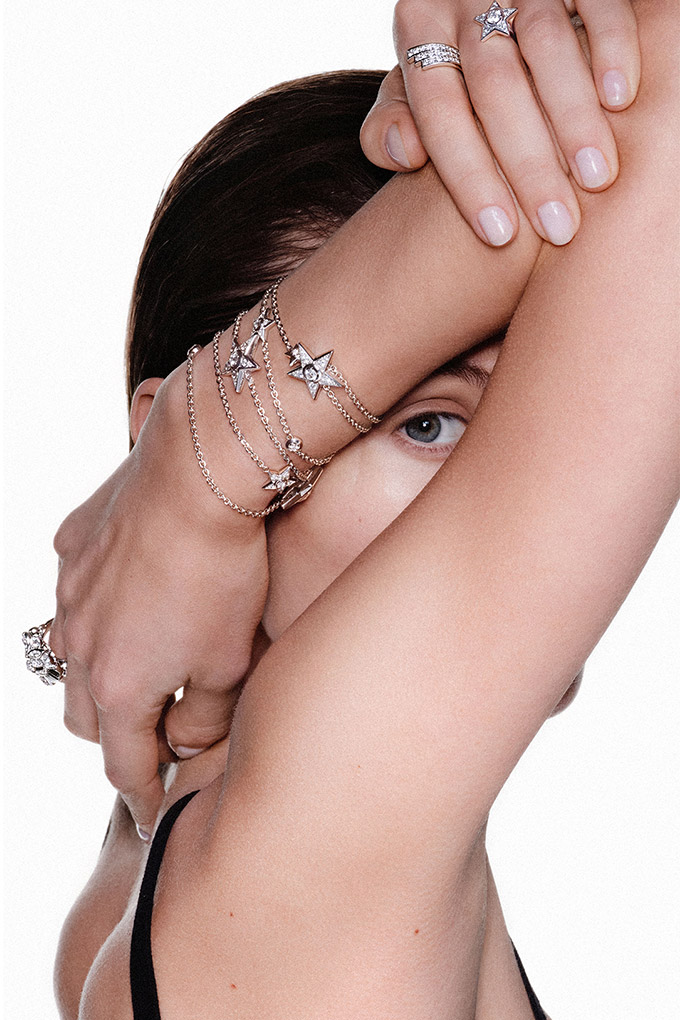
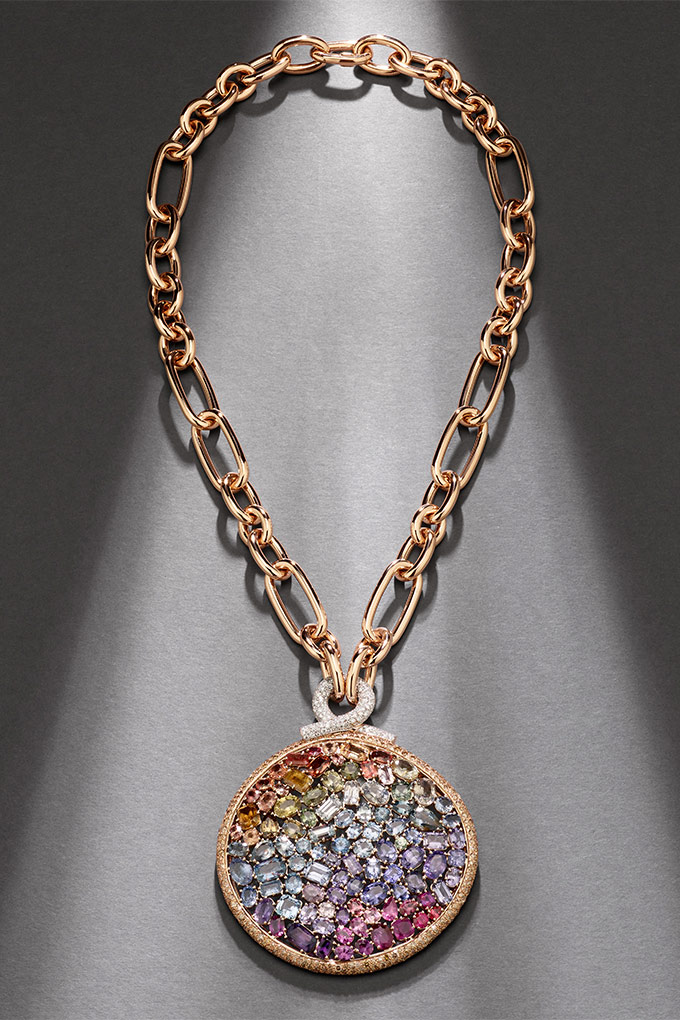
The exuberance of the ’70s is paired with the brand’s expertise in crafting chain jewellery. “From a creative perspective,” explained Castaldo, “chains are the calligraphy of Pomellato.” The variegated bulbous, curved, voluminous and shapely designs have a tactile life to them. “We shape the model of every chain by hand, honouring our tradition,” he added.

The ’80s saw the introduction of coloured gemstones to the universe of Pomellato, with a gemological philosophy called ‘free gems’. “Nudo is the perfect embodiment of this philosophy,” said Castaldo, referring to the brand’s collection of jewels with coloured stones cut with 57 facets in a gently curved cushion shape. “The gem is free, devoid of traditional prongs or settings.”


A swing to bold volumes in the ’90s was in step with the minimalist mood in fashion at that time. There are also creations from the brand’s present-day high jewellery collections, a category it debuted in 2020. “Our heritage is… an unforgettable force that sits as a constant presence at our creative table,” said Castaldo, who has been with the brand for more than 20 years. “It represents Pomellato’s living memory, which must always be projected into contemporary and future landscapes.”

Art & Jewellery closes on a fittingly forward-looking note. At the end of the Pomellato exhibition is a pair of installations with specially commissioned visual works. The first is a series of AI-generated portraits by Milanese artists Alberto Maria Colombo and Anna Paladini, which imagines women of all ages and ethnicities wearing elegant Pomellato jewels.

The second is a pair of photographs by the Chinese artist Chen Man that speaks of sensuality and feminine authority. They portray a model decked out in Iconica chain jewellery by Pomellato, her arms, neck, shoulders and back poised and powerful. The youthquake of the ’60s may be behind us, but the ideas imbued in this Milanese jeweller’s creations still hold water today.
Vogue Singapore’s December ‘Gratification’ issue will be out on newsstands from 9 December and available to preorder online.